
Becoming Lake-Facing People: HDS Student Pilgrimage to Great Salt Lake

Over the 2023-24 academic year, HDS Writer-in Residence Terry Tempest Williams and Professor Stephanie Paulsell led 16 students from the classroom to the landscape of Great Salt Lake through a year-long seminar. The course, “Walking the Inland Sea: Desert Contemplation and Great Salt Lake,” examined the ecological, economic, spiritual, and artistic imprint of the lake and the surrounding area.
When asked about the significance of teaching this course at Harvard Divinity School, Paulsell, who is the Susan Shallcross Swartz Professor of the Practice of Christian Studies, says, “Terry and I imagined this course as a pilgrimage that would lead us inward toward our own inner landscapes and outward toward Great Salt Lake and the community of poets, scientists, activists and indigenous leaders for whom the survival of the lake is a matter of life and death. As students of religion, we were challenged to ask what resources we could offer in the face of this environmental and existential crisis.”
Drawing from contemporary and historical sources, the class looked at Great Salt Lake’s influence on the history of Utah, the ways the state and its communities have altered the saline lake, and the presence of divinity in the natural world. The course grew out of the deep connections Tempest Williams shares with the land as a conservationist, writer, and educator. In her words, “The very first year that I came to the Divinity School, I saw how important it is for students to be embodied in the specificity of a landscape, not just in their minds.”
When the course began in fall 2023, students were invited to reexamine their assumptions about how—and by whom—they would be taught. “The class felt like it was taught by Terry, Stephanie, and the lake,” said Raisa Tolchinksy, MRPL ’24.
The coursework began with landscapes, introducing students to Great Salt Lake’s geography through the Harvard map collection at Pusey Library. Paulsell and Tempest Williams encouraged students to push past their inhibitions in understanding the lake not just as a place to be examined in an academic setting, but also as a force that could shape how they see themselves as scholars, artists, climate advocates, chaplains, and spiritual leaders. For their final exam, students wrote lyric essays weaving together personal stories with spiritual, environmental, and social concerns inspired by the inland sea.
In March 2024, Tempest Williams led students on the second part of the seminar: an eight-day pilgrimage to Great Salt Lake. Throughout the trip, students learned about becoming “lake-facing people,” a term coined by poet Nan Seymour, who mentored students through workshops—at HDS in the fall and on Antelope Island in the spring—which describes the many ways of living in deep relationship to Great Salt Lake.
Building Relationships Within and Outside the Classroom
During their time out west, student learning was shaped by the vision of HDS: scholarship in service of a just world at peace across religious and cultural divides. Paulsell and Tempest Williams planned each site visit with the intention of fostering connections between Utah locals and Harvard students. Students met with Indigenous leaders working to preserve ancestral lands, government experts focusing on policies related to industry and sustainability, and Utah Youth Environmental Solutions advocates building the next generation of conservation efforts within lakeside marginalized communities. The class also connected with farmers, adventure tour guides, industry leaders, scientists, artists, and poets to become immersed in the landscape and the local community. Conversations invited students to employ critical analysis and engage with multiple disciplines—putting an emphasis on respect when discussing differences in opinion, strategy, and ideology.
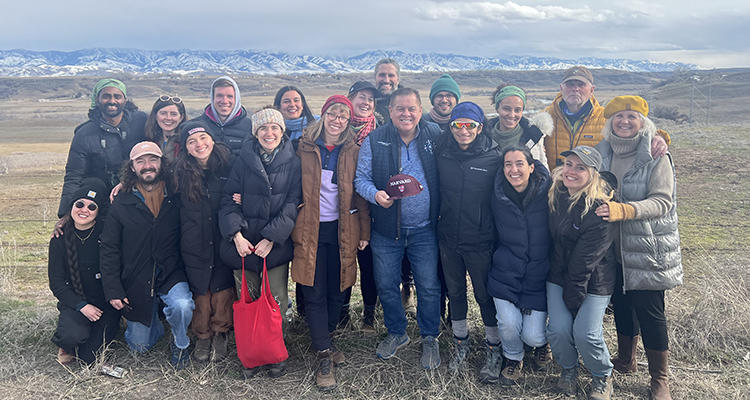
One particularly powerful experience included meeting Darren Parry, former chairman of the Northwest Band of the Shoshone Nation and author of The Bear River Massacre: A Shoshone History, at the Bear River Massacre Site.
This land marks a brutal chapter in history. In January 1863, Colonel Patrick Edward Connor and roughly 200 settlers known as “California Volunteers” attacked a Northwestern Shoshoni winter village on the Bear River in the far northern section of Cache Valley, located near the present-day Utah and Idaho boundary line. This community lost over 400 people, with fewer than a hundred survivors. Now known as the one of the worst recorded massacres of Indigenous people, the attack was historicized as a “battle,” then was overshadowed by the Civil War.
Parry shared about his ancestors' painful past, following in the tradition of his grandmother, Mae Timbimboo Parry, who was the Northwest Band of the Shoshone’s matriarch, record keeper, and historian. He also spoke of the future, teaching students that generational grief and resilience go hand in hand with restoration of the land. Standing on the site where violence was used to silence the Shoshone people, he reflected, “We are still here.”
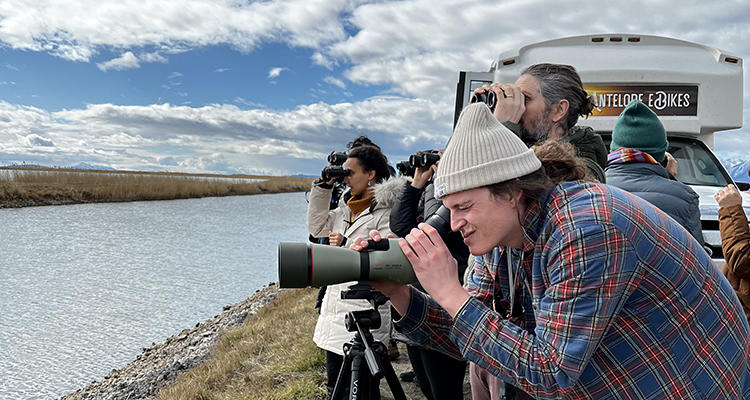
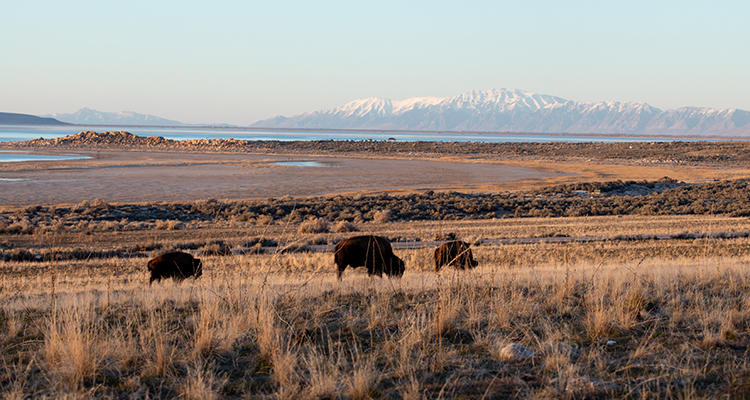
As a long-time advocate for wildlife, Tempest Williams shaped the trip to encourage students to think about care for nature and preservation of the lake beyond a human-centered lens. Students learned about the diversity of local ecosystems, from free-roaming bison and bighorn sheep on Antelope Island to the more than 12 million migratory birds that grace Great Salt Lake on their annual journey between the Arctic and South America. One such example was the visit to the Bear River Migratory Bird Refuge, where Jake Dreyfous of Grow the Flow Utah took students out to the refuge to witness the spring migration, including Tundra Swans, mating Western Grebes, and a pair of Sandhill Cranes.
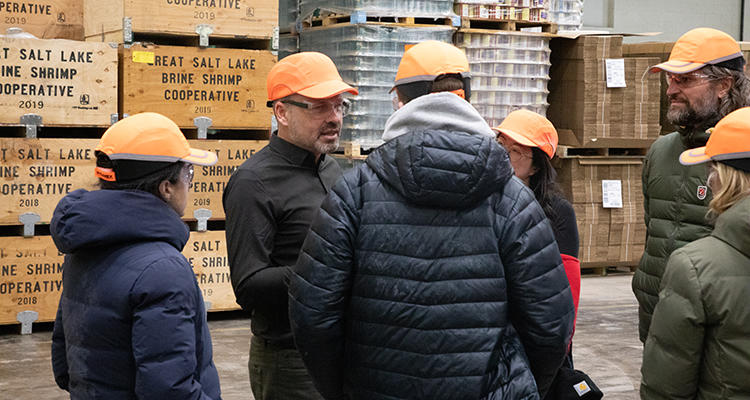
At another site, the Great Salt Lake Brine Shrimp Cooperative, students confronted questions about diverging political, religious, and economic interests in preserving the brine shrimp population of Great Salt Lake. The brine shrimp industry, which brings in $67 million annually, supports fish and shrimp hatcheries nationwide. Students and speakers, including research scientists from the onsite laboratory, discussed how to effectively navigate multiple streams of advocacy and sustainability efforts from different ends of the political spectrum. Throughout various discussions, one commonality became clear: a deep respect for the largest saltwater lake in the Western Hemisphere.
Each visit on the trip ended with a gratitude circle, where students and guest speakers shared insights that emerged. At the Cooperative, students expressed appreciation for the artistry of the industry and willingness to talk about sustainability from a variety of perspectives. They noted the unexpected experience of having heart-centered, spiritual conversations in an industrial setting. “This conversation brought us to a place of balance,” said Tempest Williams.
Inspiring Art and Expression
Students were encouraged to explore their creativity as part of the course, including freewriting exercises, exploring art installations across Utah, and writing a collective poem to honor Great Salt Lake. Many students found that the pilgrimage sparked inspiration, sharing that that the natural landscape offered literal and figurative space for new ideas.
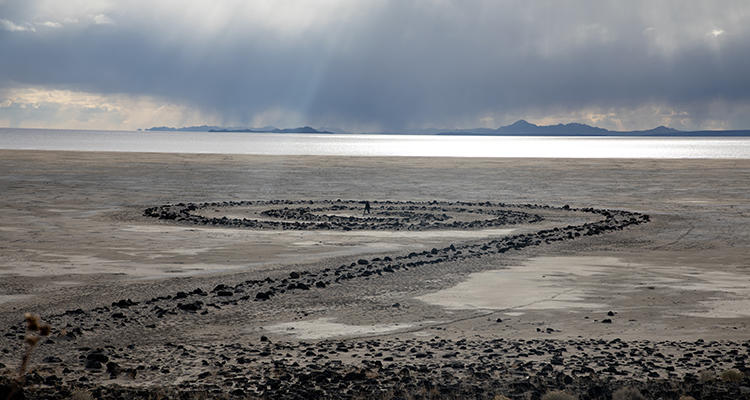
Midway through the trip, students visited Spiral Jetty, a work of land art created by Robert Smithson from mud, salt, and basalt rocks. Tempest Williams invited students to hold a question for reflection as they entered the labyrinth, stepping carefully on densely packed sand layered with crystalized salt and coyote prints. Enveloped in a moment of solo pilgrimage, some students wept, sang, or prayed. Others wandered across the salt flats to touch the lake, which still reaches out to the horizon despite receding at a concerning rate.
“As I was walking the spiral jetty with the class, this line came to me: sometimes you’ll be afraid and you’ll do it anyway,” remarked Tolchinsky, a poet and recent graduate currently serving as the creative writing specialist for Religion and Public Life at HDS. “The scariest part of the trip for me was just stepping on the bus and letting the experience teach me without having control. It was a huge lesson in my personal life, but also in my creative life and in my writing.”
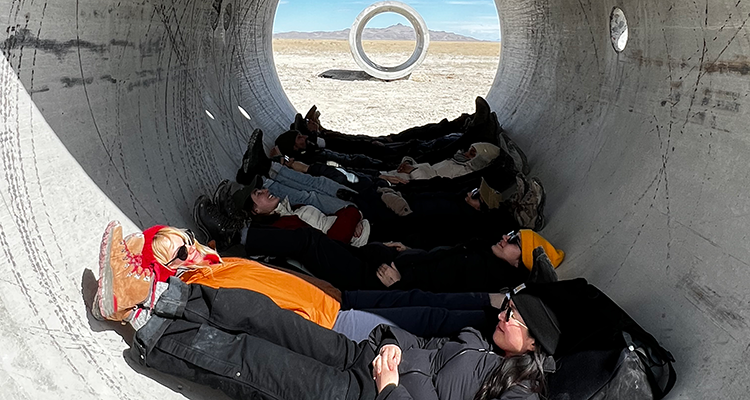
Students also explored sculptor Nancy Holt’s Sun Tunnels, a concrete installation arranged to capture the sun as it rises and falls during the summer and winter solstices. A four-hour drive from Salt Lake City, visitors to the sculpture must brave Utah’s unwieldy Great Basin Desert without the help of GPS, rest stops, or clearly-marked roads. Those who reach the site are met with a design that honors the constantly changing play of light and shadow, with the concrete tubes acting as viewfinders to “bring the vast space of the desert back to human scale,” in Holt’s words. Holt is described by the Utah Museum of Fine Arts as “one of the few women associated with Land art,” as well as “a pioneer of time-based media.”
As students lay head-to-toe within the tunnels, they began to hum and sing as 85-mph winds swirled outside, reflecting their sounds off the concrete interior. Auds Jenkins, MDiv ’24, described the tunnels as “a sacred chapel space in the middle of nowhere.”
“I began to feel that I wasn’t in a chapel, but that I was being held and guided by a chaplain,” she said. Jenkins felt inspired to ask how art, structure, and buildings could serve as chaplains that “bring you somewhere and move you to song.”
The trip, which was largely off the grid with limited access to internet, inspired natural creativity and curiosity. Josh Kurtz, a weaver, fiber artist, and current student, shared how his experience encouraged him to develop a deeper relationship with place through art. “Being at the lake was incredibly moving, and I felt instantly connected to that landscape,” he said. “I felt more at peace than I have in a long time.”
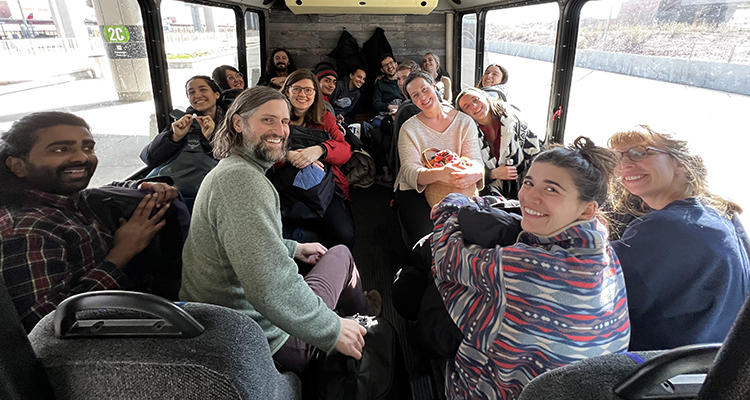
By thinking in “weaving terms,” as Kurtz called it, he was able to imagine how to bring his art and experiences together. “On a bus ride during the trip, I had this vision—wouldn’t it be amazing to have a small-batch dyeing company where people could request skeins of yarn that are naturally dyed, inspired by particular landscapes or places they call home?”
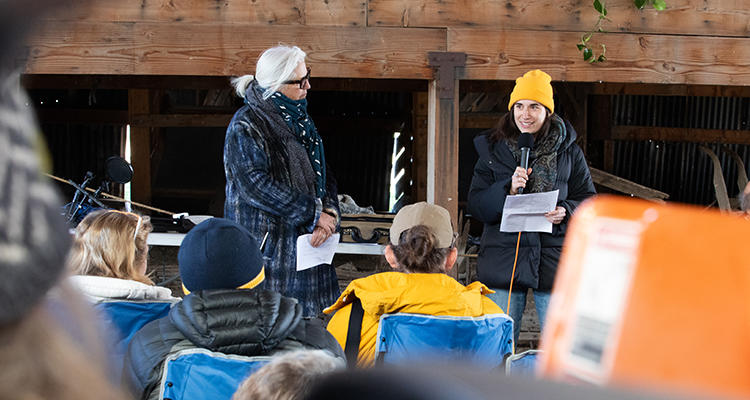
On their last full day in Utah, Tempest Williams organized a gratitude concert where students and local artists shared poems, songs, and reflections in honor of the inland sea. Set against the stunning background of Great Salt Lake, the concert was held at Fielding Garr Ranch on Antelope Island.
Author and composer Gerard Elias, a former member of the Utah Symphony, along with other musicians from the University of Utah, created original music to score the evening. Antelope Island’s poet-in-residence, Nan Seymour, delivered an original poem for an audience of over 100 guests, which inspired several HDS students to share their own writing. Poetry and song performances blended grief and hope, calling attention to the loss of the lake and its ecosystem while also expressing optimism for future preservation efforts.
Student Eve Woldemikael wrote an original song for the concert. “I signed up to perform something and so I focused, became present, and listened,” says Woldemikael. “I felt like the song came pouring out of me because of that connection with the lake. I wanted to give back to the lake and the community of people who love the lake.”
Backed by a swelling melody played by the symphony musicians, Tolchinsky shared a poem inspired by the pilgrimage, titled “Dear Great Salt Lake.”
When I peer into the face of the deep and see lake, I see also my own face—
I peer into lake and see the face of the deep being seen.
I know my face is the face of the deep, just as yours is.
Throughout the performance, Tempest Williams thanked the many people who made the pilgrimage possible, including former Dean David Hempton, who approved the Great Salt Lake Pilgrimage Project in 2022 with the support of Susan and Jim Swartz, and Dean Marla F. Frederick, who continues to champion these efforts. Tempest Williams dedicated the gratitude concert to Geralyn Dreyfous, a friend and collaborator of the HDS community.
She also honored each local mentor who worked with the HDS students, especially Ben Abbot, an ecology professor at Bringham Young University and lead author of a groundbreaking 2023 report on the collapse of Great Salt Lake. Tempest Williams expressed deep appreciation for all those continuing the challenging work of preserving Great Salt Lake and its surrounding communities.
(Read more about the event in The Standard-Examiner’s article, “Great Salt Lake-Inspired Words, Music Shared by Visiting Group from Harvard.”)
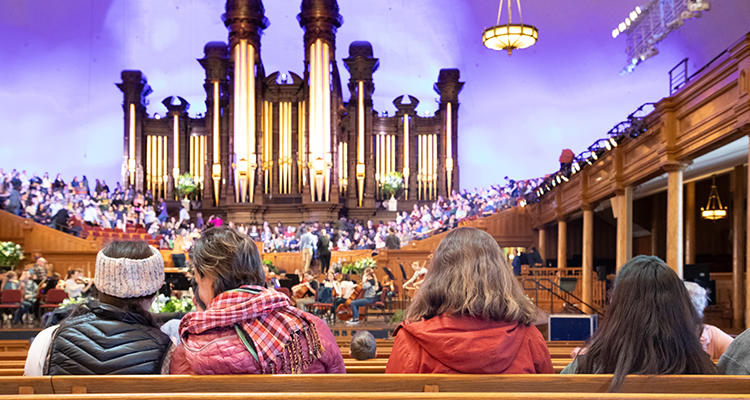
On the last day of the trip, the class emerged from their campsites on Antelope Island and made a final visit to Temple Square, a center of history and worship for The Church of Latter-Day Saints in the heart of Salt Lake City. Students listened to the renowned Mormon Tabernacle Choir rehearse, letting the music wash over them as they sat under the celestial architecture of The Tabernacle.
Touring Temple Square also allowed those raised in the Mormon tradition, including Tempest Williams, to share more about the influence of The Church of Latter-Day Saints on the region, including preservation efforts related to Great Salt Lake.
Reflecting on Pilgrimage, Returning to Cambridge
Months later, students are still uncovering how the course and pilgrimage have affected them. Students expressed gratitude for the mentorship offered to them by Tempest Williams and Paulsell, as well as for the relationships they built with one another. Living in close quarters in a new landscape for a week, students shared that they had experienced an “embodied bonding” that could only be felt outside the classroom.
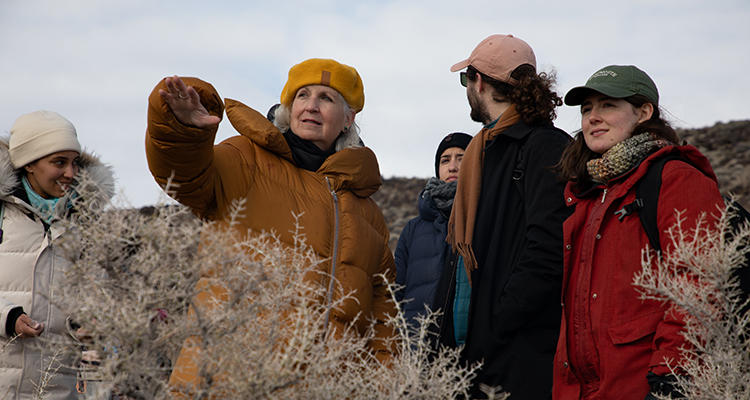
“This is the type of community I want to be around,” said Jenkins, reflecting on her work building new spiritual communities. “This might be the only way to live well in this world. We must seek out the people who live deeply grounded in where they are.”
Students also expressed admiration for the integrated approach between science, art, and spirituality. “It shows me that we don’t have to be compartmentalized in our work. Scientists and farmers and activists and artists can all work together around something, with each contributing their perspective and skills,” said Woldemikael.
Others, including several who are now alumni, conveyed the impact of the course on their HDS experience as a whole. “I left the class thinking about the power of witnessing so much pain, beauty, and joy with such incredible people. This experience is what I hoped for when I applied to divinity school,” said Tolchinsky.
This was the hope Tempest Williams brought with her when she accepted the role of writer-in-residence in 2017. “The fact that we could spend a year thinking about Great Salt Lake at the Divinity School—exploring ethical stances toward life even as the footprint of humans register as a geological epoch in the climate crisis—has been alchemical,” says Tempest Williams.
"I came to HDS with the question: ‘What are the spiritual implications of climate change?’ because climate change tends to be so abstract, until it isn't. To really explore this question, I wanted to get students out into the land, into their bodies and their hearts, not just in theory, but in practice. Yes, this is an ecological issue. Yes, this is a political issue, but more than anything, the climate crisis is a spiritual issue about how we respond to this moment in time. How we engage with the issues that break our hearts—for me, the grief of witnessing a dying lake—allows us to put our love into action.”
A Meaningful Milestone
This course also marked a meaningful milestone—it was one of the last taught by Paulsell before her retirement. Reflecting on the class and students transformed by this experience, she shared, “I’m so grateful to Terry and to our open-hearted students for the opportunity to learn alongside them this year. My hope is that we continue to feel the claim of Great Salt Lake on us in all the landscapes in which we find ourselves and that we continue to draw on the wide range of resources we have as students of religion to face the crises of our day with courage, creativity, and love.”
To learn more about climate and care for nature work happening across Harvard Divinity School, visit our coverage in the 2024 Dean's Report and sign up for the HDS Current newsletter. You can also see additional coverage on LinkedIn, Facebook, Instagram, and TikTok.
By Shir Lovett-Graff, MTS ’24, HDS Communications
With contributions from Caroline Cataldo and Amie Montemurro, HDS Communications