
Exploring Art and Scholarship through a New Lens at the Center for the Study of World Religions

On a frigid January afternoon, students, faculty, staff, and alumni from Harvard Divinity School and Harvard College stepped carefully around the ice and snow surrounding Walden Pond. Accompanied only by a phone camera and a spirit of open curiosity, they were invited to explore two reflection prompts as part of “Thinking Through Photography,” a workshop hosted by the Center for the Study of World Religions (CSWR).
The three-day workshop, which ran from January 21-23, 2025, focused on photography as a means of visual storytelling, self-reflection, and engagement with the natural world. The workshop was led by CSWR Artist-in-Residence Sarah Schorr, whose work spans a range of mediums and examines themes including light, water, embodied contemplation, ephemerality, and climate change.
“Photography’s roots are deeply entwined with theories of time and mortality, much like religion,” said Schorr. “So I suspected that there might be some interesting conceptual intersections with the CSWR and HDS community.”
On the first day of the workshop, Schorr introduced participants to reflect on the presence of visual curiosity in their daily lives, prompting them to scroll through their camera rolls and notice which visual themes or images emerged most clearly. She then directed students to use the camera lens in responding to two reflection prompts, facilitated through a field trip to Walden Pond on the workshop’s second day. Schorr emphasized that participants take themselves seriously as artists, no matter their level of experience with photography.

HDS students attending the workshop found new ways to engage with questions driving their studies. One such student is Danping Long, a second-year master of theological studies (MTS) student, who focuses on Buddhism around religion, literature, and culture.
“As a person who works primarily with texts and manuscripts, there is a part of visual culture missing,” Long explained. “Buddhists were constructed by texts and narratives, but there is also an untold story simply composed by images.”
Long decided to take the workshop to deepen her understanding of visual culture in “religion, worship, and storytelling.” She was particularly moved by a metaphor introduced by Schorr, that “art happens at the place where the two seas meet.” Schorr invited participants to understand one sea as representing the research questions driving their academic curiosity; the other sea represents the way they see the world visually. One of the two prompts for the visit to Walden was to take a photo “where the two seas meet.”
Long reflected on the connection between this prompt and metaphors around water in Buddhism. “In Buddhism, we use the same metaphor,” she said. “We refer to ‘the stream-enterer,’ which is used to describe people who aspire to be the enlightened Buddha but are not there yet. They travel in the same direction along the stream of nirvana. They haven’t emerged yet into the stream of enlightened life, but they are walking in the same direction.”
Walking along Walden’s shore, Long took monochrome photos of ice swirled and cracking beneath the surface of the pond, noticing that “because of different temperatures, ice can melt into different shapes—like giving birth to new life.”
For Cass Morales, a first-year MTS student, “Thinking Through Photography” offered a chance to connect her academic work to her art practice. As a visual artist focused on drawing and painting, as well as digital art, collage, and print, this experience prompted Morales to consider photography as a new medium to explore her studies.
"I am interested in studying what alternative spiritualities live and exist in the Americas, with a focus on Latin America because that’s where my ancestry is from,” says Morales.
She identified her research question as: “How can spirituality and religion be used as tools of resistance, specifically culturally and politically? How can we combine spirit and cultural/political resistance and see how they're useful?"
“This workshop exposed to me how art can influence scholarship, and can even be a part of scholarship,” said Morales. “Sarah [Schorr] is such an example of an artist-scholar thinking about stuff that is so relevant to the changing world, including climate change.”
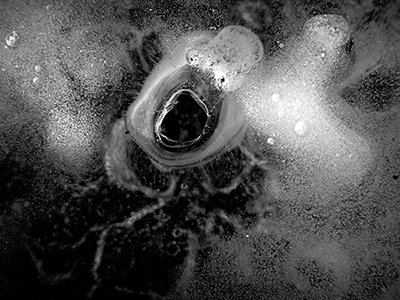
Walden Pond, monochrome, photo by Danping Long.
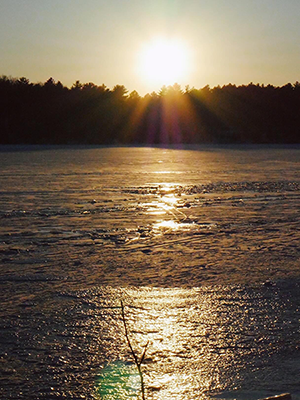
Sunset at Walden Pond, photo by Cass Morales.
Morales shared that seeing Schorr integrate her scholarship and art provided a vision for doing that in her own work. “It showed me that this is a possibility,” Morales remarked.
For Schorr, creating relationships between art and the changing realities of the material world are an essential part of her practice. Growing up in Massachusetts, Schorr developed a deep connection not only with the natural landscape, but also with the rich literary tradition shaped by writers who wrote and lived in New England. Her father was the executive director of the Robert Frost Foundation, and after he passed away, he left her a collection of transcendentalist writings and poetry books.
“Many of my projects are conversations with him, because he was my first creative mentor,” she said.
Although she currently resides in Denmark, Schorr still feels tied to the lands and waters of Massachusetts. She expressed worries about the future of the ponds and beaches she swam in as a child and plans on collaborating with CSWR director Charles Stang on a book about water through their experience of swimming and walking at Walden. She has also been painting and photographing color studies of water, which led her to “contemplate how Walden Pond might have changed since Thoreau wrote Walden, especially due to climate change.”
Although much of her art captures the natural world moving through natural stages of growth and decay, Schorr is also focused on how to communicate effectively about climate change through art.
“Artwork about climate change often contains catastrophic or destructive imagery, which can be overwhelming,” said Schorr. “I have been exploring the imagery of climate change through the lens of how water can reflect beauty, care, and a wonderment for ephemerality itself.”
In a recent project, Schorr spent four years in residency at Claude Monet’s gardens creating “cinemagraphs”—delicate compositions of painting, images, and videos—which show the impact of climate change on the vulnerable natural environment.

Throughout the workshop, Schorr encouraged participants to pay attention to the stillness and dynamic movement of both their interior and exterior landscapes. Her second prompt invited them to capture a “still life as a self-portrait,” inspiring discussion about the relationship between humans and nature; building art from the natural world; and the impact of investigating these questions at a historic site like Walden Pond. Some students arranged photo prints, cloth, and candles in altar-like configurations on the ice to create their self-portraits, while others stacked stones and pieces of wood to craft images composed solely of natural materials.
On the final day, participants gathered to share their photos and reflect on the workshop. Many described how photography offered a path toward greater attentiveness, providing them an opportunity to slow down before the new semester began.
“It reminds me of how much I am missing when I am just contemplating in my head all the time,” said Long, a sentiment echoed by Morales. “It was like we were having conversations with the world around us,” she shared.
Through the workshop, what began as a creative exercise became a new way of seeing—one that offered the practice of presence as they looked with curiosity across the frozen pond.
—by Shir Lovett-Graff, MTS ’24, HDS Office of Communications
Editor’s note: For more stories about the “Thinking Through Photography” workshop, we invite you to view a workshop video on the CSWR's YouTube channel; read the essay "Bowing to Walden: Finding the Sublime in the Small" by CSWR executive director Gosia Sklodowska; and view a collection of reflections and photos from workshop participants on the CSWR website.
You can learn more about research and programming at the CSWR on its website.