Harvard Divinity School Convocation Celebrates the Promise of Multireligious Education
Dean Marla Frederick and Professor David Holland call on the HDS community to embrace inquiry, dialogue, and transformation at the start of the 2025–26 academic year.
Entering the 2025–26 academic year, Harvard Divinity School (HDS) is highlighting the transformative power of a multireligious education.
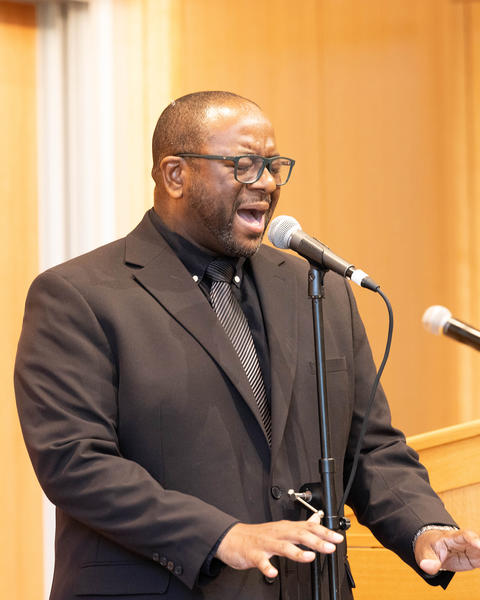
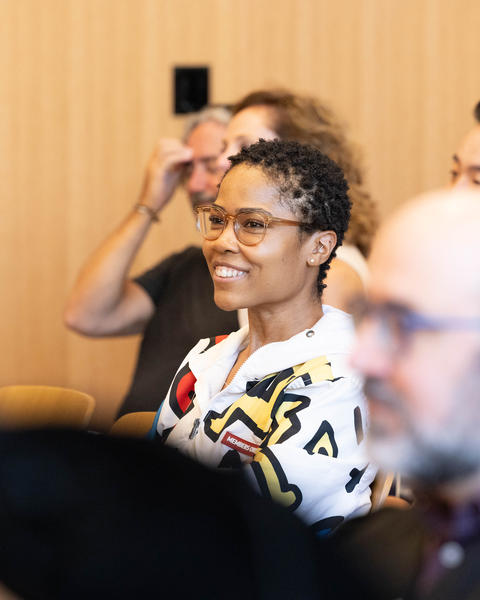
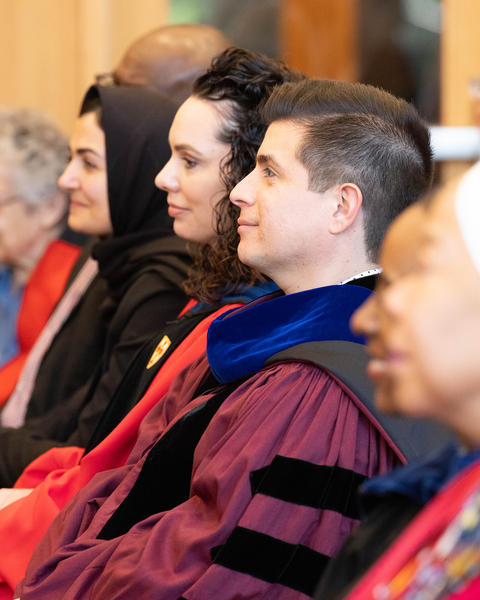
On September 4, 2025, HDS students, faculty, staff, and other community members gathered in Swartz Hall to celebrate the School’s 210th Convocation. During Thursday’s event, which included music by HDS musicians and singing by associate dean for ministry studies and Lecturer on Ministry, Teddy Hickman-Maynard, speakers emphasized the importance of this year’s theme: the value and formational possibilities of an HDS education.
HDS Dean and John Lord O’Brian Professor of Divinity, Marla F. Frederick, opened the Convocation ceremony with a quote from last year’s service, her first as Dean of the School: “Convocation is an opportunity at the opening of each new year to convene, to connect, to reflect, and to project a vision for the coming year.”
Dean Frederick addressed the importance of the HDS mission amid its broader interconnections with Harvard University and this nation.
“This country, set to celebrate its 250th anniversary next year, and this esteemed University, with its storied Divinity School, have long influenced each other and evolved together,” said Dean Frederick. “Our past, present, and future are entwined. With this history and an eye toward the future, it is imperative that we each protect the promise of education.”
She urged the community to safeguard core values—championing inquiry, respectful dialogue, openness to the free exchange of ideas, and modeling belonging in daily life.
HDS associate dean for faculty and academic affairs and John A. Bartlett Professor of New England Church History, David F. Holland, delivered the Convocation address entitled, “Religious History as a Model of Learning.” After tracing his own academic journey to the study of religious history, Holland outlined the multivalent pedagogical importance of studying the subject at HDS—an academic institution that, according to Holland, provides “extraordinary opportunities for thinking and for thinking about how to think” through its rich curricula and exploratory methods.
This is where not just teaching religious history but teaching religious history in a multireligious Divinity School becomes especially generative, in my experience."
Using the Kolb Experiential Learning Cycle as a paradigm, Holland detailed the ways an HDS education, particularly with its emphasis on the study of religious history, fulfills the four steps in effective learning: through a direct encounter with the religious historical artifact within a community of fellow inquirers, the student of religious history not only theorizes novel approaches to the subject, but creates unique applications and exhibits—thereby expanding the horizons of academic possibility, opening space for the transformation of both subject and student.
Concerning the latter point, Holland emphasized the advantage of HDS’s academic community.
“This is where not just teaching religious history but teaching religious history in a multireligious Divinity School becomes especially generative, in my experience,” said Holland.
Using two readings recited during the ceremony—selections from James Baldwin’s 1953 novel Go Tell It on the Mountain, read by HDS registrar Jamie Johnson-Riley, and Ralph Waldo Emerson’s 1867 poem entitled The Past, read by MTS candidate Sophia Snyder—Holland further underscored elements of religious history as sites of educational possibility.
“To teach religious history is also to bring students into a daily convergence of discursive and conceptual difference,” said Holland. “It is to invite active and critical comparisons. It is to create a challenging context for deep contemplation. It is a model of learning in this way, too.”
Quoting a line spoken by Baldwin’s protagonist at the end of the novel, Holland set a vision for the year ahead.
“This year's HDS community, committed to these challenging and promising models of learning, declares at the opening of a new year, ‘We are coming, and we are on our way.’”
SPEAKER 1: Harvard Divinity School.
SPEAKER 2: Convocation of Harvard Divinity School at the opening of the 210th year. September 4, 2025.
MARLA F. FREDERICK: Good afternoon.
CROWD: Good afternoon.
MARLA F. FREDERICK: And welcome to Harvard Divinity School's 210th convocation.
[APPLAUSE]
Each of you, our students, faculty, staff, alumni, and friends, are deeply valued members of our growing, vibrant, intellectually curious community. Thank you for gathering here today in celebration of the start of this new academic year. And a special thank you to our wonderful musicians and to everyone here at HDS that worked so hard to make our community events warm and welcoming. Please, let's give them all round of applause.
[APPLAUSE]
Today, I have the distinct honor of welcoming you, those returning and those just joining our community, to our beautiful campus. I also have the privilege of recognizing this year's convocation speaker, David Holland.
[APPLAUSE]
He is the John A. Bartlett Professor of New England Church History and Associate Dean for Faculty and Academic Affairs. This time last year, it was David who was introducing me before I addressed the school at the beginning of my first full year as dean. And his opening words have stayed with me since.
He said, convocation is an opportunity at the opening of each new year to convene, to connect, to reflect, and to project a vision for the coming year. One of the best things about academic life is the steady rhythm of beginnings and completions, like the reliable beat of waves surging onto the shore and then returning to sea.
As a senior leader and an exceptional scholar, David was asked to offer this year's convocation address. In these fraught times, he has been, for many and especially for me, a trusted advisor and friend. For this entire community, he serves as a respected mentor and mediator.
His very presence brings calm, embodying the steady rhythm he spoke of at last year's convocation. His focus today on religion, history, teaching, and learning is pertinent now more than ever. I am grateful to David for the words of wisdom he will offer us on religious history as a model of learning.
The importance of understanding history, history that contains the range of human experiences, from the most devastating to the most divine, cannot be understated. This country, set to celebrate its 250th anniversary next year, and this esteemed university with its storied divinity school, have long influenced each other and evolved together.
Our past, present, and future are entwined. With this entwined history and an eye toward the future, it is imperative that we each protect the promise of education. As we have seen over the past year, freedoms and rights are not guaranteed. They must be championed, fought for, and protected again and again and again.
In President Alan Garber's message to the community last night regarding the US district court granting Harvard's motion for summary judgment, finding that the federal government's freeze of university research funding was unlawful, President Garber said, and I quote, "The ruling affirms Harvard's First Amendment and procedural rights and validates our arguments in defense of the university's academic freedom, critical scientific research, and the core principles of American higher education," end quote.
This is an important ruling. And while this continues to play out in the courts, there is much we can and must do together to safeguard and live our principles and values in our daily lives, including championing that spirit of inquiry and respectful dialogue, cultivating an openness to the free exchange of ideas, and modeling a community of belonging for us all.
And so with gratitude, I wish to acknowledge our stellar professors and visiting scholars who have dedicated their lives to teaching and learning, to living and modeling these important values. Here at Harvard Divinity School, we are truly blessed to have great thinkers who share their academic expertise, ranging from ancient languages to history and theology and anthropology and so much more.
And to our students, you are part of a vibrant community that represents more than 35 different faith traditions, a community committed to fostering intellectual rigor, compassionate dialogue, and ethical leadership on campus and beyond.
Our alumni network includes more than 6,800 graduates across all 50 states and more than 70 countries. These remarkable individuals lead religious communities, serve as chaplains and monastics, and advance understanding across a wide range of fields and disciplines, from academia to the arts, ministry to medicine, and the private sector to public service.
Whether your gift lies in scholarship, spiritual leadership or service, this is a place where you can discover your life's calling and create a world of difference. Here's to a new academic year, guided by our school's clear vision to provide an intellectual home where scholars and professionals from around the globe research and teach the varieties of religion in service of a just world at peace across religious and cultural divides.
And now I would like to welcome our HDS registrar, Jamie Johnson-Riley, to the stage to offer a reading from James Baldwin. Thank you.
[APPLAUSE]
JAMIIE JOHNSON-RILEY: Good afternoon, everyone.
CROWD: Good afternoon.
JAMIIE JOHNSON-RILEY: This is from James Baldwin's Go Tell It on the Mountain.
"He had never tried to think of their trouble before. Rather, he had never confronted it in such a narrow place. It had always been there at his back, perhaps, all these years, but he had never turned to face it.
Now it stood before him, staring, nevermore to be escaped. And its mouth was enlarged without any limit. It was ready to swallow him up. He would be led into darkness, and in darkness he would remain.
The light and the darkness had kissed each other and were married now forever in the life and the vision of John's soul. I'm ready, John said. I'm coming. I'm on my way." Thank you.
[APPLAUSE]
And now I'll welcome up Sophia Snyder to do a reading.
SOPHIA SNYDER: Hello, everyone. A poem by Ralph Waldo Emerson entitled "The Past."
The debt is paid,
The verdict said,
The furies laid.
The plague is stayed,
All fortunes made.
Turn the key and bolt the door.
Sweet death is forevermore.
Nor haughty hope, nor swart chagrin,
Nor murdering hate can enter in.
All is now secure and fast.
Not the gods can shake the past.
Flies-to the adamantine door
Bolted down forevermore.
None can re-enter there.
No thief so politic,
No Satan with a royal trick.
Steal in by window, chink or hole
To bind or unbind,
Add what lacked,
Insert a leaf or forge a name.
New face or finish what is packed,
Alter or mend eternal fact.
Thank you.
[APPLAUSE]
JANET GYATSO: afternoon, everybody. Very nice to see you all. It's my honor and pleasure to introduce our speaker. As you heard already, it's David Holland, who is currently serving as our academic dean.
This is a job that I did before him. And I know how very, very hard it is and demanding and complicated, especially in times like now, where issues around academic freedom, freedom of speech, and many other really important issues. And I've seen him navigating this with incredible diplomacy, incredible sense of humor, incredible sensitivity.
Yes, as Dean Marla said also, he is the calm in the storm. And he's also extremely efficient. So he's a really fantastic dean. But don't mistake the fact that he's also a very serious scholar.
Oh, I also wanted to add that he served as interim dean and also acting dean of the entire school in the past couple of years, as well, as we were in a transition moment. So he's had a lot of leadership experience. But he is also and foremost a very serious and wonderful scholar.
He has his PhD from Stanford University in United States history. And his emphasis is on early America religious and intellectual histories. I just wanted to tell you just a little bit about some of the projects he's worked on.
His first monograph in 2011, published by Oxford University Press, was Sacred Borders-- Continuing Revelation and Canonical Restraint in Early America. It's a fantastic book. I had the pleasure of reading it.
And I just want you to that just as a sign of the way things go here at Harvard Divinity School, my own field is Buddhist studies. And I worked on a tradition of Revelation and issues around scripture and canon. We have so much intersection, even though we're working in very different areas.
He writes, amongst other things, about someone named Rebecca Johnson, who had dreams of a home where she found many sacred scriptures, revealed scriptures. And you could have written that same sentence for the people who I worked on in Tibetan Buddhism. That's just one of the types of intersections that we can enjoy here all the time.
In terms of his other work, he wrote for a largely devotional audience, so a much different audience. He wrote a brief theological introduction to the prophet Moroni. He also has written a lot on slavery in the United States, including the entry for the Encyclopedia of Religion and Politics in America.
His current project he describes as a dual biography, which is an interesting genre. I'm not exactly sure what that means. But two 19th century towering female figures. One of them is Mary Baker Eddy, who was the founder of Christian Science, and the other, Ellen White, the founder of Seventh Day Adventism.
And I haven't read it. But he noted in the summary that he sent to me, they're products of the same New England culture, but they have radically opposite theologies. One's all about immaterial transcendence. And the other is all about materialist embodiment.
So first of all, I'll say so much for history creating theology. Or I really want to hear how he works that out. And I also want to hear especially about the theology of embodiment. But we're hoping that he finishes his book even as he serves as academic dean.
He has a bunch of other essays, one on how some American prophets have appealed to eternal timelessness of their divine messages, and others have appealed to the historical timeliness again. So you see that kind of theme, time versus timelessness, transcendence versus physical embodiment.
These are big issues in the study of religion, of course. And it's great to see how David tackles them in the context of his own work in American history. So we're really looking forward to his talk today.
Other than the title, which sounds fascinating, I have no idea what he's going to focus on. But I advise you to listen closely. There's going to be a lot to hear.
[APPLAUSE]
DAVID HOLLAND: Thank you, Janet, for that very kind introduction. I'm honored to be introduced by Professor Gyatso, particularly honored. At my very first HDS convocation, a memorably beautiful and moving address was given by Stephanie Paulsell, who spent the substantial first portion of her remarks reflecting on a convocation address given a decade earlier by none other than Janet Gyatso.
Completely new to the community at that point-- I hadn't even been to my first faculty meeting-- I found myself wondering, who is this remarkable person whose convocation address of 10 years earlier was continuing to inspire the moving remarks that I was hearing in that moment.
And now, a decade plus beyond that, to be introduced by Professor Gyatso is a particular privilege and to add my reflections to a tradition that I so strongly and appreciatively and admiringly associate with her.
Thank you to the musicians. And thank you to our wonderful dean, with whom I have the great privilege and honor of serving, and to everybody who contributed to this event. Sitting now in the Office of Academic Affairs, I see how much effort goes in to these events. And I am overwhelmed by the acts of devotion and dedication to this community reflected in a gathering like this.
Thank you, too, to our readers, Jamie Johnson-Riley, our registrar, and to Sophia Snyder, one of my students. Their renderings poured new life into these texts, which have particular meaning for me. The selection of readings may seem a little bit idiosyncratic, but there is a point to them. I promise. And I will return to that in due course.
My title for these remarks, as Janet has mentioned, is "Religious History as a Model of Learning," which, like the readings, is admittedly a little bit cryptic. So I should clarify, noting that my preoccupation this afternoon is with teaching and learning, students and teachers, classrooms and curricula, probably not the sexiest or most scintillating topics. But I am who I am, and that's what you're stuck with today.
Perhaps I can begin to explain my topic and title by indulging in a bit of intellectual memoir. Like most people, I can point to a few key moments in the formation of my particular academic orientations.
Among the most influential of those moments was a decision my parents made in the summer after my sophomore year of high school to move from the Utah suburbs, where my life had been overwhelmingly defined by the surrounding familiarities of faith and family, to the West Midlands of the United Kingdom, where I would spend the next two years enrolled in a British state sixth form college, which at age 16 seemed a long, long way from the world that I had known.
Dislocation sometimes brings discovery. And among the discoveries for me was an early opportunity to compare two very different educational settings. In particular, the move highlighted the contrasts and similarities of two history teachers.
Before leaving the United States, my history teacher was a zither-playing soccer-coaching gubernatorial candidate for the Utah Libertarian Party. Upon arrival in England six weeks later, my history teacher was a Marx-quoting, irony-effusing member of Britain's then fragmenting Communist Party.
Both believed that their study of history led them to their personal and political worldviews. And yet they arrived at diametrically opposed positions regarding the place of the state and the purpose of civil society.
My 16-year-old self made note of this thing called history that had such formative power and such unpredictable conclusions. These two teachers shared very little other than an admirable commitment to their students, a penchant for corduroy, and an unmistakable disinclination to take religious institutions very seriously, my English teacher because they were religious, my American teacher because they were institutional.
These adolescent academic experiences left me convinced that I needed to study this powerfully unruly thing called history and that academic history functioned quite separately from this other thing that infused so much of my life, called religion. Indeed, they seemed almost oppositional to me.
This perception of a fundamental tension between the subject I understood as religion and the discipline I understood as history remained very much operative as I made my way into a doctoral program in history, intending to write on topics that I believed to be at some remove from religious considerations in a history department that seemed disinclined to consider religion much at all.
Just as I was completing my doctoral coursework and contemplating a topic for a dissertation, the University of Chicago historian Bruce Lincoln famously, or in some circles, infamously, made a series of declarations about the relationship of what he dubbed history and religion.
Among these was the following. The history of religions is a discourse that resists and reverses the orientation of that discourse with which it concerns itself. To practice history of religions is to insist on discussing the temporal, contextual, situated, interested, human, and material dimensions of those discourses, practices, and institutions that characteristically represent themselves as eternal, transcendent, spiritual, and divine.
Lincoln's categories of history and religion are notoriously static and narrow and flat here, as a number of insightful scholars ranging from Timothy Fitzgerald to Kathryn Lofton have effectively identified, noting, among other things, an uncritical and unnamed naturalization of Western secularity.
Nonetheless, what Lincoln's declaration highlighted was a persistent question for me and for many others about the implications of using a method that makes certain assumptions about how the world works to study a subject that may make very different assumptions about how the world works.
My early understanding of this oppositional relationship actually left me quite resistant to the vocational field of what we often call religious history. After all, who wants to spend their professional life at the convergence point of such violent collisions, what Lincoln called resistances and reversals?
Well, obviously, some do. But I didn't think it was for me. Nonetheless, I had a problem. After four years of living in Europe, I very much wanted to understand early American intellectual history. Its ideas informed social and cultural and political cultures.
It did not take me very long to realize that to grapple with early American thought without a serious historical engagement with the cultural forces we characteristically called religion was akin to a study of botany without a consideration of climatology.
These kinds of academic siloings can and do occur all the time. But I realized fairly quickly that nothing I was interested in would be well served by such a partition.
And so began a series of intellectual and professional developments that I won't bore you with that eventually brought me 12 years ago to a divinity school, a place in whose classrooms the strenuous academic applications of historical method, among other equally rigorous disciplines, converge with fulsome conceptions of religion every single day. And it has been, quite simply, the most rewarding intellectual experience of my life.
Among other things, HDS's purpose as the dedicated arena in which academic method meets the complex category of religion has cultivated an ever richer conception of the complex relationship among the areas of human endeavor to which these terms are so often applied, pushing well past the simple oppositional paradigm with which I began.
When laboratory scientists combine two volatile substances, they do so in what they call a reaction vessel, a container solid enough and steady enough to let the experimental mixing produce its revelatory results. I sometimes think of HDS at its best as this kind of vessel. And I'm grateful that so many people who have made it and continue to make it the stable and steady setting for these essential and sometimes volatile explorations.
I stand before you as a witness, after more than a decade living and learning within such a vessel, that the results of this combination include extraordinary opportunities for thinking and for thinking about how to think.
Indeed, today I would like to suggest that in our classroom, these categories, complicated as they are, history and religion, even in their most polarized expressions, can look less like conceptual or even cosmological rivals and more like pedagogical partners in the cause of learning.
I'd go so far as to propose that their interaction can produce an especially promising model of learning. What, then, is a model of learning? Well, typically the phrase is used in educational research to refer to a more or less simplified schematic description of how human beings acquire new knowledges and new abilities.
This, in turn, becomes a kind of prescriptive guide that teachers can follow in promoting learning among their students. But there is, of course, another meaning to the word "model," which refers to an especially exemplary instantiation of a value.
For instance, the phrase "model of decorum" might refer to the schematized steps one might take to achieve decorous behavior. That would be definition number one. And it might also refer to a person who particularly exemplifies that virtue. That would be definition number two.
I'd like to talk today about a model of learning, in both senses, suggesting the ways in which the academic field we call religious history might serve as an especially productive site for the implementation of well-established principles of learning.
That is, by relating it to a model of learning in the first sense, I hope to comment on its particular potential as a model of learning in the second sense. And in the process, I hope to say something of value about the start of another year here at Harvard Divinity School.
One of the more widely accepted models of learning is the Kolb experiential learning cycle. It's been around for something like 40 years. It suggests that there are four steps in effective learning, including concrete experience, reflective observation, abstract conceptualization, and active experimentation.
Maybe I can now outline what a variation of that model might look like in an HDS classroom, with a specific eye to the particular learning enhancements that religious subjects can bring to the study of history as academic method.
To do so, it may be of some value to zero in on a religious tradition that comes quite close to matching the assumption of a fundamental clash between history and religion, maybe just to prove the point.
Let's say Christian Science, a faith founded by Mary Baker Eddy and resolutely committed to a cosmology of immaterialism, transcendence, and timelessness. The very things that Bruce Lincoln believed made religion the reverse image of the universe, as presumed by the academy's historical method.
Eddy did insist, after all, that history is the mere material shadow whose changeableness threatens to obscure the unchanging truth of divine mind. Emerging in the United States in the last quarter of the 19th century, the Christian Science movement offers a student of history a really compelling opportunity to understand its time, its place, and its people as they informed a new religious movement.
How should we learn to make historical sense of such a thing? More specifically, what do we do with Kolb's first learning step, concrete experience? We should note here that concrete experiences are properly built into any historical course that has a primary source component, as most self-respecting history courses do.
That is, students encounter the stuff of the past at first hand in a way that prevailing learning models suggest can deepen the learning experience. This would be true whether one was an economic historian holding a 100-year treasury memorandum, or a historian of science holding Darwin's observational notebooks.
To encounter the original matter of history is to experience history in a way that virtually all modern learning models encourage. Note, though, the way that this specific religious history in relation to Christian Science may enhance that experiential component, given what we at HDS often hand our students by way of primary sources, our artifacts that the actors of the past saw not only as a record of experience, but as the source of experience.
For instance, later editions of Mary Baker Eddy's defining text for Christian Science, Science and Health With Key to the Scriptures, contain a concluding chapter called "Fruitage," which consists of testimonials of Christian scientists who experienced a healing, sometimes simply by holding or opening or reading the book.
Maxine Greene's theory of aesthetic education makes much of a student's direct encounter with a work of art as the beginning of learning. I see in her learning model a reflection of what we do in these classrooms every day. When I hand students Science and Health, for instance, I have similarly placed the thing in their hands to experience for themselves.
Students of religious history often have the chance to encounter not just the evidence, but the engine of the thing they hope to better understand. And this need not necessarily be a text-based tradition, but any culture with experience-inducing material at its core.
In this case, the students' own encounter with the very text that lies at the center of so many healing stories invites them to reflect at a deeper level on the historical record of Eddy's ministry, on the experience of the people they hope to understand, and of the movement's growth.
The next stage of Kolb's process is reflective observation. For the student of history, this involves reflecting on the student's own encounter with the experienced artifact, but also reflecting in conversation with the diverse observations of many others on that same artifact.
Here, Kolb's learning cycle coincides with many other models of learning that encourage collaborative reflection. For someone trying to understand the historical presence of science and health, a text with such remarkable claims and such remarkable consequences generates responses from a striking variety of perspectives.
Students can hear Eddy's own reflections, Willa Cather's biographical treatment of the book, Mark Twain's half-sardonic, half-mystified review, the devotions of adherence, the dismissals of the skeptical, the laments of the disaffected, the frustrations of the physicians, the heated heresy-seeking of the Orthodox, the contextualizations of the historians, and the invocations of the practitioner.
Certainly, historical texts of all sorts have inspired diverse reflective observations. But one would be hard pressed to see any observational range surpass the array of reflections inspired by the writings we commonly characterize as religious.
If you're looking for viewpoint diversity on a historical phenomenon, the reception history of a text like Science and Health offers an astonishingly broad range. Students exercise of reflective observation is thus challenged and enhanced within a complex community of commentators.
Kolb's next stage is abstract conceptualization. This is where the combination of experience and reflection is supposed to lend itself to transferable interpretive frameworks and explanatory theories.
History is an academic field prioritized, contextualized particularity over trans historical theorizing, for reasons with which I fully sympathize. But that also leaves historians relatively un-self-reflective about the assumptions they bring to their work.
Here, I would venture to say that historical literature on religion has been unusual among historical subfields in evoking self-conscious considerations of history as an object of disciplinary self-reflection.
In my academic generation, historians of religion have posited history as the earthy debunker of immaterial claims. They have seen religious history as a call to understand the world through the eyes of the historical figures themselves. They have proposed a history that expands its own ontological range.
They have argued for either the separation or the inextricable relationship of description and explanation. They have insisted that a more capacious historiography would see religious experience as a chance to reflect on the profound otherness of historical worldviews.
Again, I'll note, historians in general are not instinctually given to these kinds of abstract conceptualizations. But it seems that when it comes to the study of religious experience, they find they have little choice but to stretch in these directions.
Accordingly, our students are necessarily exposed to scholarly models of abstract conceptualization that help them think more carefully about entire academic fields, and in my HDS experience, facilitate their own careful conceptual thinking in our classrooms.
Kolb's final step is active experimentation, that is, to take the things learned from direct experience with and reflective observation on an abstract conceptualization from the first example and begin to apply them in analyzing new examples.
This is where not just teaching religious history, but teaching religious history in a multi-religious divinity school becomes especially generative in my experience. In a course I offer, Writing About Revelation-- Scholarly Approaches to Religious Experience, students spend the first part of the course studying a variety of scholarly literatures on religious experience.
They then consider some of the more thoroughly covered examples from my particular area of academic expertise, American religious history. And then their final project is to find a historical phenomenon that they want to try their hand at understanding as a historian of religion.
The results have been stunningly diverse, from a use of religious experiential theory to engage Martin Buber's I and Thou to an examination of the invocation of a higher power in Alcoholics Anonymous, to an account of the revelatory origins of the Taiping Heavenly Kingdom movement in 19th-century China.
There is no shortage of historical questions to consider around claims of religious experience. And our students consistently demonstrate the validity of experiential learning theory in promoting their analytical depth, their contextual sensitivity, their scholarly self-awareness, and their capaciousness as historians exploring a vast variety of histories.
Watching students learn and learn in this way ranks among the great satisfactions of faculty life at Harvard Divinity School. Now, what I have sketched out here is an ideal, not always achieved by every student, and certainly not always accomplished by me as a teacher. In fact, I have reason to believe that the success rate is higher for my esteemed colleagues here.
My title is "Religious History as a Model of Learning" not because it always is, but because it gives us so many remarkable opportunities as teachers and as students to make it so.
Now, in making this case today, I have quite consciously named and then sidelined the oppositional framework suggested in my opening. I have posited these things that we sometimes call history and religion as pedagogical complements rather than combatants. But in conclusion, I should note that the tensile aspect of this categorical relationship also contributes abundantly to the learning experience in our classrooms.
So as previously promised, let's go back to today's somewhat eclectic readings. Jamie read from James Baldwin's Go Tell It on the Mountain a text of particular significance to me. I often offer a first-year seminar over in the college titled Faith and Fiction, which uses novels as the sources by which to teach American religious history.
Syllabus for that course has evolved over the years, but Go Tell It on the Mountain has been a steady constant. In part, it has retained its prominent place among the vast number of texts from which I could choose to teach that course, simply because it is a beautifully crafted piece of art.
Here's Greene's theory, again, on the aesthetic education of direct artistic encounter. Its young protagonist is 14-year-old John Grimes, whose combination of heartache, innocence, and world-weary wisdom swiftly invite the reader's full emotional investment, securing first-year college students' attention in ways that have proved increasingly difficult with other books.
Partly, it's that the book is a semi-autobiographical treatment of Baldwin's own life, a 1950s recalling of memories from earlier days. And it thus serves as a complex primary source of mid-century America.
But perhaps the main reason it anchors and continues to anchor my syllabus is that it is itself, or can at least be reasonably read as, a rumination on religious history. The entire novel ostensibly takes place over the course of one single day, John's 14th birthday. But interwoven into those 24 hours are the lengthy, looming histories of his elders, his mother, his father, his stepfather, his grandmother, his aunt.
It depicts the ways Christian worship and belief moved along transformative pathways from the rural South to the urban North during the Great Migration. It reflects the tensions between an emergent 20th-century popular culture and traditional religious worldviews. It captures the gender dynamics of early Pentecostalism on the harshly segregated cityscape of New York's throbbing metropolis.
Every interaction John Grimes has during that one day is freighted with the weight of decades past. The very structure of the novel conveys the idea that our days are informed by the years that precede them, and that we cannot understand what today bequeaths until we grapple with what it has inherited.
And much of what John's day inherited flowed from the religious experiences of his progenitors. The passages Jamie read cite the past sorrows and the hopes of the saints upon which John yearned to write his own story.
In Baldwin's phrase, John was just beginning to face that history. Some of his elders had not yet found the courage to face the facts of their own pasts. And here they encountered the concrete realities described in Emerson's poem, read by Sophia.
This is a hard, troubling, challenging poem for me. The finality with which he describes the past feels brutal and unyielding.
All is now secure and fast.
Not even the gods can shake the past.
Flies-to the adamantine door
Bolted down forevermore.
Baldwin's treatment of the past is more nuanced than Emerson's here. It is multiple and perspectival and human, whereas Emerson's poem renders it as singular and stark and impersonal. But they're both unrelenting in their own ways.
Joining American literature's long list of hypocritical clerics with skeletons in their closets, from Arthur Dimmesdale to Elmer Gantry, John's ministerial stepfather refuses to acknowledge the realities of his past actions, and thus does immense harm to the very people that would heal him.
He believes that his special relationship with God would obviate his need to face the reality of his history. His theology of redemption offered him what the post-Christianity Emerson claimed even the gods cannot offer, changes to the record of the past.
Emerson's past catches up with Baldwin's antagonist. The post-church Baldwin seems to echo Emerson here. The closing scene involves the self-deluding minister confronting a document, an archive, the damning evidence of things done and undone. The past, both pieces declare, is not an object to bend to our pleasure, to escape without accountability, or to ignore without peril.
If my earlier comments suggest this thing called religion is history's resource, these passages from Emerson and Baldwin suggest history as religion's reckoning. These are not mutually exclusive, and they are both relevant at a school that promises to prepare students to learn and to lead.
But this is not the only commentary the novel has on the relationship between history and religion. The final segment of the book is consumed with a narrative of religious experience, John's conversionary experience. In a remarkable, truly remarkable bit of writing, Baldwin takes us deep into a Pentecostal rebirth, depicting John's descent into horrifying despair and then his upward journey out of the pit toward redemption.
It is as vivid and evocative a literary effort to capture the experience of being born again as may be found anywhere in American fiction. After coming out on the saved side of this spiritual crisis, John offers an alternative view of the challenge of religious history. He was deeply worried that later narrators of his experience would not capture it the way he had lived it.
Beginning to understand something about his own emerging sexuality and his own critical worldviews, John fears that later events in his life might be used to obscure or diminish the experience he knew he had just lived.
He begs for a witness. Elisha, he says to his friend, no matter what happens to me, where I go, what folks say about me, no matter what anybody says, you remember, please remember, I was saved. I was there.
He agonizes between the Emersonian finality that he feels about his own experience and the knowledge that later interpreters will do as they will with his experiential claims. Certitude and contingency clash in a 14-year-old soul.
The religious subject seems to be caught between a past that is for good and ill, inescapable, and a history that is, for good and ill, ever open to reinterpretation. The novel ends with the reader contemplating this conflict.
Baldwin here seems to be struggling with the memory of inner experience, which claims the power of Emerson's eternal fact and the reworking of that experience through the lens of later discovery.
He forces us to consider questions of subjectivity and documented data. He cultivates sympathy for the inner religious experience of the characters we like and cynicism toward the inner experience of the characters we dislike, demonstrating a set of tendencies that often play out in our classroom and that our students may recognize in themselves, having seen them on display in this remarkable work of art.
Reading Baldwin's work invites hard and revealing questions about both the demands of history and the claims of religious experience, precisely because it is willing to place these phenomena in such intimate and insistent proximity to one another.
There is something about the combination that compels us to think. There is learning power in the vessel that is built to hold their interactions.
And so here I would note one other element of religious history as a site of pedagogical possibility. It is not just as the first part of my remarks suggest, an educationally fortuitous merging of historical thinking and vivid religious sources, though I do believe it to be that.
To teach religious history is also, in full keeping with my early student anxieties and in fulfillment of my present, teacherly hopes, to bring students into a daily convergence of discursive and conceptual difference. It is to invite active and critical comparison. It is to create the challenging context for deep contemplation. It is a model of learning in this way too.
Now, religious history is just one of the academic areas on offer here, but it exemplifies a consistent presence that I find throughout this place. The intrepid endeavor to engage unrelentingly in the academic study of religion is to create a space conducive, it seems to me, to the pursuit of the academy's highest hopes for itself.
Each new class of students brings fresh energy to that endeavor and reignites the worthy effort that has animated this school, this purpose-built vessel for generations past.
In a speech to New York City educators given about a decade after publishing Go Tell It on the Mountain, James Baldwin said that if he were to teach students American history, he would quote, "try to make them know that just as American history is longer, larger, more various, more beautiful, and more terrible than anything anyone has ever said about it, so the world is larger, more daring, more beautiful, and more terrible, but principally larger, and that it belongs to them."
This is something of the same note from the conclusion of his semi-autobiographical novel. Recall that last line as Jamie read it. After all the experience and all the inherited weight, in light of the reckoning and in possession of the resources, young John Grimes stands at the cusp of a new day, declaring to all the world, I am coming. I am on my way.
That is, for me, what this year's HDS community, committed to these challenging and promising models of learning, likewise declares at the opening of a new year. They are coming, and we are on our way. Thank you very much.
[APPLAUSE]
[MUSIC PLAYING]
TEDDY HICKMAN-MAYNARD: (SINGING) Just a man who's lost some things and left with memories
I'm just a man who's growing old
I made some friends along the way
I made some enemies
But I pray they're all good in their souls
I've seen the reasons and the meanings and the seasons change
I've seen the magic come and go
I fell in love with shiny things I thought would keep me warm
I felt the heat when it turned cold
All over me
You want my peace but you won't get it
I hear the devil steady knocking at my door
I'm just a man who's lost some things and left with memories
Still I believe there's so much more
'Cause I got joy in the battle
I got joy in my victory
I keep my eyes to the heavens
So my joy never slips from me
You shouldn't let yourself get tangled up in worry
Because that kind of living takes its toll
You gotta take the pencil back, rewrite your story
And tell them this one never told
All over me
You want my peace but you won't get it
I hear the devil steady knocking at my door
I'm just a man who's lost some things and left with memories
Still I believe there's so much more
'Cause I got joy in the battle
I got joy in my victory
I keep my eyes to the heavens
So my joy never slips from me
Yeah, I've got joy in the battle
I got joy on this journey set for me
Oh, and when they see me coming, they going to see I got this joy all over me
Have you ever seen a man dance with [INAUDIBLE]
Ain't looking back
I seen a lady scare the devil with the way she moves her feet
Now look at that
I think I'm singing again
Have you ever seen a man dance with [INAUDIBLE]
Ain't looking back
Oh, that pretty lady scared the devil with the way she moves her feet and [INAUDIBLE]
Oh, I feel it all over me
Joy in the battle
I got joy in my victory
I keep my eyes to the heavens
So my joy never slips from me
Oh, say it
I got joy in the battle
I got joy on this journey just for me
Oh, when they see me coming, they don't see I got joy all over me
'Cause I got joy in the battle
Joy in my victory
When I keep my eyes to the heavens
This joy never slips from me
[APPLAUSE]
MARLA F. FREDERICK: I always say, if Teddy closes us out, it really doesn't matter what happened before. Come on. But I so want to thank David Holland for setting such a beautiful tone-- thank you so much-- for the real work that we have to do this year.
And so my deepest gratitude to Jamie, to Sophia, to Janet, to David, Teddy, Chris, the entire band, everyone who joined to help celebrate this milestone today. Thank you. And my best wishes to each of you as we begin this next chapter together.
This concludes our formal programming, and so please join us downstairs for a reception in the HDS Commons.
[APPLAUSE]
SPEAKER 2: Musicians Michelle Milliben, MTS candidate, violin, Joyce Chen, MTS candidate, cello, Craig Rusert, MDiv candidate, bass, Amie Montemurro, senior communications officer, HDS, Chris Hossfeld, Director of Music and Ritual, HDS.
SPEAKER 1: Copyright 2025. President and Fellows of Harvard College.
Photos from the 210th HDS Convocation
All photos by Evegenia Eliseeva.