

Gustavo Gutiérrez Exhibit Explores 50 Years of Liberation Theology
The exhibit opening event will offer space to gather and reflect on Gutiérrez’s life and legacy.
On October 28, 2025, Harvard Divinity School (HDS) will welcome members of the School and wider University community to a special event and reception celebrating the HDS Library’s new exhibit, “In Memory of Gustavo Gutiérrez: 50 Years of Liberation Theology.”
The exhibit, curated by Professor Raúl Zegarra in collaboration with the library, honors the work and legacy of Gustavo Gutiérrez, the influential theologian known as the father of liberation theology. The timing of the opening is especially meaningful, coming just a few days after the first anniversary of Gutiérrez’s death.
The evening will begin at 5:45 pm with remarks by Zegarra and HDS Dean Marla F. Frederick, who will introduce attendees to the exhibit. Zegarra, a former student and close friend of the late Gutiérrez, described the process of creating the exhibit, which included combing through the HDS archives. This process revealed the “significant presence of liberation theology at HDS,” Zegarra said.
HDS’s early attention to liberation theology, Zegarra said, began as the movement was just emerging in Latin America in the early 1970s. The presence of liberation theology at the Divinity School in its early days stands as a testament to the importance of Gutiérrez’s work on a global scale.
From photographs of Gutiérrez’s early life and documents highlighting his role in Vatican II, to a first-edition copy of his groundbreaking 1971 book Teología de liberación and recordings of his lectures at HDS, the exhibit brings together materials that tell a powerful story of his lifelong commitment to liberation.
Having lived to 96 years of age, Gutiérrez was one of the few people to live long enough to see the institutional Church become “committed to the liberation of the poor, working on questions of social justice…and really putting their money, their infrastructure, their theology at the service of society,” according to Zegarra. His work in liberation theology over the course of 50 years makes Gutiérrez a “decisive” figure in the increasingly justice-focused orientation of the Catholic Church he noted.
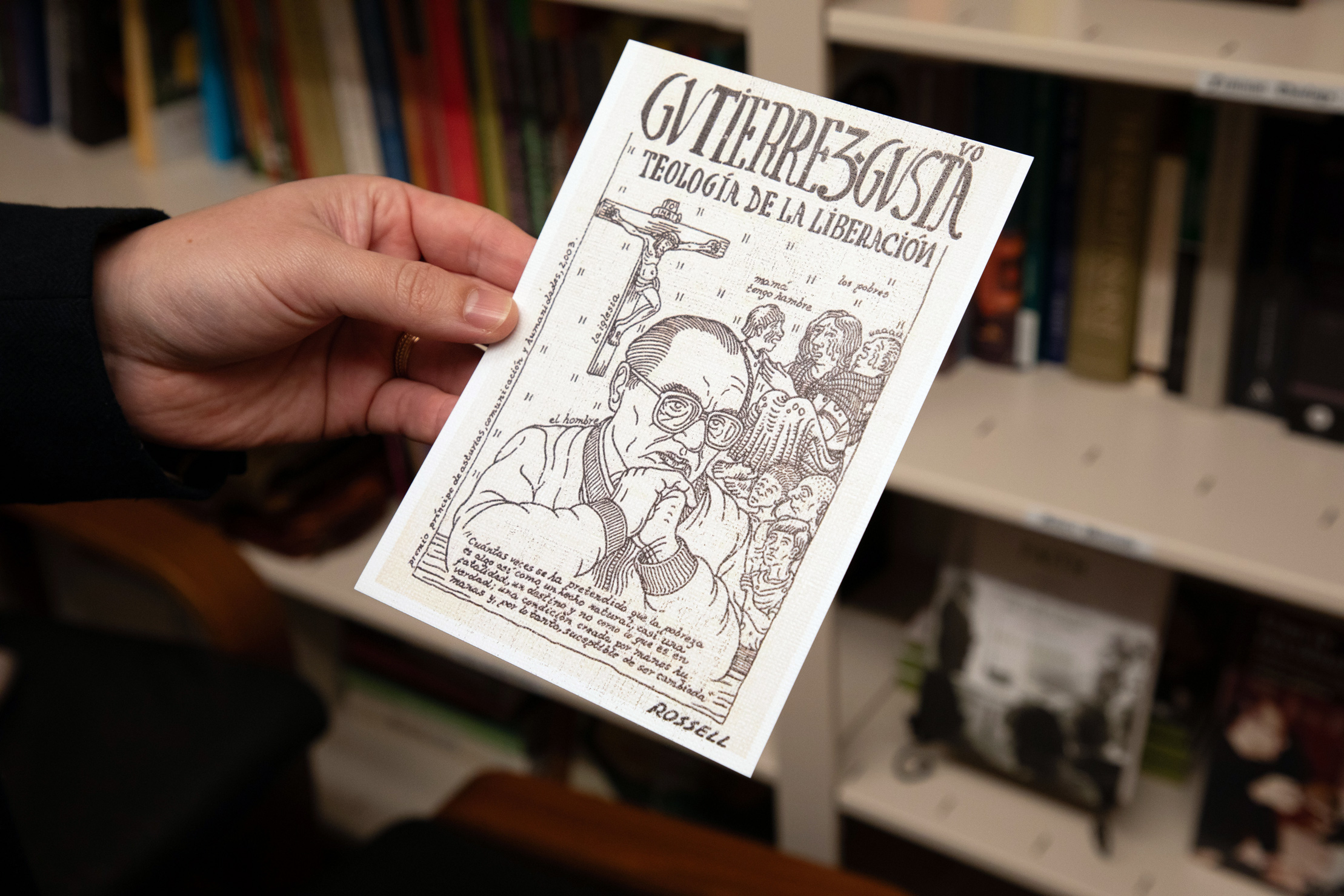
Professor Zegarra holds a print made by Peruvian artist Lucho Rossell depicting Gustavo Gutiérrez as one of the famous drawings of indigenous chronicler Felipe Guamán Poma de Ayala (1535-1616). Photo by Alex Bayer.
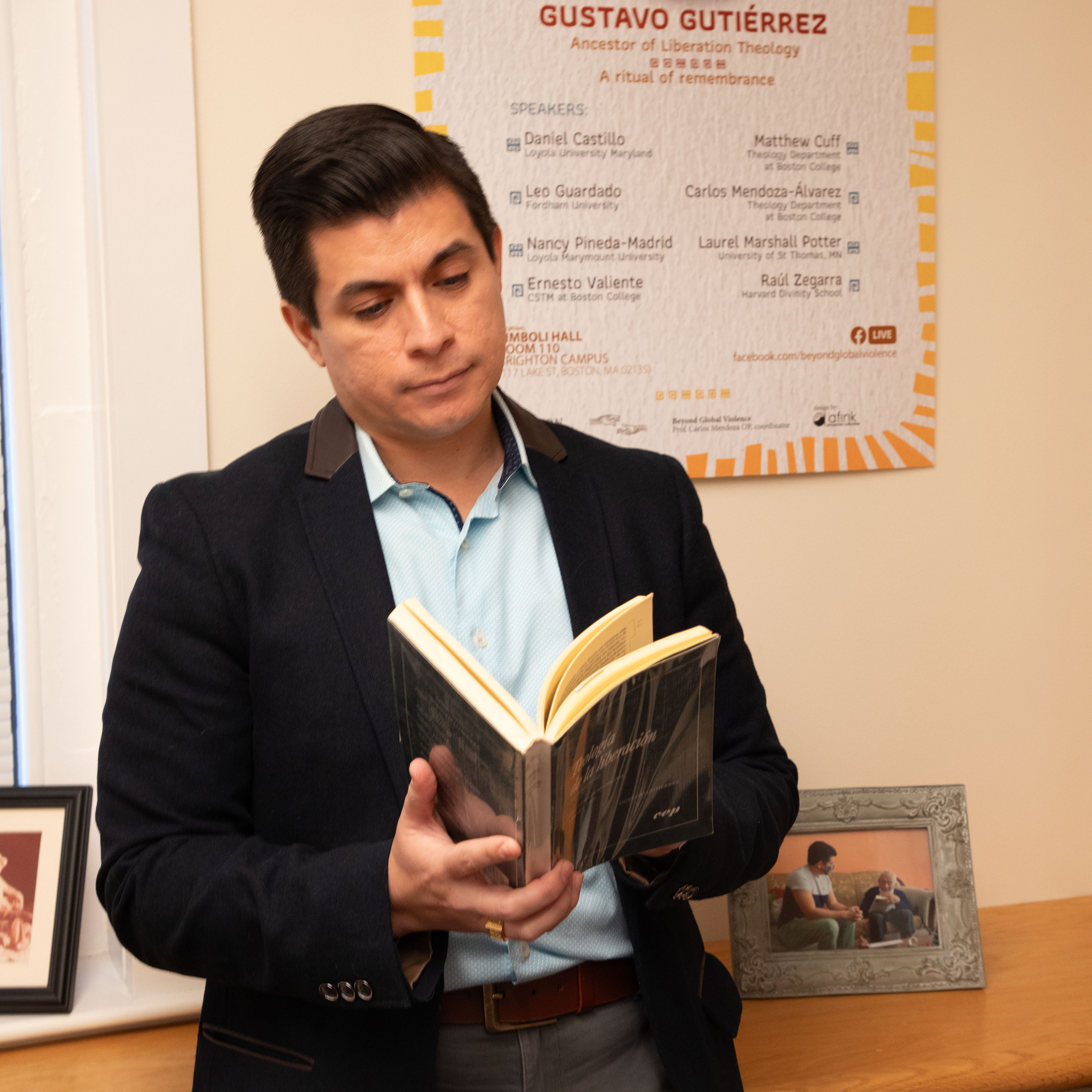
Professor Zegarra reads Gutiérrez's Teología de la liberación. Behind him, a poster from an event held at Boston College on November 1, 2024, celebrating the life of Gutiérrez after his passing on October 22, 2024. Photo by Alex Bayer.

Professor Zegarra holds a picture of himself and Gustavo Gutiérrez in Gutiérrez's house in Lima, Perú (2021). Gutiérrez is signing a copy of a volume published to celebrate the 50th anniversary of the first edition of Teología de la liberación (1971). Photo by Alex Bayer.
Fordham University Professor Leo Guardado, editor of Gutiérrez’s posthumously published book, Vivir y pensar el Dios de los pobres, will also speak at the exhibition opening on October 28. Guardado, with Zegarra, is one of the last students with whom Gutiérrez worked before his retirement, and, like Zegarra, he came to know Gutiérrez deeply while working with him at the University of Notre Dame. Guardado’s talk will reflect upon Gutiérrez’s legacy, giving attendees a sense not only of Gutiérrez’s profound intellectual influence, but also of “the person he was,” said Zegarra.
The exhibit at the HDS library seeks to honor the memory of Gutiérrez both as a scholar and a caring, steadfast person. One of Gutiérrez’s defining qualities as both a theologian and an intellectual was that he “balanced intellectual achievement with kindness and care for others, and commitment…to a political and ecclesial project that was not easy,” said Zegarra said. More than anything, Gutiérrez’s work and life reflected his identity as “a human being devoted to the care of others,” he added.
The exhibit and its opening invite attendees to reflect on how faith intersects with the pursuit of justice today. Zegarra hopes that attendees will consider how Gutiérrez’s lifelong dedication to liberation theology can inform our understanding of the role faith plays in struggles for social justice, as well as how the history of liberation theology has something to teach us about the relationship between faith and justice in the present.
The opening reception will conclude with a guided tour led by Zegarra, offering attendees the opportunity to experience the exhibit through his eyes. He hopes participants will take away what he calls a “creative or re-creative reading of our commitments” to justice and liberation.
Ultimately, the exhibit stands as both a testament to Gutiérrez’s 50-year devotion to liberation theology and an invitation to carry that vision forward. As Zegarra said, it affirms the enduring conviction that faith should matter in this world—and that it has the power to transform it.
Banner photo by Alex Bayer.
RAUL ZEGARRA: OK. Good evening. Good evening. My name is Raul Zegarra. I'm assistant professor of Roman Catholic Theological Studies here at HDS. I'm also the curator of the Gutiérrez exhibit. And I'm also your emcee for this evening. So welcome, welcome. It is so nice to see so many of you colleagues, students, friends from other parts of Harvard and also beyond. Really, really a pleasure.
So at this moment, we will get started with our program for tonight. I would like to invite Dean Marla Frederick, Dean of Harvard Divinity School, John Lord O'Brien, Professor of Divinity, Professor of Religion and Culture, and Professor of African and African-American Studies of the Faculty of Arts and Sciences at Harvard University, to welcome the audience.
[APPLAUSE]
MARLA F. FREDERICK: Good evening, everyone.
AUDIENCE: Good evening.
MARLA F. FREDERICK: Thank you for joining for the celebration of this incredible event in memory of Gustavo Gutiérrez-- 50 years of liberation theology.
Before we begin, I would like to thank those who were instrumental in bringing this together-- Professor Raul Zegarra, Beth Bidlack, who heads up our HDS library, the entire library staff, and everyone who's involved in making this event possible.
I want to also thank our guest speaker, Professor Leo Guardado, thank you so much, of Fordham University for joining us today. You will hear more about Professor Guardado and his scholarship in just a moment.
Today, we are gathered in memory of Gustavo Gutiérrez, one of the most influential theologians of the liberation theology movement, who passed away last October at the age of 96.
His work and an exhibit honoring 50 years of liberation theology will be on display here at HDS, thanks to the expert curation of Professor Zegarra and collaboration with the library. From photographs of Gutiérrez early life and documents highlighting his role in Vatican II to a first edition copy of his groundbreaking 1971 book, Theology of Liberation, and recordings of his lectures at HDS, the exhibit brings together materials that tell a powerful story of his lifelong commitment to liberation.
Professor Zegarra took on this work with exceptional care as both a former student and a close personal friend of the man known as the father of liberation theology.
The exhibit stands as an invitation to our HDS community to consider the role of religion in times of moral uncertainty and overlapping crises around the globe that threaten equal access to rights and resources. The legacy of Gustavo Gutiérrez extends far beyond Latin America, as his ideas have inspired and been in parallel with conversations with various forms of liberation theology around the world, from Black liberation theology and womanist theology here in the United States, to Minjung theology in South Korea, Dalit theology in India, and theology of struggle in the Philippines.
His body of work represents a powerful source of inspiration for all those navigating the demands of faith, scholarly work, and responsible citizenship. Known for his insistence upon God's preferential option for the poor, Gutiérrez inspired generations of theologians and church leaders to place at the center of their work a passionate concern and commitment to the poor and marginalized in our society, as a faith commitment.
In his Theology of Liberation, he made clear that quote, "If there is no friendship with the poor and no sharing of the life of the poor, then there is no authentic commitment to liberation, because love exists only among equals." In his work, he suggested that, quote, "theology linked as praxis, fulfills a prophetic function insofar as it interprets historical events with the intention of revealing and proclaiming their profound meaning."
His work is a gift to generations of scholars and church leaders. And so I want to thank you, Raul and Beth, the library staff, the entire team, for the gift of honoring, both Gustavo Gutiérrez and the importance of liberation theology for us together as a community. And thank you all for the hope you each bring to your work in service of a just world at peace. I would like to turn things back over to Professor Zegarra, who will be introducing tonight's speaker. Thank you.
[APPLAUSE]
RAUL ZEGARRA: Also, I have a few remarks before my dear friend Leo Guardado takes the stage.
But before that, I would like to just say thank you to many, many people without whom this exhibit just wouldn't be possible. From the HDS library, and I hope I don't forget anybody, but I think I have done my best. I got really the most wonderful team that plotted with me for months, helping me make an initial idea a beautiful reality.
Thanks to Beth Bidlack, Rebecca Villarreal, Nell Carlson, Jessica Suárez, Alex Buchan, and Catherine Badot-Costello, and Andrew Leonard from the preservations team. To Catherine most warmly, who retired in the midst of the process, but offered her experience and support taking this project-- her last project at Harvard. Really, thank you.
From the Office of the Dean and the Office of the Academic Affairs, without you, this simply wouldn't be possible. Thanks to Ani Kalousdian for her work, Stephanie Rosario, Karin Frundler-Whitacre, Dean David Holland, and very especially to Dean Marla Frederick for her support from the very start.
From HDS communications, whose efforts to promote the event and the exhibit have been just fantastic thanks to Tyler Sprouse, Jonathan Beasley, Caroline Cataldo, and to Emma Chavez for the nice interview for the HDS website and to Alex Bayer for the photos.
Lastly, from the Bartolomé de las Casas Institute in Lima, Peru, were my dear colleagues and friends made every effort to provide almost all the materials displayed in the exhibit. Thanks to Pilar Arroyo, José Luis Franco, Silvia Casares, Carmen Lora, and very especially to my dear, dear friend Father Andrés Gallego, who passed away last night and whose life Gutiérrez's was a true blessing for so many of us.
The idea of this exhibit is started inspired by two events. The first, more tangible and public, was the passing of Gustavo Gutiérrez on October 22, 2024. Gutiérrez was, of course, as Dean Marla just mentioned, one of the most influential theologians of the 20th century, whose work reached every continent in word and deed.
The other event was more private and, indeed, intangible. The mark left by Gutiérrez in my life as a mentor and a dear friend. Having the privilege of serving at the library committee as one of the faculty members, it became clear to me that working in some kind of project with the library to celebrate the legacy of this remarkable man could be a good way to bring these two events together.
Thus, the in memory of Gustavo Gutiérrez exhibit was born. Beth and her team were simply amazing. Thank you, Beth. We met many times, brainstormed together, and little by little, quite quickly, actually, were able to put together the exhibit that we will see later this evening if you're willing to accompany us.
A third event, however, not anticipated by me or the library team, took place through the planning process. We discovered the legacy of Gustavo at HDS as well. Through classes, readings, public lectures, and much more, liberation theology and Gutiérrez left a mark in HDS. Professors Harvey Cox and Francis Schüssler Fiorenza were particularly important in this regard.
Remarkably, Professor Cox was already teaching liberation theology, even before Gutiérrez's famous book, Teologia de la Liberacion became available in English in 1973. Gutiérrez also came in 1984 to give the Dudleian lectures. Funnily enough, as you will see in the exhibit, one of the goals of these lectures was quote, "detecting, and convicting, and exposing the idolatry of the Romish church." And yet, a Catholic priest was invited to deliver those lectures.
Let me conclude by building on this somewhat funny episode, in this complex moment for higher education in the United States, a moment in which HDS is trying to imagine a new its role in the ever changing landscape in which-- landscape of the study of religion. I believe that this little anecdote has plenty to teach us.
First, it stands as an example of the capacity to build bridges in places where before, we had barriers.
Second, it represents a commitment to an ecumenical and multi-religious outlook that has defined this institution for decades and that we should not give up on. Third, it invites us to make an even greater commitment to quote, "advance scholarly research on religions around the world, as our mission statement maintains, and to be particularly attentive to what once was called the third world, but now so clearly shows to be the majority world."
Lastly, through the example of Gutiérrez, it puts forth an aspiration for the community, and those engaged in the study of religion, that our research should be conducted with seriousness, rigor, and erudition, but that such a study is enriched by a deep commitment to justice and care for the most vulnerable, and if I can add, inspired by Gutiérrez, with a little bit of sense of humor. Thank you.
[APPLAUSE]
Now to the main thing. Let me now introduce my dear, dear friend and colleague, Professor Leo Guardado. Salvadoran by birth, Guardado is associate professor in the Department of Theology at Fordham University. His research areas include forced displacement and the religious tradition of church sanctuary. The theology of Gustavo Gutiérrez, mystical theology, Gandhian nonviolence, and Indigenous healing practices among migrant communities.
Guardado received his PhD in both theology and peace studies from the University of Notre Dame, and Guardado is also the editor of the posthumous book by Gustavo, Vivir y pensar el Dios de los pobres. Leo, the floor is yours. Thank you.
[APPLAUSE]
LEO GUARDADO: All right. What wonderful energy in this room, especially before we sat down. So thank you Raul for the invitation. I want to begin just by remembering Andrés, whom Raul just mention. I just returned from Lima yesterday, was accompanying him these past few days. And Andrés is one of those individuals that represents all of the community that accompanied Gustavo Gutiérrez.
I mean, Gustavo Gutiérrez and what is liberation theology, what is this way of thinking, it's not a person. It's really a community, and it is always communal. And he's a Spanish priest who spent 50 years of his life there as a missionary and worked to form whole new generations in this line of thought. So thank you for the memory. And so we remember him as well.
So Gustavo Gutiérrez constantly reminded his readers that there is nothing more demanding than gratuity. And so I want to thank you for the gratuitous invitation that has placed upon me, the responsibility to be with you this evening, and to say a few words. And of course, special thanks, to the emcee, as you said, Professor Raul Zegarra to Dean Frederick, to Abby and Stephanie, who helped-- Annie and Stephanie, who helped with my logistics arriving here, and all who have collaborated in this exhibit, which I have not yet seen, but I believe and trust that it is a space of living memory of encounter across geography and cultures, of struggles and hopes, of sufferings and utopias.
I will take the 15 minutes that I have been gifted to remember Gustavo's legacy and the rich questions that he still poses for humanity and for the future of theology and religious studies. And then I think we will have a little time for discussion or Q&A.
Gustavo's books from his landmark, A Theology of Liberation, in 1971 to his posthumously published, Vivir y pensar el Dios de los pobres. Living and thinking the God of the Poor, gathered the theological insights that Gustavo received throughout his long life as a response to the complaints that he lodged deep in prayer to the God of his ancestors, to the God whom he knew deep in his bones, to be a God who does not forget the little ones whom the world forgets.
Gustavo's theological insights were forged in the fire of historical struggle, written down so that they may be read and become food for a journey of a people alienated from themselves and from each other.
Gutiérrez is widely known as a theologian, and it is because of his intellectual production, because of the theoretical depth, because of his thinking, that he is held in such esteem by a global community of scholars from across disciplines. But for Gutiérrez, the depth of one's thinking was correlative to the depth of one's immersion in life, in historical reality, and particularly, the reality of the threatened life of the poor, that cries out to God for a response.
Gutiérrez's theology, that gift that he leaves us in his books and in his oral recordings, is the result of his spirituality, of that enfleshed way of life that he called walking according to the spirit.
I want to highlight that when we speak of a way of life as a spirituality, we truly are speaking of a relationship with that mystery that some of us call God, a relationship that is fundamentally lived through one's relationships with others, and with all creation. Gustavo's approach to spirituality only makes sense if we take seriously that God became human, and that the incarnation continues in history, that God is, in fact, present among humanity, among all creation, and dwells therein.
This is not figurative speech. For Gustavo, it is sacramental. It is the cornerstone of faith that demands that we use all of our reason to think critically, to denounce injustice and death, to announce in words and actions a different vision of social life together, where the corruption that makes the rich richer and the poor poorer does not remain the norm.
Gustavo taught us that faith in the God of Jesus Christ demands that we use our intellectual gifts in service to a wounded creation. For in that struggle, we come face-to-face with the deepest meaning of our shared humanity. In a university setting, where it can be tempting to sever intellectual production from the rest of daily life, perhaps it's awkward to ask the question, how do you pray? This is an intimate question that appears to violate modernity's relegation of faith to the private sphere.
But still, I want to ask this impertinent question in this public setting, how do you pray? How do we pray? Our response to this question contains our spirituality and our respective theologies. And I also want to ask, how did Gustavo pray? There are many ways to respond to this question, but I was always struck by the silence from which his words arose.
Silence is that fertile ground for listening to what the spirit may be saying in the depths of the heart and in the sanctuary of one's conscience. This is the silence that accompanies the praxis from which theology emerged for Gustavo.
In his books, we find a mystical attunement to God. That kind of direct encounter with mystery that unravels us, that transforms and transfigures us, that sends us forth to live life differently in humility, but with boldness, knowing that our life is not our own, that it is bound to all creation.
At the heart of Gustavo's way of praying was that apophatic surrender to a love that gave the deepest meaning to his life. And it is because of that surrender to love that he was able to endure the persecutions and sufferings that come when one speaks the truth that sets us free. One's own truth.
Some of that persecution was funded by governments and corporations, but much also came from his own Roman Catholic Church, sectors of which to this day dismiss a preferential option for the poor as merely politics, as merely a Marxist project, and who label liberation theology as simply a social philosophy.
I think that it's very difficult to grasp the prophetic boldness of Gustavo and the political dimension of his faith, unless we also understand his biblical theology, his continual affirmation that justice is holiness, that the struggle for just world is to enter into the holy, and that to be a person of faith is to struggle for life amid the forces of death.
I have raised a question of prayer, of how we pray, how Gustavo prayed, because his books are his prayer, his recent conversation with that mystery of God and humanity, his offering and truth about what he has seen and heard in the following of the Jesus that he believed in. They are also his prayer for us to remember where we have been, so that how to live the time that is given us, amid old and new challenges that destroy the life of the poor and insignificant of this world.
In his final book, published in Spanish this June 20, 2025, Gustavo speaks about three challenges that concern the future of the poor and thus the future of any credible Christian theology. These three challenges constitute the last part of the book. And I'd like to briefly mention them. The first challenge is our conception of the modern world. He traces the history of European modernity that begins in the 15th and 16th centuries, which is deepened in the 18th century. And it continues to remake the global community in which we now find ourselves inextricably linked, whether we choose to or not.
In a time when the particular dominates, when Meta narratives are not trusted, when thought and its history is increasingly fragmented, he asks whether there is a future for the construction of the utopias of the poor, whether there is a future for a global solidarity with the poor. Is there even a future to history, he asks?
These questions invite us to send our roots deeper into that central affirmation of liberation theology that because of the incarnation, there was one history that is both human and divine, and that it is in this history where God is encountered and where the struggle for liberation from all oppression becomes the work of salvation.
The second challenge Gustavo presents has to do with the emergence of theologies beyond Europe and North America. He writes, quote, "in recent decades, for the first time in a long time, we have seen a discourse emerge outside of what were, until recently, the traditional centers of theological thought. The output is abundant and uneven, as might be expected, but it represents the new voices that are making themselves heard in this field-- he continues, the practices of the peoples they seek to serve, and the theological dialogue within the church will gradually refine their ideas and thesis. And so from their particular perspective, and without renouncing it, they will make their contribution beyond their borders." close quote.
At the heart of Gustavo's concern is the capacity for particular theologies to speak across difference, in order to contribute from the plurality of perspectives to the universal understanding of the task of theology amid a suffering world. Here, we can think of Black theology, Minjung theology, Dalit theology, Palestinian theology, Filipino theology of struggle, to name a few.
We know that when these theologies are labeled contextual theologies and European theology is simply theology, particularity becomes a way of limiting the universal relevance of a community's insights while keeping Eurocentric approaches as the default universal. The radicalness of poverty must contextualize all our theologies for the deeper we go into particular experiences of suffering and joy, the more they illuminate the universal longing for humanity.
The third challenge Gustavo presents, and with which the book finishes, deals with the plurality of religions, especially the little religions or traditions of the world, like, those in the Amazon, or in villages in Africa, whose cultures and cosmologies are not often present in our theological reflections.
This is, in fact, a topic with which he wrestled since his student days in Europe in the late 1950s, and which he further developed in his 1992 book on Bartolomé de las Casas, where he examines the colonial coalition and what he calls the right to be different.
For Gustavo, it is the alterity of the poor that must be placed at the center of all interreligious encounter and dialogue. And it is imperative for Christian theology to listen to what God is saying in other grammars of the divine.
In his final book, Gustavo also responds to various critiques or misunderstandings of liberation theology, its impact, or its ongoing relevance. For example, he addresses the question of whether euphoria or a naive optimism about liberation led to the assumption in the 1970s that a social political change was right around the corner.
Gustavo was already addressing this question in his 1979 book, La fuerza historica de los pobres, The Power of the Poor in History, which Professor Zegarra recently edited. But the persistence of this critique leads him to say that only persons with a quote, unquote, "fragile memory" keep repeating such perspectives that confuse wishes with reality.
Repetitions, he says, that are oftentimes come from those who speak from a North Atlantic perspective. Another critique to which he responds is that the analysis of reality forged in the past decades, including those on the reality of the poor and on liberation, are essentially a relic of the 20th century, because the times have drastically changed.
Gustavo warns about the effects of delinking the past from the present. Instead, he emphasizes that quote, "new times open up unprecedented paths, in which the path walked and the path yet to be walked nourish each other reciprocally," close quote. This desire to bridge the lived experience of different generations is a constant in this final book, for it recognizes that indeed history is alive and changes, but that the certain truths about the world of the poor and of the task of theology and religious studies remains the same.
To bind together the struggles of the past generations with our own, and not to fall into the temptation that everything is new and different, is to locate ourselves in the long history of a memory and a force that exceeds our present moment, and to which we are called to make our own humble contribution.
I personally believe that the category of liberation is still ripening in our ecclesial and theological and societal consciousness, and that we're simply in the beginning stages of grasping its depth and its revolutionary power.
To finish, let me simply say the following. As we consider the legacy of Gustavo Gutiérrez, the challenge before us is not to repeat Gustavo's theology, but to receive it in a way that can orient our deepest experiences of that mystery that some of us call God and of the poor, and more fundamentally, God's preferential option for the poor.
History is never static, and neither is theology or religious studies. But the credibility of our theologies is found in the degree to which we inhabit our time with our issues and work to transform the economic, political, philosophical, scientific, cultural, and yes, theological forces that justify the death of whole peoples, whom dominant history renders insignificant and simply collateral damage to progress.
To be a friend of God is to be a friend of life for Gutierrez, and it is in the struggle for life amid the forces of death that he believes we find our own liberation. And so I want to thank you again for this exhibit that invites us to remember that there is still much work to do together across our differences, in solidarity with those communities whom Bartolomé de las Casas called the smallest and the most forgotten.
So thank you.
[APPLAUSE]
SPEAKER 1: Sponsored by Harvard Divinity School Library.
SPEAKER 2: Copyright 2025.
The President and Fellows of Harvard College.