

At HDS, Henry Louis Gates, Jr. Explores the History and Future of Black-Jewish Solidarity
During a recent conversation at Harvard Divinity School, Henry Louis Gates, Jr. and panelists discussed his four-part PBS documentary tracing the rich, complex history between Black and Jewish Americans.
Henry Louis Gates, Jr., Alphonse Fletcher University Professor and director of the Hutchins Center for African and African American Research, has long turned to history to illuminate the present. In his latest PBS documentary, Black and Jewish America: An Interwoven History, he traces the intertwined experiences of Black and Jewish Americans, framing the series as an urgent call for renewed solidarity in a time of deep division.
That call shaped a recent panel discussion at Harvard Divinity School (HDS), moderated by HDS Dean Marla F. Frederick. Gates joined Terrence L. Johnson, Charles G. Adams Professor of African American Religious Studies and director of Religion and Public Life at HDS; Susannah Heschel, Visiting Professor in Jewish Studies at HDS; and the documentary’s co-executive producers and directors, Sara Wolitzky and Phil Bertelsen, to reflect on this shared history and its implications for collaboration today.
The conversation drew on the documentary by Gates as a starting point to examine overlapping struggles, cultural connections, and shared efforts during the Civil Rights Movement, as well as how the relationship between the two communities has evolved in the decades since.
Co-sponsored by Harvard Divinity School, GBH, Harvard’s Hutchins Center for African and African American Research, and Harvard’s Center for Jewish Studies, the discussion built on other programs at the School, such as the Black Jewish Leadership Initiative and the student-led Black-Jewish Pluralism Project, a dialogue series fostering connection and understanding across Black and Jewish communities.
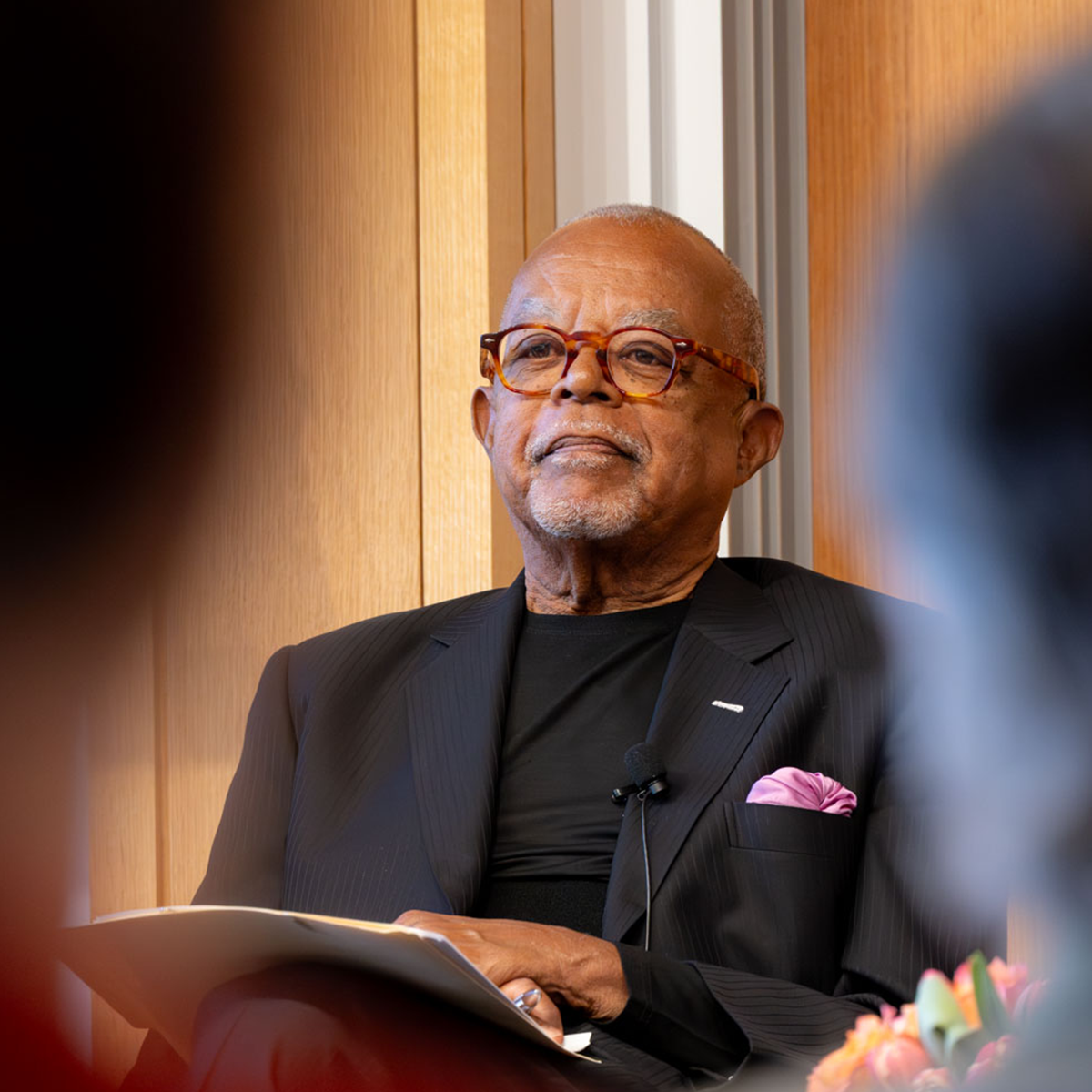
Henry Louis Gates, Jr. Photograph by Melissa Blackall
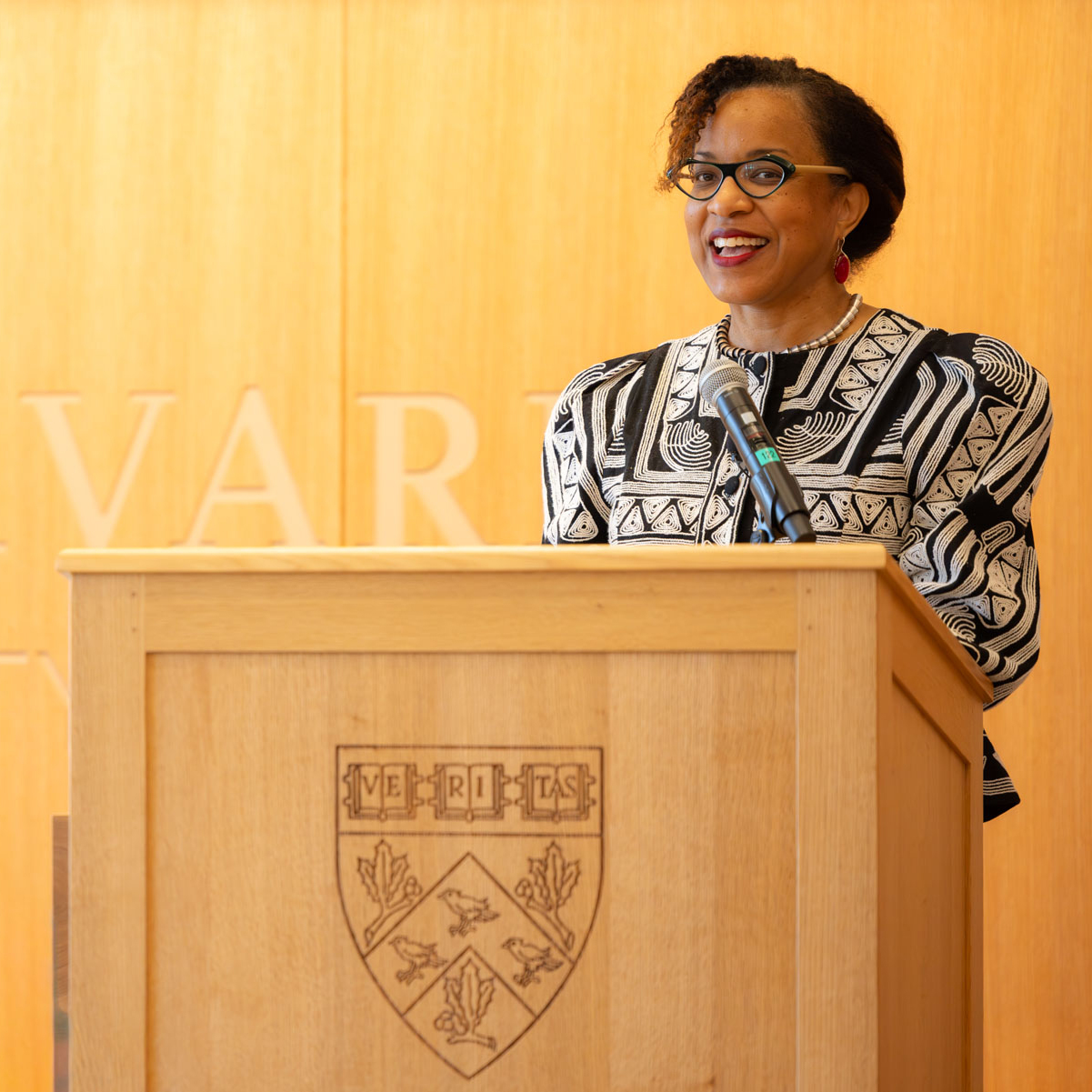
HDS Dean Marla F. Frederick delivers opening remarks. Photograph by Melissa Blackall
As Frederick emphasized in her opening remarks, the discussion was organized to promote peace across religious and cultural divides—a cornerstone of the School’s vision.
“Now more than ever, it is vital to engage in dialogue across difference, to connect with the hope that as we learn more about each other, our worldview becomes more capacious,” said Dean Frederick, who also served as the conversation’s moderator.
Debra Adams Simmons, editor-in-chief for special editorial projects at GBH, reflected on Gates’s 30-year partnership with PBS, during which time his projects “transformed the way viewers understand the American experience.”
“Professor Gates has spent decades teaching us that while our individual stories are unique, our histories are inextricably linked,” said Simmons.
Gates emphasized that the series is meant to reignite a sense of shared purpose between Black and Jewish communities at a moment of renewed strain.
“I thought it was time to remind our two groups that though there are major issues about which we would disagree, we share enough in common that we need each other in this fight,” said Gates.
Heschel’s connection to the project was deeply personal. Her father, Rabbi Abraham Joshua Heschel, was an integral Jewish leader in the Civil Rights Movement, working closely with the Rev. Dr. Martin Luther King, Jr., during several campaigns, including the Selma to Montgomery march. As Heschel attested, the partnership between her father and King serves as a model for what is needed today.
“It is a challenge. It’s something that needs to push us forward because the work is not over at all,” said Heschel. “We need strong alliances. We need each other.”
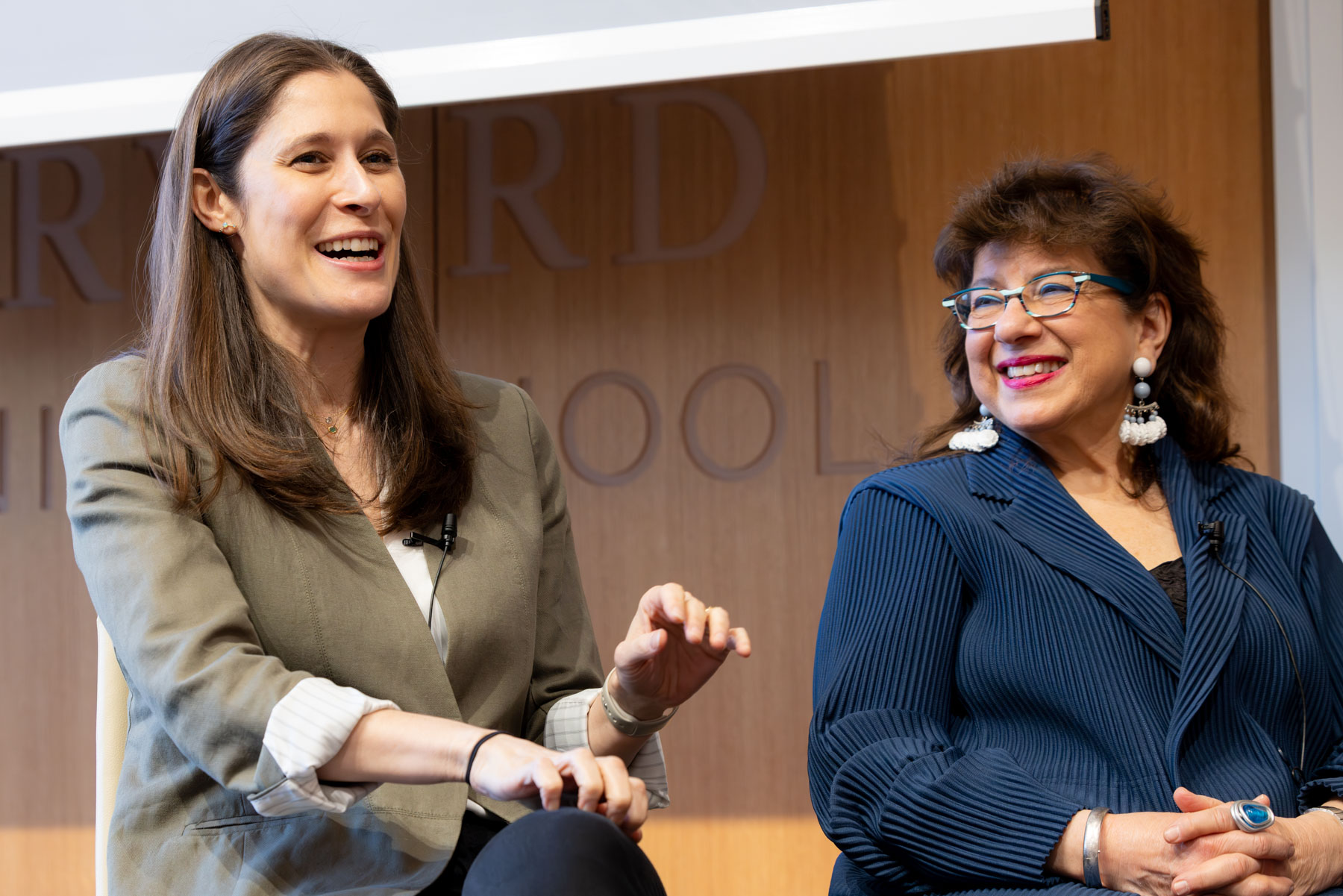
Co-producer and director Sara Wolitzky speaks during the panel discussion as HDS Visiting Professor Susannah Heschel looks on. Photograph by Melissa Blackall
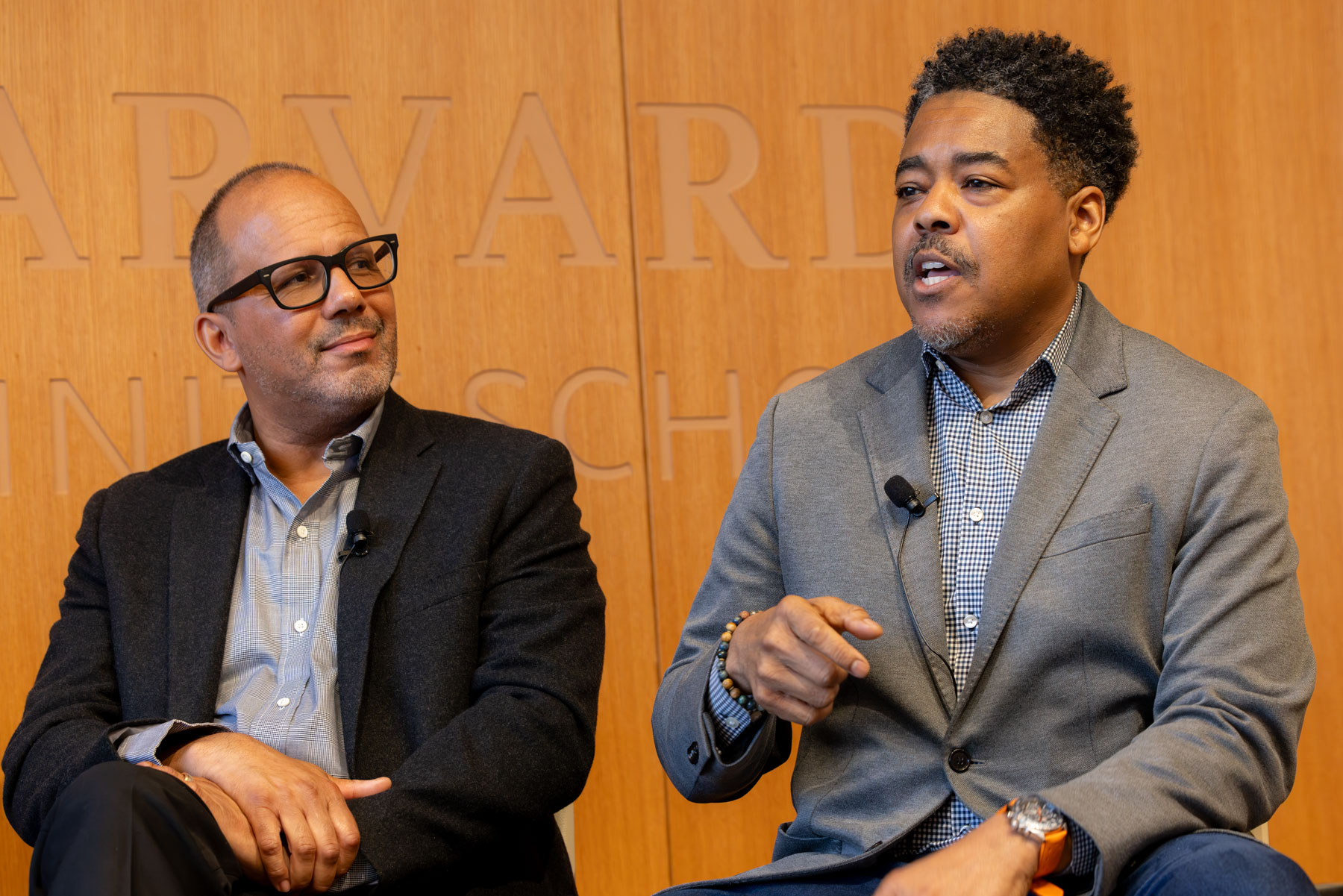
Co-producer and director Phil Bertelsen listens as HDS Professor Terrence L. Johnson speaks during the discussion. Photograph by Melissa Blackall
Wolitzky and Bertelsen shared insights into the unique power of visual storytelling. For Wolitzky, this project was an opportunity to say something essential about the identity of this country.
“It was exciting to tell a complex history and not a straightforward one—one that took these seemingly disparate groups and experiences and examined how they are interwoven,” said Wolitzky. “The project shows the best of America as well as some of its fault lines. We hope it reveals more about the American story in general.”
Bertelsen spoke about the documentary’s ability to bring contemporary audiences near to the heart of history. “People like to leave history in the past,” he said. “We get the opportunity to bring history into the present moment, to put flesh and bone on the story, faces to names.”
In highlighting the historical ties between the two communities, the panel did not gloss over moments of division—particularly in the period following the Civil Rights Movement. Wrestling with the reality of these complex issues, the participants reflected on discord, difference, and the hard work of coalition-building.
“Creating strategic partnerships is possible without loving each other in the weak sense,” said Johnson. “A bigger theological love is certainly possible. But I think we can organize around real commitments and leave the other issues to the side.”
In his closing remarks, Gates stressed that coalition-building is, at this moment, a matter of existential necessity.
“Coalitions endure only if everyone accepts that they are provisional and partial by nature,” said Gates. “They rest on the discipline of not policing disagreements but capitalizing on convergences. And that is the only way we will survive.”
Banner photograph by Melissa Blackall.
[MUSIC PLAYING]
SPEAKER 1: Harvard Divinity School.
SPEAKER 2: Black and Jewish America-- An Interwoven History. March 25, 2026.
MARLA FREDERICK: I would first like to acknowledge the many people who made this event possible. To the teams from GBH, Harvard's Hutchins Center for African and African-American Research, and the Center for Jewish Studies, as well as colleagues across the Harvard Divinity School community, we cannot thank you enough for your time and care. And to each of you for joining us for what I am sure will be a vibrant conversation. Thank you for your time, your care, commitment to knowledge as a force for good in the world.
As you well several divisions and conflicts around the globe and here at home have come into starker contrast over the last couple of years. Now, more than ever, it is vital to engage in dialogue across difference, to connect with the hope that as we learn more about each other, our worldview becomes more capacious.
Here at HDS, we are a multi-faith and multifaceted community committed to rigorous intellectual engagement and civil debate. Our primary focus is education, with an emphasis on empathetic and ethical leadership across faith traditions, the field of academia, and all professional sectors in service of a just world at peace across religious and cultural divides.
I hope you witness those shared values and commitments here today. May the work of our special guest, Professor Henry Louis Gates Jr.
[APPLAUSE]
Indeed. And the work of all those he has inspired with this empathetic and ethical leadership inspire you as well.
To set the stage, I would like to begin with a description of the work we are here to discuss. Black and Jewish America-- An Interwoven History is a four-part series tracing the rich, complex relationship between Black and Jewish Americans, defined by solidarity and strained by division, drawn together by racism and anti-Semitism, they forged civic and cultural bonds, especially during the Civil Rights Era.
The series explores both the challenges and enduring promise of that alliance. This work could not be more timely. And I'm deeply grateful that Skip welcomed my invitation to host this vital conversation.
I would now like to invite Debra Adams Simmons, editor-in-chief, special editorial projects of GBH, the leading multi-platform creator for public media in America, to the stage. GBH has been instrumental in helping bring this series to life. So please offer Debra and the whole GBH team a very warm welcome.
[APPLAUSE]
DEBRA ADAMS SIMMONS: Thank you, Marla. And good afternoon, everyone. GBH is honored to partner with Harvard Divinity School for this important and timely conversation. Today, March 25, we are gathering on the International Day of Remembrance of the victims of slavery and the transatlantic slave trade. It's also the 61st anniversary of the day Martin Luther King Jr. completed the 54-mile Selma to Montgomery Voting Rights March. And Jewish families are preparing for next week's Passover holiday.
I am thrilled to represent GBH on behalf of our CEO, Susan Goldberg. And I first encountered professor gates in the mid 2000s, when I was the editor-in-chief of the Cleveland Plain Dealer, the daily newspaper there. And he was the jury chair of the storied Anisfield-Wolf Book Award. Led by the Cleveland Foundation, Anisfield-Wolf is the only juried American book prize specifically focused on works that have made important contributions to our understanding of racism and human diversity.
But I learned of him about 20 years prior as a college student, as one of my mentors was one of his peers. I'm also thrilled to be back on Francis Avenue, where I spent quite a bit of time down the street at Lippmann House and here at the Harvard Divinity School during my time as a Nieman fellow.
For more than 30 years, Skip's treasured partnership with PBS and GBH, as Boston's leading public media organization, has transformed the way we understand the American experience. From his groundbreaking weekly series, Finding Your Roots, to this latest four-part series, Black and Jewish America-- An Interwoven History, Professor Gates has spent decades teaching us that while our individual stories are unique, our histories are inextricably linked. And that is what public media, the most trusted media institution in America, is all about-- sharing stories that matter when audiences need them the most.
This series has started a national conversation about American history, civil rights, the arts, and Black and Jewish culture. We're living in a time when our political and social landscape feels increasingly and urgently fractured and when anti-Semitism and anti-Black racism are alarmingly on the rise. So it is with impeccable timing that Professor Gates returns to the classroom of history to uncover a deep, complex legacy of solidarity, struggle, and resilience between Black and Jewish people.
I can't think of a more urgent conversation that needs to be happening now to strengthen our democracy and our shared humanity. This International Day of Remembrance is a moment for reflection, for education, for truth telling, and for dialogue. On behalf of everyone at GBH, thank you for being here. And I'd like to extend a special thanks to our members for your continued support.
To get us started, I'd like to introduce the series trailer for Black and Jewish America-- An Interwoven History, which is available to stream now on the PBS app. And I look forward to the discussion with our distinguished panelists.
[APPLAUSE]
MARLA FREDERICK: Thank you, Debra, for your warm welcome. And I would now like to invite our panelists to the stage as I offer brief introductions. So please come forward. Maybe you can come.
I emphasize brief introductions because our guests have worlds of experience. And we have a conversation to get to. So I'm going to introduce them as they come.
Professor Henry Louis or Skip Gates Jr., is the Alphonse Fletcher University professor and director of the Hutchins Center for African and African-American Research at Harvard University. An award-winning filmmaker, literary scholar, and institution builder, he has published numerous books and produced and hosted an array of documentary films about Black history. He holds more than 60 honorary degrees and numerous prestigious awards. Among the most recent are the Spingarn Medal from the NAACP and election as an honorary fellow by the Royal Academy of Arts in England.
Terrence L. Johnson is the Charles G. Adams professor of African-American religious studies, professor of African and African-American studies and FAS, and director of the Religion and Public Life Program here at Harvard Divinity School. His research interests include African-American political thought, ethics, American religions, and the role of Religion in Public Life. Johnson's interdisciplinary research agenda is historical, critical, and constructive. He is an award-winning author of several books and an alumnus of Harvard Divinity School.
Susannah Heschel is the Joseph Engel visiting professor here at Harvard Divinity School and at Harvard University, and a visiting professor in Jewish Studies here at HDS. She joins us from Dartmouth College, where she is chair of the Jewish Studies program and a faculty member of the Religion Department.
Her scholarship focuses on Jewish and Protestant thought during the 19th and 20th centuries, including the history of biblical scholarship and the history of anti-Semitism. She has authored several books, edited many volumes, and written numerous articles in English, German, and Hebrew. She is also an alumna of Harvard Divinity School.
[LAUGHTER]
Excuse me. Phil Bertelsen is a director and producer who harnesses the power of film and television to entertain, inspire, and challenge audiences with a diverse body of award-winning work that includes documentaries for Netflix, NBC, PBS, and Paramount. Bertelsen's storytelling delves into overlooked aspects of history, emphasizing the critical role that Black history plays in the broader narrative of America. He is the co-executive producer and director of the series Black and Jewish America-- An Interwoven History. And he too could become an HDS--
[LAUGHTER]
Sara Wolitzky is an Emmy-nominated filmmaker dedicated to creating emotionally resonant and socially conscious documentaries. Most recently, she served as a director and co-executive producer of the series we will be discussing today. She previously served as supervising producer on HBO'S Ms.-- A Revolution In Print. And on Dr. Gaetz's Webby Award winning series, Black History in Two Minutes or So. Earlier in her career, she directed Not Done-- Women Remaking America, which was nominated for a news and documentary Emmy. And guess what? She too could be an alum of HDS.
[LAUGHTER]
So I will-- with those introductions, I will begin our conversation.
HENRY LOUIS GATES JR.: Thank you, Marla. That was great.
MARLA FREDERICK: I so thoroughly enjoyed watching this documentary series, every minute of the four-part series. It is powerful, groundbreaking, insightful. And it gives us so much food for thought for this particular moment. And so, Skip, I want you to please tell us about why you decided to make this film. Films take a lot of time to gestate. But the timing of this particular series feels especially acute. What inspired you to want to make this film and why now?
HENRY LOUIS GATES JR.: Well, the tipping point for me, Marla-- first of all, give it up for Marla Frederick.
[APPLAUSE]
And it's so nice to be in Schwarz Hall. I have a group of-- Dyllan McGee is my film partner. And we have a group of supporters called the Inkwell Society. And many of you know that's named after the Black section of the beach in Oak Bluffs. Ken Burns is a Better Angels Society. So I'm always trailing Ken. Where's Ken? What's he doing?
So we created the Inkwell Society under the leadership and the advice of Jim Schwartz, the same person and his wife, Susan, whose generosity we are sitting in today in Schwartz Hall. And they're here. Give it up for Jim and Susan Schwartz please.
[APPLAUSE]
You can at least wave.
[LAUGHTER]
And Jim is the chair of the Inkwell society. And I love him. And I love Susan. The tipping point for me was Charlottesville. Mary Ellen, my wife, and I were watching CNN. And I saw all these lunatics. And they were chanting something. And I asked Mary, what the hell are these guys saying? And finally, we figured out "Jews will not replace us." What in the world did that mean? And then, they were carrying those Confederate flags.
And this is just two years after the horrible murders of the worshippers at Mother Emanuel AME Church in Charleston. The minister there was Reverend Clementa Pinckney. And I did the last interview that he ever gave. And so that tragedy was extremely personal for me. So I knew I had to do something because both Blacks and Jews were under attack. And we needed to be reminded of the fact that we need each other to fight this mutual hatred. And then of course, came the horrible Tree of Life murders in Pittsburgh a year later in 2018. So I knew it was time.
Dyllan and I began to prepare. We got some development money from Georgette Bennett, who's a philanthropist and very active in Jewish causes and has been a big supporter of my work on PBS. And then, that was 2022. And then, we turned to Sara Wolitzky and asked her to write a treatment, doing a documentary. As you said, you have to walk up a lot of steps.
And unlike PBS-- I tell my friends. I have all kind of friends on the faculty of Harvard. They said, they just published a book. And they say, hey, you think PBS will-- would you ask PBS if they'll make a documentary about that? And I go, sure. So I'll call someone at GBH or WETA, which is my station and Ken Burns' station in Washington. And the CEO's chairman, Rockefeller. So I'll say, so-and-so has written a book about such and such. Well, would you be interested in doing it? And she goes, yeah.
So I call him. And I say, well, I have good news and bad news. They said, well, what is the good news? I said, PBS will do-- They're willing to do your documentary. And they go, what possibly could be the bad news? The bad news is that you have to raise all the money.
[LAUGHTER]
Unlike for Netflix or Amazon, they would pay the whole thing. So PBS said yes. Now, obviously, we could have absolutely no idea that a war would break out some 10 months after we began to film. And I remember thinking and talking to Mary Ellen, thinking, oh, my god. What have I gotten myself into? This is the worst possible timing ever to do this series. And it turned out it was the best possible timing.
As some of my students in this room know, I would begin my big lecture course at Harvard with the following sentence. Under the floorboards of Western civilization run two streams. One is anti-Semitism. And one is anti-Black racism. And anytime any demagogue needs a scapegoat, all they have to do is lift up those floorboards and dipper out any of that hatred. And when they do, what do they find? They find us. They find you. They find me.
Do you that in the 1930s, the Nazis got their playbook where? From Jim Crow America. They didn't have to have some evil genius invent it. It had already been invented. And all they did was import it. And one of the biggest surprises, for me-- and there were many-- doing this series, was that the word racism was not used in terms of discrimination against Black people until World War II.
I did a word search, which now is very easy with AI, of the works of Frederick Douglass and the canonical works of W.E.B Du Bois. The word racism never appears. They would talk about discrimination and prejudice. The word racism was imported into the discourse in America to describe prejudice or against Black people only during World War II from the uses by the Nazis vis-a-vis the Jews in terms of an inherited stigma, an inherited stigma, something that you can't do anything about, something that's determined by God, by the devil, by nature, by biology, whatever floats your boat.
Racism originally defaulted to anti-Jewish animus. And it was the rise of the postwar Civil Rights Movement that that default shifted. And that's when Americans began to see that Jim Crow was cut from the same cloth as the murderous ideology of the Nazis. And this led Jewish Americans understand, I think, that their own security was bound up with the dismantling of caste in America. And that's just one of the many ways that we're connected.
And we're connected in a final way, statistically, hate crimes. Between 2015 and 2020 for hate crimes, hate crimes roughly doubled. In that same period, anti-Black hate crimes increased by about 81%. Anti-Jewish hate crimes more than tripled, more than tripled. And in 2024, just over 50% of race-based hate crimes were directed against Black people. And what percentage directed against Jews, the religious hate crimes? 2/3.
Al Sharpton, as you heard in the trailer, pointed out that people were anti-Semitic, people hate Jews, also check the box for hating Black people. And the first person to say that was Fanon, in Black Skin, White Masks in 1952, in which he said, the anti-Semite is a Negro-phobe. The anti-Semite is a Negro-phobe. And I remember Jim and Susan. I read that as a sophomore at Yale. And it knocked my socks off. I thought, whoa, I never thought about that.
So given these alarming statistics, given the amount of hatred directed toward our two groups, given the political climate in our country and the rise of the right wing, I thought it was time to remind our two groups that though there were major issues about which we would disagree, issues upon which we would never agree, we shared enough in common that we needed each other. And what do we share in common? The same group hated us both.
This is a series about the war against white nationalism. It is a wake up call for Black people and Jews to put aside their differences, agree like a marriage to disagree and fight the good fight. And that's why I made this series.
[APPLAUSE]
MARLA FREDERICK: Skip, just as a quick follow up question for you, what were the personal stakes for you in making this film? How did it become such an important story issue for you? What has the Black-Jewish alliance meant for you personally?
HENRY LOUIS GATES JR.: Well, we tell a story of a woman. I grew up in a paper mill town halfway between Pittsburgh and Washington. And all my family on all sides-- my mama's side, the Coleman side, and the Gate's side-- back 200 years have lived within a 30 mile radius of where I was born. And that's rare for anybody in this room. I don't think another person of whom that's true. My family never moved. They moved 30 miles down the Potomac River. That was it.
And my particular town was an Irish-Italian paper mill town, heavy on the Roman Catholic Church. There were three towns connected by bridges on the Potomac, two in Maryland, one in West Virginia. Piedmont is right on the Maryland-West Virginia border. One Jewish family in that collective of about 7,000 people the year that I was born, I would guess, in 1950. One Jewish family, the Mamolens.
And at some point when I was about 10 years old, Mrs. Mamolen invited Mrs. Gates, my beautiful mother, over for tea. And that was widely commented upon. Those schools integrated in my county, Mineral County, West Virginia, in 1955. Remember Brown v Board is '54. Schools integrated in my county in the hills of West Virginia in 1955. No Rosa Parks. No Martin Luther King. The white people just voted.
We had a theory. Basketball was really big in West Virginia. So we had a theory that maybe even racists decided the basketball team would be better. So nobody knows why they did it. So I started school, first grade, in 1956. But there were no Jews there. There's one Jewish family lived across the bridge in Westernport, the Mamolen family. And the paper was made out of wood, out of trees. It was called the pulp and paper mill. And Mr. Mamolen was smart enough to buy the forest. And they chopped down the trees and feed those trees to the paper mills. So they were very well off.
Despite the fact that I started first grade with white kids, I never, ever was invited to a meal at any of my friends' homes. I would go pick them up. Maybe I would go in the kitchen, which was polite in our society. You enter the kitchen. That wasn't Black specific. That's the way we always did it. But I never once-- other than maybe a glass of water, I never was invited to have a meal at any of my white friends' homes.
So for my mother to be invited to have tea, high tea in the afternoon, that was a big deal. And you should have seen my mother, man, she was dressed to the nines. And then, Mrs. Mamolen decided that-- and Mrs. Gates-- that their two brilliant little boys should be friends. So I got a reading. I went to Exeter briefly. I'm a famous dropout from Phillips Exeter Academy.
But I got list of 100 books that every educated person was supposed to have read. And Mark and I spent one summer reading a lot of books like the Catcher in the Rye and A Separate Peace, and books like that. And he went off to a Military Academy. And he and I became-- he eventually graduated from the University of Chicago Law School. He worked with the Pritzker Family.
He made a fortune. He owned a beautiful home on Sunset Island, number one, in Miami Beach, where my wife and I, when we were dating. She would come over from Havana. She's right there. And we would spend time in Mark's guest house. That's the most delicate way I could put it in the Divinity.
So I had a very good, close Jewish friend. And the punchline of this is that despite the fact that Mark was sent away to school, his family, as I said, was very wealthy. He didn't get into-- he was dying to go to Harvard. And he didn't get into Harvard. He didn't into Yale. He didn't get into Princeton. He'd get in any of his major schools.
And it really blew his mind. He ended up going to America. And there's nothing wrong with American University. But he really wanted to go to Harvard because his cousin was president of MIT. And they summered in Martha's Vineyard. And he had Harvard on the brain.
I wanted to go to Yale. The colored kid whose father was a worker in the paper mill, the kid who ends up at Yale. And Mark could never figure out why. So after he became wealthy-- and the story is almost over. the military school, which he hated, hustled him for money. And he said, I will make a substantial donation if you let me have access to my school records. And you know what he found?
There was a letter written by the dean who hated his guts, that basically said, keep this Jew boy running. It was an anti-Semitic letter that said no school that was worth its weight should let this kid in because he had been such a bad citizen and such a rebel at this military school. And that scene and the language I use echoes a scene-- as most of you know-- from Invisible Man. Keep this nigger boy running. That was almost the same language that this racist guy did. And all those years that Mark suffered from a wound that was caused by anti-Semitism. I mean, can you imagine how ironic our two fates were?
And finally, of the many mentors, generous mentors that I've had, the only reason I'm sitting here is because I've had great mentors. Two of the most important were Jewish. And one at Yale was my advisor in the history department, John Morton Blum. And the other was a man who hired me at Harvard, Henry Rosovsky.
John Morton Blum told me-- I went to him junior year. And I said, what am I supposed to say? At Yale, you weren't supposed to call people doctor. You're supposed to call them mister. And I later found out that was because some people were teaching with master's degrees and some people with PhDs. And they didn't want the people with master's degrees to be offended. So I said, Mr. Blum, what do I say when kids say, I only got into Yale because I'm Black. And he goes, well, you're from West Virginia, right? And I go, yeah. He said, tell them you only got in because you're from West Virginia.
But then he said, I want you to tell him this. You tell him that-- he said, I'm the first Jew who was hired in the history department at Yale. And in order to be hired, I was told I had to be converted to the Episcopal Church, my wife's church. So he said, I always want you to remember that the first Jew to teach in the history department at Yale is an Episcopalian. Isn't that amazing thing? And I just-- I couldn't believe it.
And then when 34 years ago, Nathan Huggins-- 35 years ago, Nathan Huggins died. The Department of Afro-American Studies was in shambles. And for whatever reason, Harvard decided to hire me and ask me to rebuild it. And of course, Anthony Appiah, he was part of the deal, my very best friend. And I was smart enough to know-- I think I'm reasonably intelligent person. But I wasn't more brilliant than the other people before me who had been chairs of the Department of Afro-American Studies. And they had all failed. And so there must have been a structural reason for their failure.
And so I was smart enough to ask Henry Rosovsky to teach me the culture and sociology of Harvard, to teach me how to be successful here. And he looked at me. And he said, what do you want to learn? I said, well, I want to learn where the bodies are buried in Harvard Yard because you put them there. And he said, young man, that's the smartest thing that you ever asked for.
And every two weeks before February, between February 1, 1991 and July 1, 1991, when I started my job here, Rosovsky flew me up from Duke, where I was miserable as a professor. He flew me up. And he had me talk to people. He gave me lessons. He told me stuff that no professor was ever supposed to know.
And I would meet with him at the end of the day because I'd read his book called The University-- An Owner's Manual. And he said he did his best negotiating with Nobel laureates he was trying to steal from MIT or Yale or University of Chicago or Stanford. At the end of the day-- and he'd give them this special sherry that he kept in this wooden case.
So the secretary would say, Dean Rosovsky is free in the morning. Are you? I go, no, I'm not free. How about lunch? I go, no, only the end of the day. So I'd walk in. We'd crack open that sherry. And the more sherry we drank, the more bodies he found buried out in the park.
So I owe so much of my success to two people who happen to be a Jewish and who told me that I could do it. John Blum was the first person to tell me I could be a professor. He said, you could be a journalist or a professor. And I said, well, isn't there a difference? He said, no. I mean, a journalist is like a New Yorker writer. Or you could be a professor. And for that, I was raised, ladies and gentlemen, to be a medical doctor.
But to hear that, I went home and cried. It was the laying on of hands. And Rosovsky, the only reason that I have been successful, insofar as I have been, I had a pretty good track record until I hired an expert on religion.
[LAUGHTER]
The only reason I was successful was because of Henry Rosovsky, whom I called godfather and whom I eulogized at his funeral. So for those three reasons, this is very personal to me.
MARLA FREDERICK: One of the things that makes this documentary so powerful is the historical clips and the way they're so brilliantly woven together. And so Phil and Sara, would you talk to us a bit about the importance of visual storytelling and what drew you to this project?
PHIL BERTELSEN: Well, Sara was first to the project. I'll let her speak.
SARA WOLITZKY: Sure. Well, thank you, first of all, for having us and being interested in this. It's an honor to be here. And we're the non-academic heavy hitters here. But what we do bring to the table-- and I think this speaks to your question, of course-- is hopefully translating some of the great work that folks like Skip do into storytelling. And PBS is a long-- Skip's long-time partner for that, making it accessible for the public.
And I think with all of these things-- well, what drew me to the project-- and I think Phil as well, though he can speak for himself-- is it was really exciting to have an opportunity to tell a really complex and complicated history, and not a straightforward one, one that took these two, what could be seen as, disparate groups and experiences in America and looked at how they were interwoven and really ways that expose the best of America and a lot of the fault lines of America. And so it was hopefully going to reveal a lot more about the American story in general.
Of course, any chance to work with Skip because he brings is really, really unique in our documentary world, bringing this rigorous, scholarly standards, but being interested in and knowing that the way to bring that to the public is to marry it to great storytelling and visuals and then have an opportunity to interview some of the best minds out there, Susannah and Terrence, to tell those stories.
So I think it's like anything there. There have been a lot-- there have-- there was a phase where there were a lot of books written about this topic. I think it kind of was starting to become less remembered history. But there hadn't been that-- It didn't seem like there had been that many documentaries and film projects and cultural artifacts like that.
So it was really exciting to think that we could introduce one that-- we go back to 1492. We try to tell the really long arc of this history because it feels like we get trapped a little bit in the moment. And then, especially as Dr. Gates referred, we were in this moment making it of the war in Gaza and this very particular moment. And it felt really important to excavate the history and remind us of the long, good and bad history.
So it was a treat to come to it. And I think-- Skip told his personal story. I won't bore you with mine. But I think everyone who touched the project, either behind the camera, the team that we built, and every person that sat in that interview seat, even if they happen to be there because they were an expert in such and such, it would turn out that they had a very personal connection to this topic. We found that over and over again.
For me, I grew up with-- even though I wasn't a particularly religious family, their Jewish identity in general felt like it was centered around this idea that the Passover, Seder line of never oppress a stranger because you were a stranger in the land of Egypt type of spirit. And at the same time, grew up with a grandmother who was direct pogrom survivor and hearing those stories. But just two generations later, living a life of a white, privileged, white American, and trying to reconcile that. So it was exciting to be able to dive into those personal strands of history and this bigger story.
And, Phil, I don't know if you want to--
PHIL BERTELSEN: Well, I'll just say briefly that I'm just indebted to Dr. Gates for his body of work and his continued just scholarship and documentary storytelling about our history, our shared history, our collective history, which is American history. And the thing about history is that it tends to-- people like to leave it in the past. And what we get the opportunity to do is bring it into present day.
And what visuals do is put flesh and bone on the story. It puts faces to names. You get to see Rosenwald in Washington standing together. You get to see the plans for the schools that they built together. You get to see Jesse Owens and Marty Glickman in the '36 Olympics. This brings history to life and reminds people that we are, in fact, descendant of that history.
We are caretakers of that history. And it is our job and responsibility to build on it and not to go back. And so I feel like, for me, as a documentarian, that's the greatest opportunity is to bring life, bring face, bring body and humanity to history. And so it's beyond the story. It becomes the human existence that we all share.
MARLA FREDERICK: And Terrence and Susannah, can you tell us a bit about the history of the Black and Jewish communities, the early alliances, particularly around education and the Civil Rights Movement? What are some of the surprising people and stories we meet in the series?
TERRENCE JOHNSON: Susannah.
SUSANNAH HESCHEL: I think she's looking at you.
[LAUGHTER]
She mentioned your book.
TERRENCE JOHNSON: No, I mean, yeah, Jacques Berlinerblau and I wrote co-wrote a book called Blacks and Jews-- Invitation to Dialogue. And, I mean, I think some of the major stories are really around religion and spirituality and the ways in which both Blacks and Jews were able to embrace the ways in which they were demonized for things they could not control in terms of-- for African-Americans, this idea that they were absence of humanity without a soul.
For Jews, it was that there was something corruptible with their blood. And yet, they both found interesting ways to appropriate scripture, religious themes around the Exodus. In some ways, both to reify who they are as a people, but also to push against a country that wanted to destroy them and often destroy them over and over again. And I just find that really kind of interesting. Those kinds of stories that we don't often hear about Blacks and Jews.
And I think from my perspective, I always found it kind of odd that in my Black Baptist church, that we would refer to Queen Esther as someone Black women would really get fired up about because she spoke to the king. And yet, I knew there was something called Judaism. But we didn't talk about Judaism per se. But we talked about Queen Esther as related to Black folk and to our struggle.
And I think about Aretha Franklin in terms of this idea of using Lazarus to tell a story about meeting Moses on the banks of Jordan. And in some ways, these stories tell the richness of how we have used spirituality to fuel our political purposes. But there's also a hidden story that Skip refers to in terms of I grew up admiring Jews, in part, because what my family said was also deep distrust.
And distrust is also then guided by a kind of strange love because it was like there was a Jewish family, one Jewish family on my grandmother's block. And everyone knew you don't mess with them. They were off limits. And you could harass anyone else in the neighborhood, but not the Jewish family. And I couldn't figure out all these odd ways in which we interacted.
And so part of, I think, what drew me to this work is just having recognizing the silences that both bring us together, but also that keep us apart, and the ways in which, as Baldwin talks about, Christianity is at the heart of all of this in some ways, in terms of reifying this old notion that there is this cross that destroyed both of us.
HENRY LOUIS GATES JR.: And for as much as we are dependent as Christians, of course, on the New Testament, some of the most vivid subjects of sermons, other subjects of spirituals and gospel music are scenes from the Hebrew Bible. Shadrach, Meshach, and Abednego, it took me 20 years to learn how to spell all that.
But they were in the fiery furnace. And Daniel in the lion's den. And Ezekiel saw the wheel. I mean, the Old Testament is full of these great stories. And these Africans learned English, their own African-American English, by reinventing the Hebrew Bible, these stories in their own images. It's amazing. So symbolically, we've been connected since slavery time.
TERRENCE JOHNSON: And then Edward Blyden writes the Jewish question in 1898 from the Caribbean thinking through what is it about the Jewish problem, the Jewish question that links to African diaspora and the slave trade?
HENRY LOUIS GATES JR.: Yeah.
TERRENCE JOHNSON: Thinking about Zionism in a very, kind of, socialist, very complicated way.
HENRY LOUIS GATES JR.: And Jewish newspapers use the word pogrom to describe lynchings in the South in the first decade of the 20th century and the last decade of the 19th century because lynchings really only start after 1890. Because that's when the imposition of Jim Crow unfolded with the real rollback of Reconstruction. That was the myth of the Black man as rapist. It didn't obtain in the Civil War.
You won't find one story, the whole Civil War, of a Black man being accused of raping a white woman, even back on the plantation with all the white men all fighting the North. It was an invention, a racist invention that starts in 1890. But the Jewish newspapers, like the Forward, et cetera, always referred to these lynchings as in the same way that the lynchings of Jews in Europe were referred to, as pogroms.
SARA WOLITZKY: And vice versa, and the Black newspapers were covering the Jewish-- the violence going on in the Russian Empire, Pale of Settlement, and comparing it to what was happening to them and saying, these are bloodhound hunts and whatnot.
MARLA FREDERICK: Susannah, what are some of the alliances that stand out for you?
SUSANNAH HESCHEL: I would just want to add to this that the importance of the Hebrew Bible for the Civil Rights movement meant a great deal to my father, who came from Eastern Europe, originally from Warsaw. And he had studied for 10 years in Germany, including after '33, when Hitler came to power.
HENRY LOUIS GATES JR.: Who was your father? What was his name?
[LAUGHTER]
SUSANNAH HESCHEL: Rabbi Abraham Joshua Heschel, who is mentioned in the film. And he--
HENRY LOUIS GATES JR.: Was mentioned in the film. The most important Jew in the history of the Civil Rights Movement in America and race relations and the man who, Cornel West got his sartorial--
[LAUGHTER]
SUSANNAH HESCHEL: Prophets, prophets. But when my father was in Nazi Germany, there were Protestant theologians who said, the Old Testament is a Jewish book and should be eliminated from the Christian Bible. So we came to this country. And there's Dr. King making the Hebrew Bible the centerpiece of the Civil Rights movement, which was a movement that was also very much a religious movement, an ecumenical movement.
And that was-- you know, the other thing I have to say, my father's relationship with Dr. King was very deep, but also with other civil rights leaders. And I'm very struck that of all the different parts of the world where my father interacted with theologians, with them, with Catholics, with Jews, with rabbis, and so on.
But the Civil Rights leaders, whenever I have seen them over the years, they hug me. And they say to me, we're so grateful for your father. And I'm struck by that, that 60 years later, they feel grateful. And this tells you something about what extraordinary people they are.
I think for my father, this was something very important, his friendship with Dr. King and with the other leaders. I felt-- Reverend CT Vivian, who recently passed away, was something holy about him, extraordinary person, and so many of the others. And yes, I think that Civil Rights Movement helped my father recover. It helped Jews recover from what had happened. And it gave us pride in being Jewish in the Bible.
At the same time, I also want to say that my father's relationship with Dr. King was not something that was celebrated when my father was alive. Nobody was talking about the Selma March, for example. It was really much later. It was in the late 1970s that I noticed that Jews started to talk about my father's relationship with Dr. King and Selma and so forth.
And I was a little uncomfortable with that. And I often feel that Jews today will have the photograph of the Selma March in the children's textbooks or in a rabbi's office and so on. And they're proud of it. It's not something to be proud of. It's a challenge. And it's something that needs to push you because it's not over at all.
I agree with what you said before. We're losing. We're losing influence as Blacks and Jews in this country. We need alliances. We need to be allies. We need each other. We need each other politically. And I would just say as a Jew, I have a feeling that we're wobbling as Jews with our moral compass. Haven't lost it entirely, but we need support. We need religious support, moral support, ethical support. We need support because we're very unsteady these days.
And so we need you. We need the voices. We need the allies. This is very important. And we, of course, want to give too. We want to reestablish, as you have said, the alliances, the friendships, the closeness, and build on the gratitude. Because I certainly feel enormous gratitude for what Dr. King gave to my father.
[APPLAUSE]
HENRY LOUIS GATES JR.: But you can't underestimate-- never underestimate the importance of your father's presence. Your father was the man. And to have him there willing to die, that just sent a message, a visible message, beyond words. And the presence of other rabbis, in St. Augustine, 16 rabbis were arrested one day. Big headlines in The New York Times.
One of the most moving moments for me, Marla, this is on my list of things I learned is that Rabbi Dresner. Rabbi Dresner said to MLK, Martin, you keep talking about slavery. Slavery for Jews ended in 1945. The Germans enslaved us. The Holocaust, the Holocaust was a form of enslavement. And when I heard that, it just knocked my socks off. I mean, that's true. He said slavery is 20 years ended for Jews. And slavery ended, for you, a lot longer. And that was very important Martin Luther King to see it that way.
And I think that if there's one takeaway that I want African-Americans to get from this series is to think about that fact, that the history of the enslavement of Jews only ended very recently because of the Nazis and the Holocaust.
MARLA FREDERICK: Skip, in the final episode, you say, I think the story of this relationship between Blacks and Jews has something to teach us about difference, division, and about the hard work of coalition building. And so for any of the panelists, just briefly, what do you hope viewers see in this history that will help us look at our moment in a new or different way? What do you see as a kind of call to action from this documentary series?
HENRY LOUIS GATES JR.: Terrence, do you want to start?
TERRENCE JOHNSON: Sure. I mean, I just think it's this idea around you can have strategic partnerships without loving each other in the weak sense. You can have a thicker, theological love. But I think we can organize eyes around real commitments and leave the other stuff to the side. So I'll leave it there.
PHIL BERTELSEN: I'm paraphrasing from the end of the series when Dr. Gates says that you can have politics that are aligned. But they don't have to be identical. And the question isn't whether or not we can afford to form an alliance and regroup. The question is really whether or not we can't afford not to. And so I think that, more than anything, is the call to action for me.
SUSANNAH HESCHEL: I'll let you get the last word. So--
HENRY LOUIS GATES JR.: Yeah.
SARA WOLITZKY: I mean, two things that I hope come out through the series also is in showing both the high points and the tension points of this is that, despite all the similarities with the oppression, there's a lot of difference. And that this alliance is not inevitable. It's a choice. And so much of it came in every step, in every era from relationships, from personal relationships. There were institutional relationships.
But it was a personal relationship. And a lot of that is also, it wasn't just the Middle East issues that dissipated the relationship in the '70s. There's moving away and geographical proximity where there's less of these relationships. So I hope one of the call to actions is in consciously making that choice, not just assuming it's inevitable and it's our fate, but making that choice and relationship building.
And to also paraphrase Skip, he has a great line in an op-ed he recently published in The Wall Street Journal ending that it can't be an unrealistic Pollyanna thing. He has a line about it needs to be building a solidarity that can endure the world as it is. So there has to be a practicality and a realism to it and an honesty. So that's what I would add.
SUSANNAH HESCHEL: Well, keeping in mind that next week will be Passover. And then, comes Good Friday and Easter. And I think it's important for us to remember that evil is never the climax of history, that we can't be stuck in despair, that there has to be hope. And I think this story that's told so well in this series that I hope all of you will watch, is a story of hope that can lift us up. We need it right now.
And I would say also, we in the United States have really damaged our dignity in the way we have been behaving from the highest levels all the way throughout the country. We need to restore our dignity as individuals and as a country. And I do think there are important lessons and help, as well as inspiration, that can help guide us to restore ourselves, our dignity, and our hope.
HENRY LOUIS GATES JR.: I knew you were going to ask that question, so I wrote out a couple paragraphs. Is it OK if I read them?
MARLA FREDERICK: Absolutely.
HENRY LOUIS GATES JR.: And this is from my heart. A coalition cannot be built on ultimatums that force one side to amputate part of its identity or betray part of its kinship. Equally, it cannot be built on ignoring the suffering that others see as central to their moral universe.
The work is to find shared ground-- racism and anti-Semitism at home, poverty, fair housing, educational, equity, the reform, the massive reform, the revolutionary reform of public education in this country, which is the only reason all of us, most of us are in this room, but all of us are on this stage. And to ensure that every qualified American has the right to vote and that right is not taken away by any demagogue sitting in the White House.
Without making any one issue, including Israel and Gaza, the entry fee, the only way forward is pluralism within the coalition itself, allowing for disagreement without rupture. Coalitions aren't covenants of shared worldview. They're provisional and partial alignments of interest. Insisting that every partner sign on to a full platform of ideological positions, that only guarantees paralysis. The real task is identifying where interests overlap enough for us to act together. That doesn't mean disagreements vanish. It means they're bracketed for the sake of action where common cause exists.
And finally, the danger is when one side treats disagreement as betrayal. Coalitions endure only if everyone accepts that they are provisional and partial by nature. They rest on the discipline of not policing disagreements, but capitalizing on convergences. And that is the only way that we can survive as people. That is the only way that we can effectively combat the evil forces that have arisen against both of our groups.
MARLA FREDERICK: That's great.
[APPLAUSE]
[MUSIC PLAYING]
SPEAKER 2: Sponsored by Harvard Divinity School dean's office, GBH, Harvard's Hutchins Center for African and African-American Research at Harvard Center for Jewish Studies.
SPEAKER 1: Copyright 2026, the President and Fellows of Harvard College.