

In Honor of America’s 250th Anniversary, HDS Library Highlights Artifacts Linked to Three Founding Fathers
As the United States marks its 250th anniversary, explore treasured artifacts at Harvard Divinity School Library, including rare items associated with Founding Fathers John Hancock, Samuel Adams, and George Washington.
'The Signature Became a Legend'
Arguably the most famous signature in American history was discovered by chance in the Harvard Divinity School (HDS) Library, a once-in-a-lifetime find that highlights the link between the American Revolutionary period and the legacy of religious education at Harvard.
For some time, rumors circulated among the HDS Library team that the signature of John Hancock, the first signer of the Declaration of Independence and a 1754 graduate of Harvard College, was contained within one of HDS Library’s many historical volumes. Searches for the elusive inscription proved unsuccessful, leading some to doubt the veracity of the claim.
“The signature became a legend on our team—a great story, but something we didn’t really believe existed,” said Nell Carlson, curator of historical collections at the HDS Library.
Then, on a Saturday in 2019, amid renovations to Swartz Hall, Carlson was working in one of HDS Library’s historical collections and happened to open to the cover page of Jonathan Mayhew’s 1763 Christian Sobriety: Being Eight Sermons on Titus 2:6, which Mayhew, also a Harvard College graduate, preached to his congregation at Boston’s Old West Church. At the top of the browning page of the first-edition text was the signature of John Hancock, which has not yet been formally authenticated but, according to experts at Harvard Library, closely resembles known examples of his handwriting.
“When I saw Hancock’s signature, I squealed,” said Carlson. “I ran out of my office telling everyone, ‘It’s real!’ I was like Archimedes jumping out of the tub.”
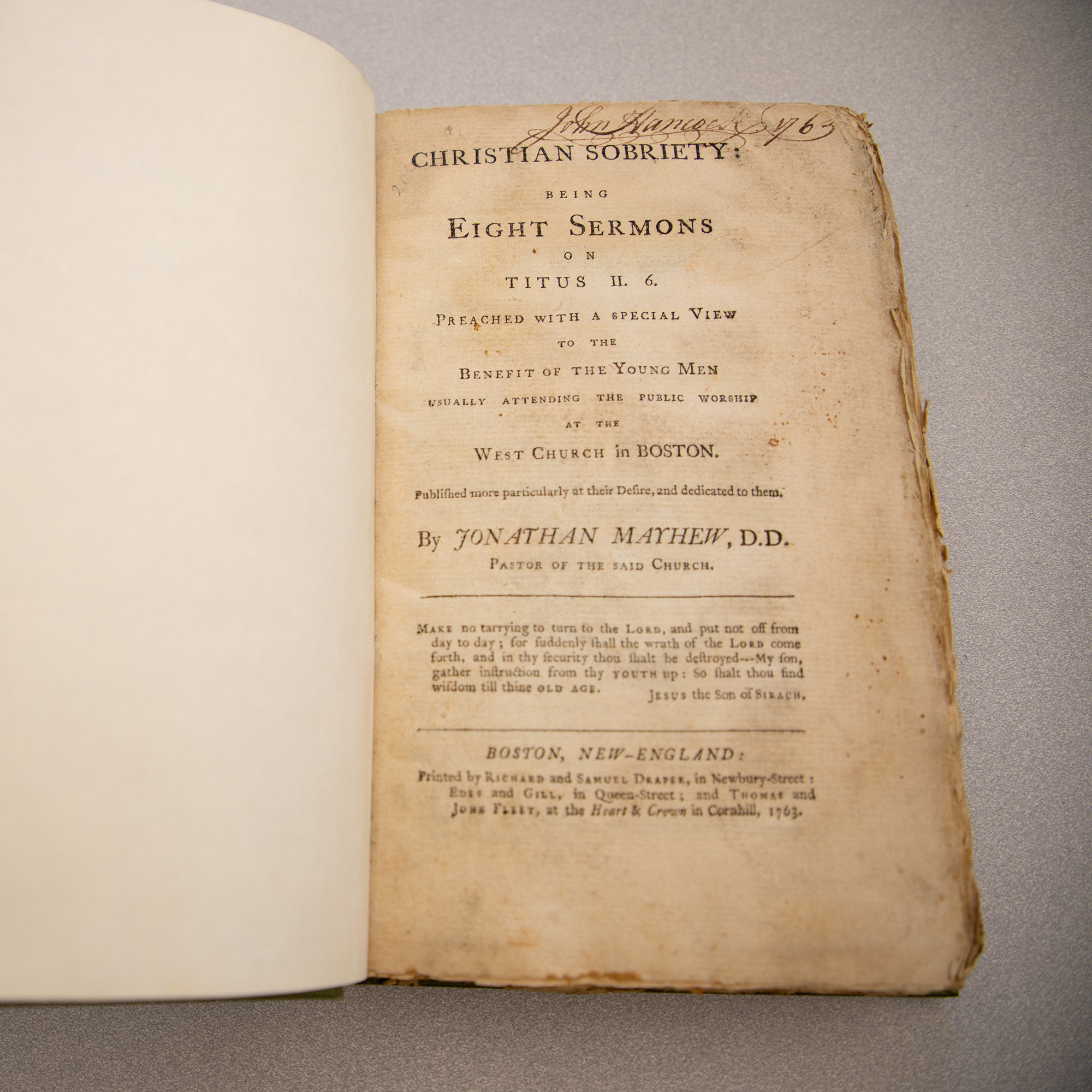
John Hancock, who served as the President of the Second Continental Congress from 1775-1777 and treasurer of Harvard College from 1773-1777, likely owned this book of sermons by Boston minister Jonathan Mayhew, who was himself an influential proponent of the revolution. Photo by Caroline Cataldo
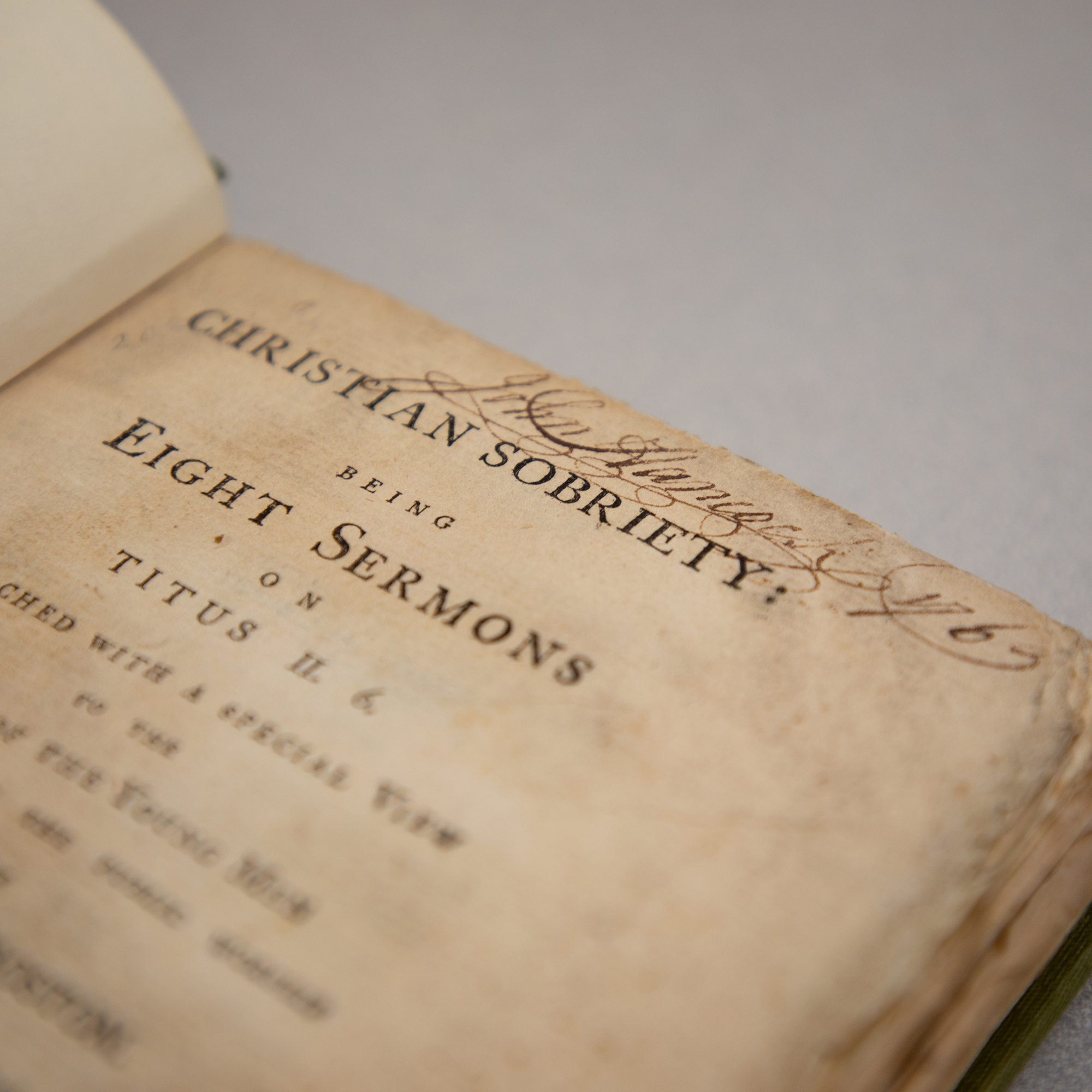
The signature of John Hancock. Photo by Caroline Cataldo
‘As He Wrote His Name in His Bible’
The discovery of the John Hancock signature adds to HDS Library’s impressive collection of inscribed volumes and important texts dating back to the American Revolutionary period. The collection features an eighteenth-century combined Book of Common Prayer and Bible belonging to Samuel Adams, another signer of the Declaration and Harvard College graduate.
The volume, which Adams likely read as a Harvard student considering Christian ministry, contains Adams’s signature in the margins of numerous pages. For Carlson, artifacts like Adams’s Bible help dissolve the distance between past and present, offering viewers added insight into the lives of significant figures.
“We can imagine Adams thinking about his future as he wrote his name in his Bible,” said Carlson. “We wonder, how did his faith change over the years that followed? How would his faith influence his life’s work?”
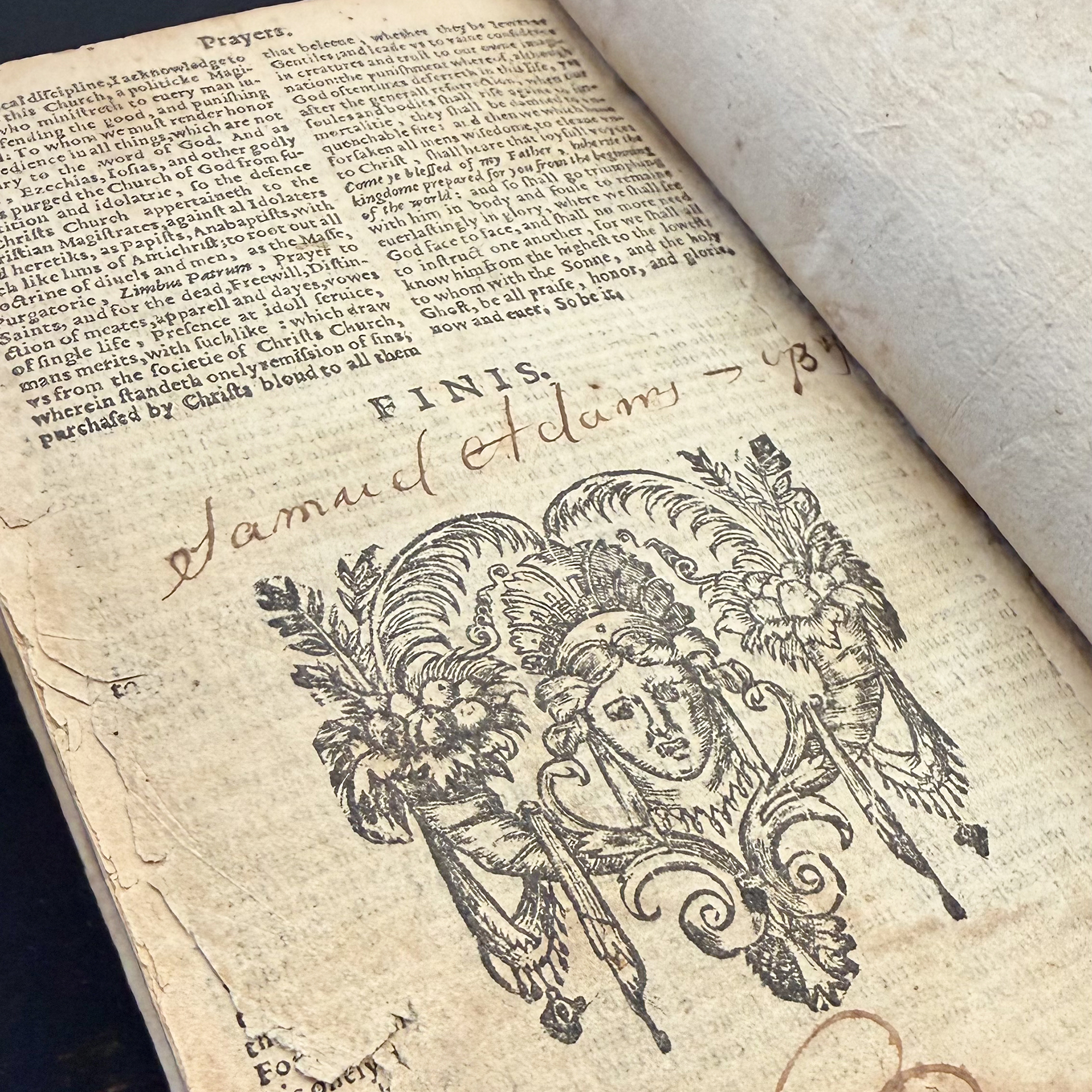
The signature of Samuel Adams, a key figure within the American Revolution and graduate of Harvard College. Photo by Caroline Cataldo
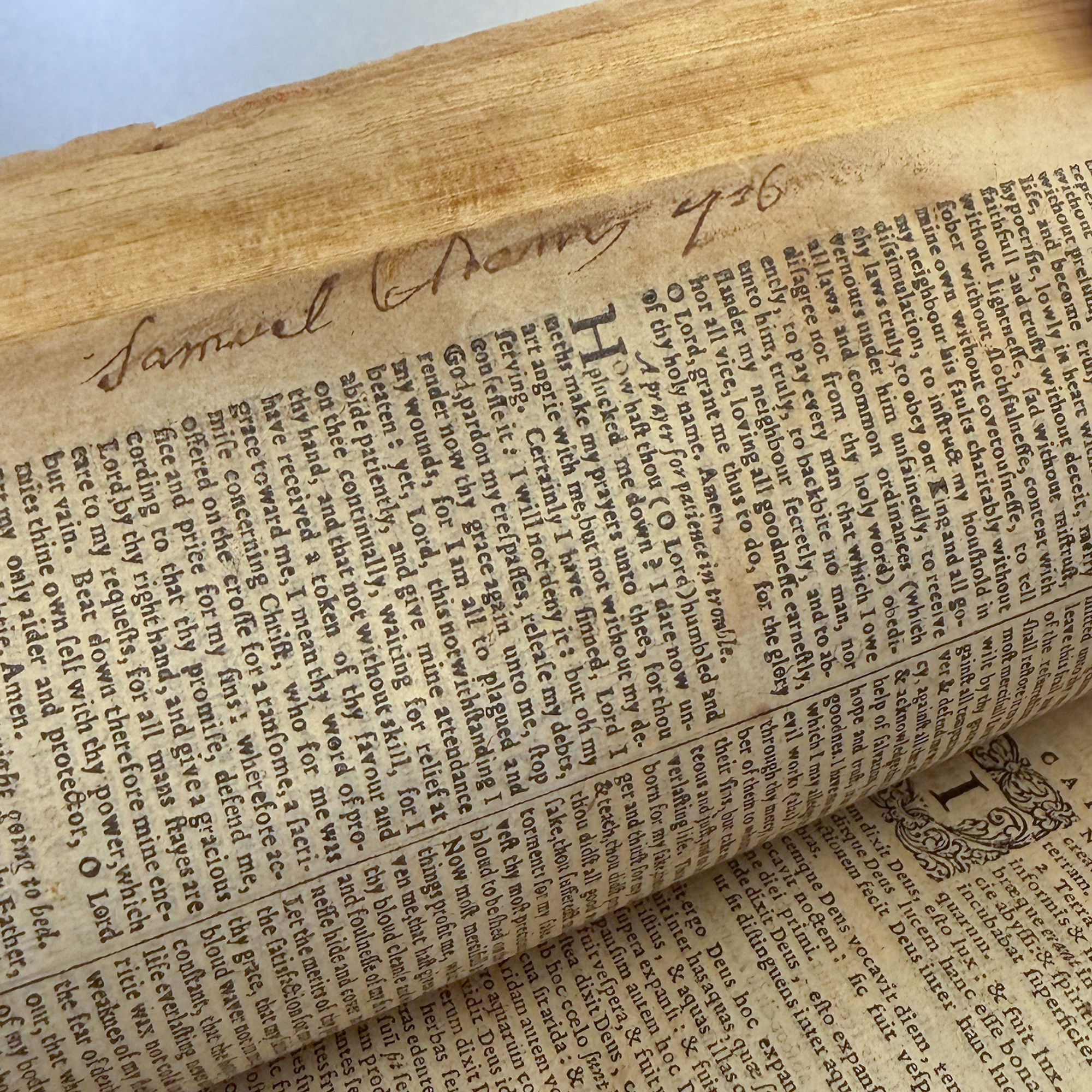
Samuel Adams's signature written in the margins of a combined Book of Common Prayer and Bible. During his time as a student at Harvard, Adams considered pursuing Christian ministry. Photo by Caroline Cataldo
The Revolutionary Spirit
The Library also has a second-edition copy of George Washington’s 1796 “Farewell Address,” in which he announced his retirement from public life—rejecting calls to seek a third term—and offered guidance to the nascent nation about maintaining unity.
As Washington wrote at the end of his address, “I anticipate with pleasing expectation that retreat to which I promised myself to realize, without alloy, the sweet enjoyment of partaking, in the midst of my fellow citizens, the benign influence of good laws under a free government, and the ever favorite object of my heart, and the happy reward, as I trust, of our mutual cares, labors, and dangers.”
Along with these texts linked to American Revolutionary-era leaders, the HDS Library possesses books of sermons preached at the time of the Revolution and an eighteenth-century book of hymns by Isaac Watts, which contains several instances of “denationalized” lyrics—songs whose Britain-oriented poetry has been reworded to reflect the revolutionary spirit of the American colonists, a process that reliably dates back to 1776.
These inscribed books and texts from the Revolutionary period preserved in the HDS Library illustrate the importance of religious life and ideas at the time of America’s founding. They have their origin in a context when revolutionary tenets were preached from pulpits across the colonies and Harvard—originally founded, in part, to promote preparation for religious learning and leadership—served as a political, intellectual, and physical base for the cause.
For Carlson, the artifacts not only connect viewers to this history; they enable those who interact with them to cultivate empathy and understanding toward those who shaped it.
“When we encounter books with traces of former owners and readers, however famous, we feel a deeper empathy with those people,” said Carlson. “Interacting with these texts can help connect us with past readers and help us understand them better.”
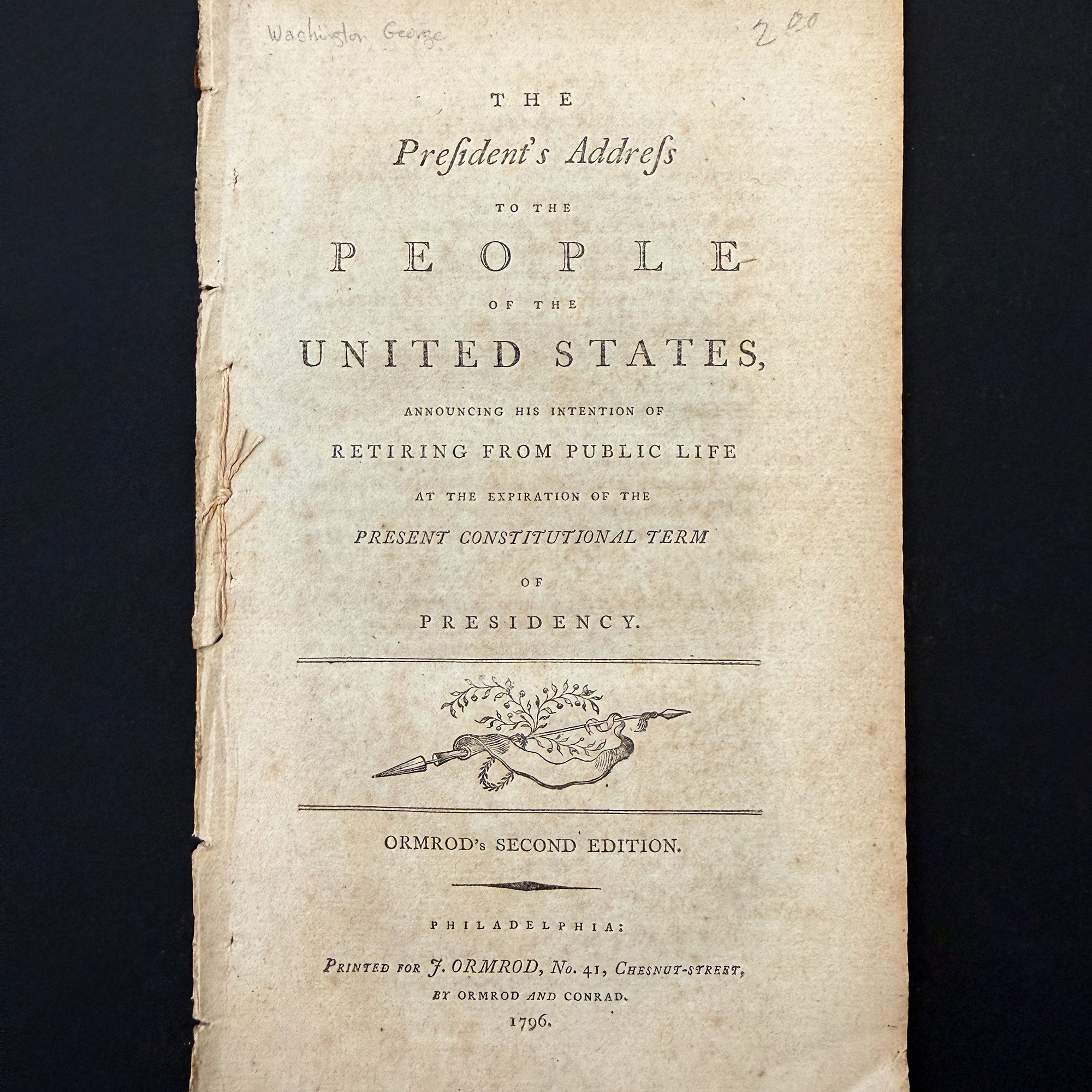
A second-edition copy of George Washington's 1796 "The Address of Gen. Washington to the People of America on His Declining the Presidency of the United States," in which Washington officially announced his retirement from public life. Photo by Caroline Cataldo
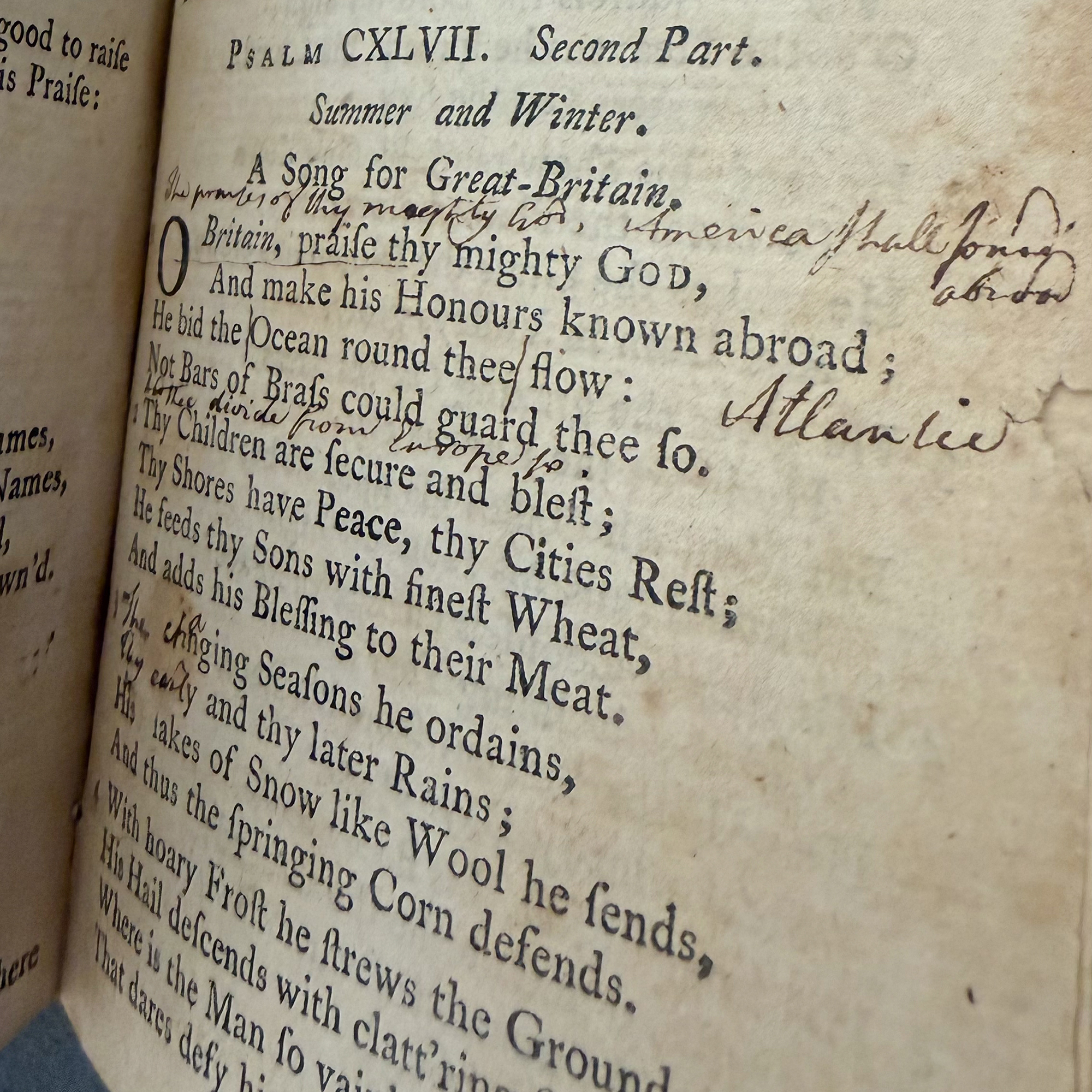
An example of a "denationalized" hymn dating back to the time of the American Revolution. The owner of this book of hymns by Isaac Watts reworked the lyrics to emphasize the revolutionary spirit of the American colonists. In this particular hymn, the owner changed "Oh, Britain, praise thy Mighty God and make his honors known abroad," to "The praises of thy Mighty God, America shall sound abroad." Photo by Caroline Cataldo
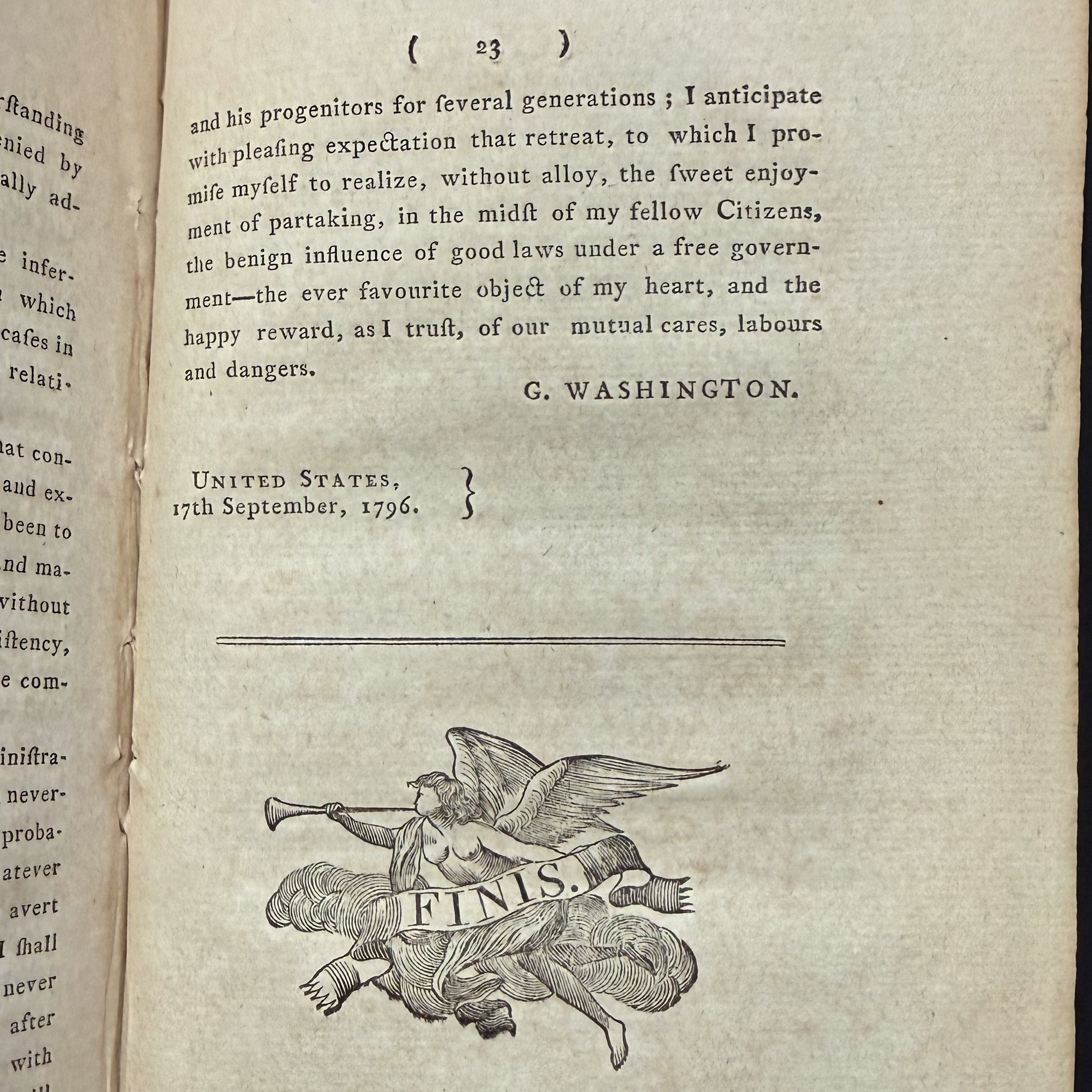
The concluding lines of George Washington's 1796 "Farewell Address." Photo by Caroline Cataldo
Banner photo by Caroline Cataldo.