

HDS Convocation Emphasizes the Enduring Importance of the Humanities
Dean Marla F. Frederick and Professor Amy Hollywood affirm the possibilities and importance of the humanities at the start of the 2026-27 academic year.
The Harvard Divinity School (HDS) community gathered to celebrate the School’s 211th Convocation on September 1, 2026. The theme of the ceremony centered on the heart of the HDS academic mission: to think, to read, and to do both together within a multireligious community committed to empathy and exchange across religious and cultural divides.
In her opening remarks, HDS Dean and John Lord O’Brian Professor of Divinity Marla F. Frederick countered a common argument leveled against the humanities—that, unlike those fields identified under the rubric of “the hard sciences” and contributing directly to industry-specific aims, the study of the humanities lacks utility. Frederick quoted poet Audre Lorde who, in her 1977 essay “Poetry is Not a Luxury” said, “Poetry is a vital necessity of our existence. It forms the quality of the light within which we predicate our hopes and dreams toward survival and chance, first made into language, then into idea, then into more tangible action.”
Frederick explored the ways in which literature and storytelling have throughout history deepened people’s understanding of the human condition and helped shape new ways of living, knowing, and being. Expanding on Lorde’s argument Frederick remarked, “One might argue that the study of the humanities is not a luxury—the stories our ancestors told around the fires at night were just as vital as the flames that kept them warm.”
She encouraged students to embrace the unique nature of the HDS curriculum, emphasizing the importance of religion, philosophy, and literature, which help create “common ground for empathy to take hold with roots that allow humanity to flourish.”
“The humanities help us find meaning—a sacred knowledge that extends beyond questions of ‘what’ and leads us toward questions of ‘why,’” said Dean Frederick.
Elizabeth H. Monrad Professor of Christian Studies Amy Hollywood delivered the Convocation address titled, “on this small fire the earth keep reading”—a line from a poem by Boylston Professor of Oratory and Rhetoric Emerita at Harvard University, Jorie Graham, whose work was read throughout the ceremony by MTS candidate Emma Scharff and MDiv candidate Clay Wackerman. HDS alum Chieh-Ting Joyce Cheng, MTS ’26, added a musical accompaniment to the ceremony, performing “Sarabande” from Johann Sebastian Bach’s Cello Suite No. 3 in C Major, MWV 1009.

If we don't exercise—and I mean that literally—our imaginations, our reason, our affective and critical responses to the world, we will no longer be human.
In his introductory remarks ahead of her speech, Plummer Professor of Christian Morals and Pusey Minister in the Memorial Church Matthew Ichihashi Potts, MDiv '08, PhD '13, lauded Hollywood’s scholarly prowess and keen ability to think alongside her colleagues and students, helping them reach new terrains of knowledge and thought.
“Amy will not only ask you the most important question; she will ask you your most important question, the one you’re not even sure yet how to formulate,” said Potts. “In doing so, she will help you find the best, the most interesting, the most insightful, and the most important answer.”
After outlining the stakes and urgency for studying the humanities in this historical moment marked by a quickly warming planet, global strife, and future uncertainty, Hollywood stressed the significance of a new academic year, underscoring the necessity to wrestle with and reflect on texts in community.
“I believe firmly that we need time and space even in the most dangerous circumstances—if we can find them—to reflect, to think, to feel,” she said. “For me, feeling, reflecting, and thinking most often happen through reading and writing, often with others—always with others if you count the ‘others’ that are the books themselves.”
With the new academic year underway, Hollywood outlined the kinds of skills and competencies students develop at HDS, arguing that all of them rest on reading.
“I take reading in its most capacious sense, yet I also believe that the written word, with its almost magical ability both to reach across time and space and to be renewed with each reading, remains essential for those of us not raised in a culture shaped by oral storytelling and memory,” she said.
Hollywood argued that in this pivotal historical moment, society must decide what it will preserve for posterity. For Hollywood, the practice of reading in community must go on.
“I know it is essential for us to hold on to, pass down, and disseminate as widely as possible, the practice of reading itself,” said Hollywood. “All of these practices teach us how to imagine, to reflect, to speculate, to question, to think, and while we have learned how dangerous the products of human thought can be. Without developing these capacities, our lives are more impoverished, thinner, more destitute—perhaps even impossible.”
As she led those gathered in a close reading of Graham’s poem “No One Today,” Hollywood urged the HDS community to continue utilizing imagination.
“If we don’t exercise—and I mean that literally—our imaginations, our reason, our affective and critical responses to the world, we will no longer be human,” she said. “This isn’t exactly hope, but it is something.”
Calling on the community to remain open to one another’s words and the texts they read together, Hollywood sketched an empowered, hopeful vision for the School’s possibilities in this present moment.
“We learn to read and to write, to think and to imagine, together; these are the practices through which we reshape ourselves, our communities, and, with luck and tenacity and imagination, through which we can begin to envision, to create, perhaps even to bring into being, renewed worlds.”
Banner photo by Katherine Taylor.
SPEAKER 1: Harvard Divinity School.
SPEAKER 2: Convocation of Harvard Divinity School at the opening of the 211th year. September 1st, 2026.
[INDISTINCT CHATTER]
MARLA FREDERICK: Good afternoon, everyone. Good afternoon, and welcome to Harvard Divinity School's 211th convocation. Each of you-- our students, faculty, staff, alumni, and friends-- are deeply valued members of our multi-faith and multifaceted community. Thank you for gathering here today in celebration of the start of this new academic year. And a special thank you to our wonderful musicians. Where are they? Thank you.
[CHEERS, APPLAUSE]
And to everyone here at HDS that makes our community events warm and welcoming, let's give them all a round of applause.
[APPLAUSE]
Today, I have the distinct honor of welcoming you, those returning and those just joining our community, to our beautiful campus. I also have the honor of recognizing this year's convocation speaker, Amy Hollywood, Elizabeth M. Monrad Professor of Christian Studies. Amy has been teaching at HDS since 2005. She is the author of The Soul as Virgin Wife, which received the Otto Gründler Prize for the Best Book in Medieval Studies from the International Congress of Medieval Studies, as well as Sensible Ecstasy-- Mysticism, Sexual Difference, and the Demands of History, among several other publications.
Amy's research and writing includes the philosophy of religion, religion and literature, and feminist and gender studies in religion. She also teaches courses on reading, writing, and poetics. As you will see throughout our program today, Amy has chosen classical music and readings of poetry that underscore her address, titled, On This Small Fire, the Earth, Keep Reading.
The title is a line from a poet near and dear to our community, Jorie Graham, Boylston Professor of Oratory and Rhetoric Emerita here at Harvard. One of Jorie's poems, I Say to the Double Doors, adorns this very building, a gift from Jorie in honor of the opening of Swartz Hall in November of 2021. And so when you go in these side doors right here and you look to the left or the right, depending on how you enter-- OK, you got it-- you will see Jorie's poem. While Jorie was not able to join us for today's event, we offer her a world of thanks for her permission to share her poetry in word and in print today.
As Amy prepares to take the stage, I would like to offer a few thoughts on this tribute to the humanities in honor of the beginning of a new school year. As I have noted in the past, the importance of honoring our shared humanity and understanding the range of human experiences, from the most devastating to the most divine, cannot be understated.
In 1977, poet Audre Lorde penned a striking essay titled Poetry Is Not a Luxury, in which she declared, quote, "poetry is not a luxury. It is a vital necessity of our existence. It forms the quality of the light within which we predicate our hopes and dreams towards survival and change. First made into language, then into idea, then into more tangible action, poetry is the way we give name to the nameless so that we can be thought."
Here, Lorde counters a common argument against the humanities, that there is little to no utility compared to the hard sciences and more industry-centric fields such as technology and business, that the study of art, history, literature, philosophy, religion, and the like is soft, frivolous, or privileged. Yet, understanding that the human condition has contained multitudes of ways of being and knowing and living over our centuries of existence remains paramount to our very survival. One might argue that the study of the humanities is not a luxury. The stories of our ancestors told around the fires at night were just as vital as the flames that kept them warm.
Poetry, arguably the oldest form of storytelling, is how our ancestors shared oral history, genealogy, law, and religious traditions. Poetry and storytelling, the foundation of the field we know today as literature, offer ways to connect across time and space, offer a chance to honor shared experiences while learning from our differences, creates common ground for empathy to take hold with roots that allow humanity to flourish.
Literature, much like the study of philosophy and religion, reminds us that the human condition contains multitudes. In all of our complexity, our creativity, and our capaciousness, we yearn to be understood. The humanities help us find meaning, a sacred knowledge that extends beyond questions of what and leads us towards why.
With gratitude, I wish to acknowledge our stellar professors and visiting scholars who have dedicated their lives to teaching and learning. Thank you for offering your expertise in service of the school's mission. And to our students, you are part of a vibrant community that represents more than 35 different faith traditions, a community committed to fostering intellectual excellence, spiritual care, and ethical leadership on campus and beyond.
Our alumni network includes more than 6,800 graduates across 50 states and over 70 countries. These remarkable individuals lead religious communities, serve as chaplains and monastics, and advance understanding across a wide range of fields and disciplines, from academia to the arts, ministry to medicine, and the private sector to public service. Here's to a new academic year, guided by our school's clear vision to provide an intellectual home where scholars and professionals from around the globe can research and teach the varieties of religion in service of a just world at peace across religious and cultural divides.
And now, I would like to welcome to the stage Emma Scharff, an MTS candidate, so that she can offer a poem by Jorie Graham entitled We. Emma, thank you.
[APPLAUSE]
EMMA SCHARFF: Thank you. Can you hear me?
"Intimation, friend, the pastness of, you can only think about it. It won't be there for you. You can talk about it. They are gone, who came before, left us nothing but ourselves on our tiny axis of blood, surrounded by all the broken columns, the marble which will itself surrender to time, to radioactivity, to we are all we ever were, necessary because of breeding, weak, dying."
"And then there are clocks, butterflies, cyclamens, geometrical patterns, lacerations of space where galaxies grow. A bottle of whiskey deep in the soil no one found. It descended, cloth with serial numbers. One says made in the USA. Underneath death, it says "made in." Where shall we put the theory of reading? There never was metaphor. Action unfolded in no temporality. Anticipation floods us, but we never were able, not for one instant, to inhabit time."
"Listen, the last step is this feeling you have here. Just as long as we keep doing this, I write, you read, with timeness an unexpected nobility, above and below flow by, cold as they are. The universals keep, solar ghosts flare, turn to cash. On this small fire, the Earth, keep reading, I say to myself, keep on. It will not be the end. Not yet. My children sleep. Not yet. A friend who's dead said this to me. It is not dead."
Thank you.
[APPLAUSE]
CLAY WACKERMAN: No One Today by Jorie Graham.
"No one today of my own died. I did not die. My love did not, is intact. I checked. Beloveds were not dragged into the net, the eye of the drone, were not dismembered into instant ancestors. Not even memories, too fast, too torn, no. Screams. We woke."
"The sun came first in veins of red, then rips, pinks, then rose, as usual. We didn't look up. Ate fast, were late. The day filled up. We asked all our questions. What questions were those?"
"I heard a cardinal. It's spring. So suddenly, soon, it was evening again. The lights came on. No oblivion was visible to us. No one lay waiting to be buried under the vast sound than the unending wait which imitates eternity perfectly."
"We're suddenly, we're down in the burning mounds, the slippery pits. How did our room disappear? And is that a cry under there? Is that a hand opening and shutting, a piece of skin? Is that a shin? Is that a nape showing through? This dust we cannot reach into, can't push away this covering which cannot be uncovered ever again."
"They take away our hands. They make us lie down. Where are my things, the things I loved? It's spring, I think. I must be alive. I check the bulbs. I touch the green. No arm is being amputated from my only ones, no rib cage crushed before it can call out a name, no body loved beyond measure growing limp here. Wake up."
"Wake. Let me feed you. Here's your milk. Here's your song. I'll whisper it into your ear. Where is your ear? Open your eyes. Where are your eyes? Why are your fingers not? Why will your eyelids not?"
"I push them back. They will not stay. Don't bend that way. You'll hurt yourself. No, you can't hurt yourself. You are all gone, all gone, who ran in the light with me to the beach last Saturday. Shall we venture out. I ask, at bedtime? Now? Tomorrow? And my sleepy ones say, maybe, if it is fine. And I say yes, of course, if it is fine."
[APPLAUSE]
MATTHEW ICHIHASHI POTTS: Good afternoon, friends. It's my honor this afternoon to introduce our convocation speaker, the Elizabeth H. Monrad Professor of Christian Studies. Amy Hollywood. Amy and I came to HDS the same year, in 2005, only she came as the inaugural Monrad chair and I came as a wide-eyed Master of Divinity student. I have only known HDS with Amy on its faculty, and it's hard for me to imagine this place without her on its faculty.
Amy is the author of four books, two of which Marla mentioned, so I won't mention those again. I'll tell you about the other ones, Acute Melancholia and Other Essays, Mysticism, History, and the Study of Religion, and also, with Constance Furey and Sarah Hammerschlag, Devotion-- Three Inquiries on Religion, Literature, and Political Imagination. Amy's also the co-editor of The Cambridge Companion to Christian Mysticism.
In these works and many, many others, Amy has established herself not only as an indispensable scholar of Christian studies, medieval studies, and Christian mysticism, but also, as Marla said, of gender studies and of ritual studies and literary studies and secular studies and critical theory and the philosophy of religion and of the study of religion writ large. While producing this incredible body of work, she's also been a wonderful teacher, advisor, dissertation director, colleague, and friend, not only to me, but to many, many, many others here at HDS, and also, before Harvard, at Rhodes College, Dartmouth College, the University of Chicago, with visiting appointments at Grinnell College and Syracuse University.
Amy knows everything, and she reads everything. We've been friends for a while, and sometimes I think I might catch her up and try to ask her about a book she doesn't know. And sometimes I even try to stack the deck and mention some obscure Anglican divine she has no scholarly business being aware of.
But every time I mention anything, she's always read it. And not only has she read it, she will very casually tell me why it's important and why it's dumb and how it fits into the whole complicated web of Western religion. There's lots I could say about Amy's scholarship, but given what Marla said about telling stories, I'm going to tell a story to conclude this introduction.
My first year on the faculty here, a very famous theologian came to visit Harvard. Amy already knows who it is. This very famous theologian is an intellectual hero of mine. And in fact, I came to HDS 20 years ago hoping that I would grow up to be like him. He came here to give some famous lectures. And afterwards, there was a panel discussion, and Amy was one of the panelists.
I don't really remember exactly what the famous theologian said. And honestly, I remember nothing of what the other panelists, all distinguished scholars in their own right, I remember nothing of what they said. And if I'm still being honest, I don't remember exactly what Amy said, either. But I do remember what she did.
Now, these lectures were sort of like technical philosophical explorations, not my favorite works by this favorite theologian. But when it was Amy's turn to speak, she held up a hardback copy of Hanya Yanagihara's at that time just-released novel, The People in the Trees. And using that just-released novel-- that she had read immediately-- using that as a frame, she put to the famous theologian the most essential ethical and political question, the thing that had been missing from his long and erudite talks.
And not just the most essential ethical and political question-- she asked the most pressing theological question, too. This book has nothing to do with Christian theology, but using this book, she put to him the most pressing ethical, political, and theological question. She asked him to say something that mattered about God, which, honestly, he had weirdly kind of avoided the whole week.
And in doing so, she coaxed-- maybe forced-- this famous theologian to clarify the stakes of his project and to give her, and all of us, an answer which, for my money, was the most important and the most interesting thing he said all week. His response to her question was better, to my mind, than the whole of his lectures. Amy might disagree with that. Not because she liked his lecture so much. I just don't think she liked his answer, either.
[LAUGHTER]
But that's sort of the point, that she disagreed with him. This is what she does. Amy gets right to the heart of the matter. Whether she agrees with you or not, she reads closely and draws in unexpected sources. And when she draws them in, they immediately become indispensable to the way you're thinking about the thing she's asking about. And then she poses the most pressing questions and offers the most cutting insights.
Amy's exchange with this famous theologian was absolutely familiar to me because I can't tell you how many times I've sat across from Professor Hollywood in her office in Div Hall or at Simon's Coffee Shop over a very tiny table or at the Abbey restaurant on Mass Ave, and talked to her about my dissertation or about my book or about my other book. And every time, she is always able to see what I'm trying to get at, usually more clearly than I do. And every time, she pushes me further toward what I am going after.
This is actually pretty rare. Lots of folks can listen to you, and lots of folks can give you feedback on your ideas. It's actually my job to do that kind of thing. It's our job as faculty, as professors. It's your job as students and scholars to do this, to listen to one another and give feedback.
And we do it all the time. But a lot of the time when we do that-- and I include myself in that we-- when we give you advice on your work, what we're really doing is trying to tell you how your work could be more like our work. This is largely innocent, and understandable. Our work is the work most legible to us. We see better our own things, and we see things through our own. But that's not what Amy does.
Amy will not only ask you the most important question. She will ask you your most important question, the one you're not even sure how to formulate yet. And in doing so, she will help you find the best, the most interesting, the most insightful, the most important answer.
I still deeply, deeply admire that famous theologian. But friends, let me tell you, as I left the Barker Center that day and as I walked toward the Harvard Square T station to go home, I realized that I didn't want to be like the famous theologian when I grew up. I wanted to be like Amy.
Friends, to give her address entitled On This Small Fire, the Earth, Keep Reading, please welcome our convocation speaker, the Elizabeth H. Monrad Professor of Christian Studies at Harvard Divinity School, Amy Hollywood.
[APPLAUSE]
AMY HOLLYWOOD: That made me feel a little dizzy, so I'm just going to try to stay upright.
Thank you. Thank you, Matt. I think it's probably suitable that the word God is not going to appear in anything that I say today, proving once again that I am not that very famous, distinguished theologian to whom I asked the question. On This Small Fire, the Earth, Keep Reading.
So thank you to Matt. Thanks to David Holland and to Marla Frederick for asking me to speak today, and to Marla and David both for their ongoing friendship, support and loyalty. I'm grateful to both of you for trusting me with this moment. I also want to thank-- you might wish you hadn't when I'm done.
I also want to thank [INAUDIBLE] Whitaker and all of the staff in the dean's office and all the staff across the Divinity School who made this event and who make everything we do here every day possible. Thank you to Joyce Chang and to Christopher Hossfeld for the beautiful music, only some of which we've heard. We'll hear more.
And to Emma Scharff and Clay Wackerman, you read Jorie Graham's words with urgency, beauty, and precision, and I'm very grateful. Jorie Graham graciously allowed me to use her words for the title and to reprint the entirety of No One Today in the program. I'm both sorry and also kind of glad that she can't be here today. She was like, oh, I'm sorry [INAUDIBLE]. I was like, ah.
[LAUGHTER]
But mostly, I thank all of you who are here. A warm welcome. I second Dean Frederick's warm welcome to the entering class of 2026, friends, family and guests new to Harvard Divinity School. To my colleagues on the faculty and the staff, returning students, alum, friends who have been here before and are back, welcome back if you've been away. And my condolences if you were here working all through the summer.
I hope that everyone has had some quiet in the midst of so much that is chaotic, overwhelming, threatening, frightening, right now here at Harvard, and in the larger world of which Harvard is a part. I hope that all of you and all of your friends and families and loved ones, your communities, your people are safe.
And that's something I know we can never assume, now less than ever. As will become clear in my remarks today, I believe firmly, perhaps, only in this one thing, that we need time and space, even in the most dangerous circumstances, if we're able to find them-- and sometimes we're not-- to reflect, to think, and to feel. The fact that we're all here today means, I hope, that we're among those lucky enough to be afforded this time and space.
I hope it lasts for you and that it is extended to others. For me, feeling, thinking, reflecting most often happens through reading and writing, often with others. Always with others, if you count the others that are the books themselves. This is what I want to talk about today. Or more precisely, this is what I want to do today, to read a poem with you, to ask, or perhaps better to show, some of the things reading can do.
Harvard Divinity School is, first and foremost for me, a school. Many things are taught and learned here, many different kinds of practices pursued, competencies gained, skills honed. All of them rest, I think, on learning to read-- sometimes books, sometimes people, situations, images, oral stories, songs.
I take reading in its most capacious sense. Yet I also believe that the written word, with its almost magical ability both to reach across time and space and to be renewed with each reading, remains essential for those of us not raised in a culture shaped by oral culture and memory. And I come from a storytelling family, but it's just not the same.
There are many kinds of books, I would also add, many ways of reading and forms of thought and imagination generated by that practice, only one of which I'm going to be able to explore today, particularly the literary. So we all do philological, historical, philosophical, theological work, sociological, anthropological. What I'm going to focus on today is a mode of literary reading.
On This Small Fire, the Earth, Keep Reading. The core of the Earth is not fire, although it is extraordinarily hot. It's too hot to actually be fire. But the Earth is on fire, literally and metaphorically. Soaring heat and unpredictable weather patterns result in vast fires across the globe.
At the same time, the ice caps are melting, the seas are rising, air and water currents are radically shifting. We're inundated by floods, mudslides, superstorms, but also drought, famine. The result of this mostly or largely humanly generated climate derangement is intense precarity for all living things, humans among them, and species death at numbers I cannot even fathom.
Wars are being fought, illegal, unethical, at times genocidal wars. And can any war that routinely purposively kills children, which every war now seems to do, be ethical or legal? Wars are being fought over land that often will be uninhabitable in the not-too-distant future. The United States and Western Europe are closing their borders to refugees, many of them fleeing famine and the wars that catastrophe engenders, when in the not-too-distant future, it is likely that many citizens of the United States and Western Europe will themselves become climate refugees. And as we know, some already are.
The inhabitable world is shrinking, or at least its parameters are radically shifting. And our political leaders, if that's what we want to call them, seem, for the most part, unable to grapple with the reality and its consequences. We're being encouraged, sometimes by the very schools, colleges, and universities who should care about deep, transformative learning, to offload the task of reading, writing, and thinking, resorting to forms of artificial intelligence, the facilities for which are themselves arguably accelerating environmental catastrophe, and yet will possibly, likely-- I think certainly-- not survive the disasters to come. I think that, but what do I know?
There have been many moments in history when the future was unimaginable, when no one knew what was coming, but things did not look good. Times like these evoke urgent questions about what a community or polity or people want to hold on to, what they want to pass on to the generations who, with luck, will follow them, what might be helpful in an uncertain, uncharted future. This is always true. We're always asking what we should pass down. But various kind of crises make the task more conscious, more explicit. And for us now, as for many in the past, the future is paradoxically both unknown and already present.
I am by training, in part at least, an historian, a historian of medieval Christianity. Boethius, writing at the end of the fifth and beginning of the sixth century, knew that the Roman Empire into which he had been born-- just barely, depending on when you date things-- was disintegrating. He believed deeply in the modes of thought developed in ancient Greece and Rome, and so made it his life's work to translate Plato and Aristotle into Latin.
He was executed for treason. He only got through the basic logical text of Aristotle, which, for better or worse, became central to the educational program of the Western Christian Middle Ages. He also wrote textbooks on arithmetic and music, and most famously, a book, The Consolation of Philosophy, which was partly in poetry, partly in prose. Most of the works of Plato and Aristotle came later, and came to Western Europe later, excuse me, largely through Muslim, Jewish, and Eastern Orthodox Christian scholars. So in the past, when one world died or collapsed, others remained, were born, throve.
There are so many books now, so many complex methods of thought and exploration, no one mind, no one community of minds, not even Harvard, can hold them. This is one of the reasons supercomputing, the web, artificial intelligence, have been so alluring. What might we do with computational, aggregational, condensational tools, and potentially intelligent technologies that could hold all of these words, images, facts, modes of analysis, synthesis, and perhaps even thinking, and so exploration and the asking of new questions? What if this artificial intelligence could, in fact, hold all that together?
So I get it. I understand what's alluring in these possibilities, even as I know it is essential for us to hold on, to pass down and disseminate as widely as possible the practice of reading itself, and also of working with numbers, with visual culture, with scientific and social scientific protocols, practices, and procedures. I don't do those things, so I can't speak to them, but they also are vital.
More importantly, I'm not sure that any of these things are possible without the written or orally transmitted word, so reading seems fundamental to me. All of these practices teach us how to imagine, to reflect, to speculate, to question, to think. And while we have learned how dangerous the products of human thought can be, without developing these capacities, continuing to develop these capacities, developing them in the future, our lives are more impoverished, thinner, destitute, perhaps even impossible.
So reading might seem to be an indulgence in times of crisis, but it's one of the most vital practices by means of which we make ourselves and are made by each other, by which we begin to imagine the possibility of social worlds, political worlds, religious worlds other than our own. And as religious people and scholars of religion-- and sometimes they're the same person, sometimes they're not-- know Perhaps better than anyone, these texts, this reading, these practices shape us.
This is what Jorie Graham shows us throughout Killing Spree from 2026, the volume from which the two poems-- oh, no, from one of the-- the poem that Clay read is from. It's a suitably terrifying title, in which the word spring is also embedded. Graham's work can often be difficult in obvious ways, requiring reading and rereading to parse, to untangle the syntax and grammar, to make sense of the images on the page.
The poems in Killing Spree are, for the most part, more straightforward than much of Graham's earlier work. They may be poems we think we all know how to read. But there is always more to learn, both about reading and how to read, and more to learn and new modes of being to engender through the practice of reading itself.
So I want to spend some time today looking at the turns taken by the poem that Clay read for us, No One Today. And again, I joke to my class that I should have a trigger warning just on my forehead because I'm never asking people to read things that are nice. So I apologize. I apologize in advance for this again, but we're going to go through this again.
"No one today of my own died. I did not die. My love did not, is intact. I checked. Beloveds were not dragged into the net of the eye of the drone, were not dismembered into instant ancestors, not even memories. Too fast, too torn. No. Screams."
Here and throughout the poem, Graham plays with our ideas of what reading about atrocity does for or to the reader, for or to those about whom the narrator speaks. Graham pushes against models of empathic reading, in which the speaker of a poem purports to occupy imaginatively the mind and body of another suffering, in this case, excruciating violence.
The first publication of the poem overlapped with the Russian invasion of Ukraine-- it was 2024, so it was a little after-- and most directly, the Israeli destruction of Gaza and incursions into Lebanon, all of which are ongoing. Now, I can't help but read the US attack of Iran into the poem, a move its openness of voice and reference invites. The narrator imagines the horror of the violence wrought by modern technological warfare, the drone, so there is a specificity, a particularity to what she describes.
But she does not name the precise instances of destruction, nor does she claim to understand or to feel them. These things did not happen to the reader, to their beloveds, yet the viscerality of bodies dismembered is partly visible on the page, with the enjambment and tearing apart of the word dismembered itself. The em dashes with which instant ancestors, not even memories, is cut off from the body, too fast, too torn apart, that is not named. The single-word sentence screams.
Mid-stanza, the speaker shifts from I to we. And the we who wakes is distinct again from those who scream, those caught in the net of violence. "Fast, too torn, no. Screams. We woke. The sun came first in veins of red, then rips pink, then rose as usual. We didn't look up, ate fast, were late. The day filled up. We asked all our questions. What questions were those?"
Veins then rips, the body literally torn apart by bombs of red, pinks, rose. A bloody sky, but not one that bloodies the we under it who rose as usual. The doubleness of the word rose here is vital, a color tied to violence and an action indexed to peace. Those who don't look up, who live their days asking questions. This is what we get to do here in school.
The narrating voice shifts from I to we and back again. "Those, I heard a cardinal. It's spring. So suddenly, soon it was evening again. Then, lights came on." The red cardinal, a sign of spring. The spring embedded in the book's title. The red of blood, the red of a bird. But spring is also a movement. The suddenness of the season's arrival, the quickness with which the day passes. The speed with which a bomb falls.
Once again, the stance ends with a shift mid-line, one that emphasizes the no, the distance between the speaker and the devastating violence of war. "No oblivion was visible to us. No one lay waiting to be buried under the vast sound and the unending weight, which imitates eternity perfectly, where suddenly--"
And now again, midline, mid stanza, the I and the we are overwhelmed by the horror they have so far kept carefully distant, not in an attempt to disavow it or to protect themselves from it, or not only that. It might be partly that, but it's not only that, but in order to acknowledge all that, they cannot know about what it is to be immersed in that horror.
"Perfectly, we're suddenly, we're down in the burning mounds, the slippery pits. How did our room disappear? And is that a cry under there? Is that a hand opening and shutting a piece of skin? Is that a shin? Is that a nape showing through this dust we cannot reach into, can't push away this covering which cannot be uncovered ever again."
But just as the speaker's imagination converges with the experience of those dragged into the net of the eye of the drone, slipping into the pit of skin and shin and nape, and dismembered bodies buried under the rubble, the narrator pulls back. They appear, and they take the speaker back to spring, where there are green bulbs to touch rather than the scraps of human beings in the nightmare of war, a nightmare that is reality for some, but not for the speaker.
"No arm is being amputated from my only ones. No rib cage crushed before it can call out a name. No body loved beyond, measure growing, limp here, wake." The force of negation, which is all over the poem, rather than allaying the horror, intensify it.
In an earlier poem, in Killing Sprees, Graham writes. "This first person I use here is a way of referring to my being in abeyance, to my unknowing. Though, who are we kidding? It was not of the radiant kind, where we wait in line willingly, eyes closed, for the tap on the high spot of the soul for illumination."
No, no. Graham's negations do not illuminate, except perhaps, in the sense of a blistering light that exposes a world in ruins. The light, the world, the ruins, so harsh that I find myself wanting to apologize for asking you to spend time with these words. And yet, I believe, with Graham, that we must. Those of us who did not die, who must be alive, whose beloveds are alive, we must look even as we negate our power of vision.
The negations here are refusal and attempted refusal of the commodification, the fetishization of violence. And yet, for any of you who have lived through such violence, I ask, what is it like to hear these words? The final two shifts in the poem are the most difficult for me to understand, or perhaps better to follow, or maybe to accept. I'm not sure. I think it's because of the introduction of a second person addressee, and the difficulty in locating that addressee in terms of the poem's imagined worlds.
"Is this you--" this child, or beloved, or the reader, "--in the world of spring, in which cardinals sing and bulbs are planted, and we fill our days with questions? Or is it the world of burning mounds and slippery pits into which we fall?" It is finally both, and the inextricability of these worlds is one of the poems subjects.
"Limp here. Wake, up, wake. Let me feed you. Here's your milk. Here's your song. I'll whisper it into your ear. Where is your ear? Open your eyes. Where are your eyes? Why are your fingers not? Why will your eyelids not? I push them back. They will not stay. Don't bend that way. You'll hurt yourself. No, you can't hurt yourself. You are all gone, all gone. Who ran through the light with me to the beach last Saturday?"
There are so many ways in which a child or a mother or any beloved can disappear. You are all gone. All gone. And the narrating I and we do not pretend to compare the losses to which we are all subject, with those visited only on some. The poem refuses to close the radical chasm between us. Yet, a different collapse of worlds is evoked here.
For it is not just the you that is entirely gone, but all are gone. Part of a larger world that has been raised, destroyed, for whose remains the speaker does and yet, does not search through the wreckage. There are songs, raise your voice in my voice, or raise my voice in yours, Graham's writes in another book. Another poem in Killing sprees.
There are songs and there is loss and there is hurt, but all the songs and the loss and the hurt are not the same. War and terror ravage the body and the soul and specific, unacceptable, unimaginable, often even for those who live it, ways. What do we do in the face of these catastrophes? Killing Spree offers no hint of resurrection, salvation, recuperation through song or otherwise, and Graham eschews claims that poetry can save us, that empathy can enable us to stop the war machines and the systemic destruction of the world of which they are a part.
In her earlier works, she's not so sure that poetry can save us. In Killing Sprees, she's given up that hope. And that's why it's the book I resonate with the most. Yet, she continues to write and I continue to read. If we don't exercise, and I mean that literally, make use of, hone, habituate, expand our imaginations, our reasons, our affective and critical responses to the world, we will no longer be human, even if somehow we manage to save the world from ourselves. This isn't exactly hope, but it is something.
"Shall we venture out? I ask at bedtime, now, tomorrow. And my sleepy ones say, maybe, if it is fine. And I say, yes, of course, if it is fine." Virginia Woolf's To the Lighthouse. This is Stephanie Paulsell's gown, so I feel like I can talk about Virginia Woolf. But also, the poem makes me. Virginia Woolf's To the Lighthouse, published in 1927, written in the wake of great personal sorrows and a great war, opens with the line, "Yes, of course, if it is fine tomorrow," or if it's fine tomorrow. Woolf is more casual.
"We will go to that lighthouse." The next day is not fine. And it is years before James, the child to whom Mrs. Ramsay addresses these words, goes to the lighthouse, years during which Mrs. Ramsay dies. James's sister Prue dies from childbirth. His brother Andrew dies, killed in World War I. "Yet still, in some uncertain future, we will venture out into the sun, into the spring. Through the light with me to the beach."
Although James hates his trip to the lighthouse when he gets to take it, but OK. In the preface to To The Last Be Human, or The Last Human, a quartet of books in which Graham addresses the present and coming climate crisis, Robert MacFarlane folds together words from an interview Graham gave during that time.
Graham said, and this is MacFarlane, that she has begun to imagine her poetry as something that might be dug up from the rubble in the-- dug up from rubble in the future, a message sent forward to whatever and whomever comes next, part of a huge amalgam of left over signals held together by chance. Boethius.
The rubble of Killing Sprees, berries, the torn apart bodies of dead children and the voice in these poems is more self-lacerating, enraged, desperate and uncertain of the value of her song than ever before. There's no consolation here. Yet, the urgency of the writing, and with it of the reading remains.
"I look out the window to squint it all in." This is from a poem later in the book. "We are smack in the middle of history, I gather. So busy. The blank books stacked for us to fill them with questions. Barely visible helmets gleaming outside as they march. Though, it could just be fins breaking the surface." This is Graham reading and writing. The blank books evoke HD's early 20th century war poem trilogy, in which a woman carries a blank book into the world into which the future might be written.
The fins are from Virginia Woolf's diaries and her novel The Waves a sinister image, but also, as in Graham's lines, a way of being other than as gleaming helmets of war. Fins breaking the water carry the possibility, as the poet reads and writes, that we, reading her, can read and write and think and feel and imagine other less destructive, less dangerous, less devastating ways of being.
This is what we've come here to do together. The form of sociality, that is the school, rests on our openness to each other's words and the words we read in common. We're never alone, even if at times, our only companion is a book, for each book contains multitudes.
But at Harvard Divinity School, I have found over the past 20 and more years, a dedicated community of readers, people who are compelled to read and understand that we always have more to learn about how to read. And that to read is to bring the multitudes contained within books and songs, ceremonies, images, movies, conversation to life.
We learn to read and to write, to think and to imagine together. These are the practices through which we shape and reshape our worlds, our social, political, existential, or religious worlds. With luck and tenacity and imagination, perhaps we can begin to envision, to create, maybe even to bring into being new, renewed worlds.
But, and this is my last point, it is of utmost importance to me, [LAUGHS] and maybe only to me, to say this. Even if, and as the world resists, dismisses, disavows. Even if, and as the very institutions of which we are a part, within whose wealth and history we find a small space of refuge. Even as these institutions at times resist the work we do here. That work, often a kind of play.
Even if it happens only in this small world, this place of tentative safety we carve out for ourselves and a world within a world, a school within a school. That work is itself, without the need of any grand claims to its utility or purpose or capacity for saving anything. That work, reading and writing, talking and arguing, feeling and imagining, is itself, of infinite value on this small fire, the Earth. Keep reading. Thank you.
[APPLAUSE]
[MUSIC PLAYING]
[APPLAUSE]
MARLA FREDERICK: My deepest gratitude to Chris and to Joyce for the exquisite music. Let's give them another round of applause.
[APPLAUSE]
To Emma and Clayton, for the powerful readings, thank you so much. To Matt, for that absolutely magnificent introduction. And to Amy, for this most insightful address. Thank you so much, Amy.
[APPLAUSE]
Last year, Amy sent me an email. She said she wanted to meet with me. And so we met. And she says, Marla, I hate to leave you, but I am retiring January 2027. I was like, oh no! I said, Amy, I hope you know there's a moratorium on retirements. Nobody can retire before I say so. Oh!
But I knew at that moment that I wanted her to give us this convocation address, to leave us with her great well of wisdom, words of wisdom. And so thank you so much, Amy. I am so grateful for not only the lecture that you gave today, but for the years that you have poured into our students and for your incredible scholarship. Thank you so much.
[APPLAUSE]
And so I want to thank you all as well, for joining Harvard Divinity School's 211th convocation. My best wishes to each of you as we begin this next chapter together. This concludes our formal program. And so please join us for a reception with light refreshments downstairs in the HDS Commons. Have a good evening. Thank you.
[APPLAUSE]
NARRATOR: Sponsored by Office of Academic Affairs at Harvard Divinity School.
NARRATOR: Copyright 2026. The President and Fellows of Harvard College.
Photos from the 211th HDS Convocation
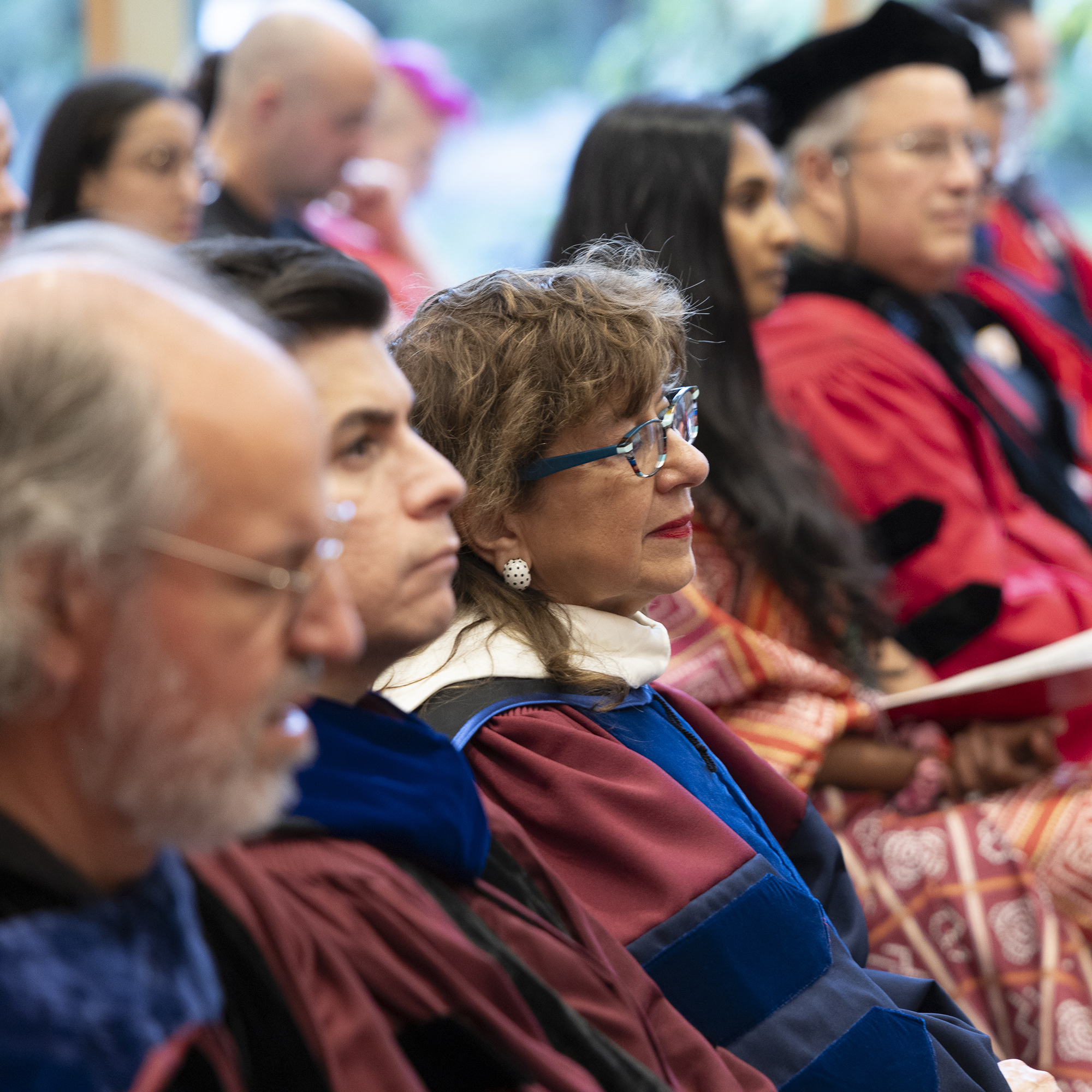
Photo by Katherine Taylor.
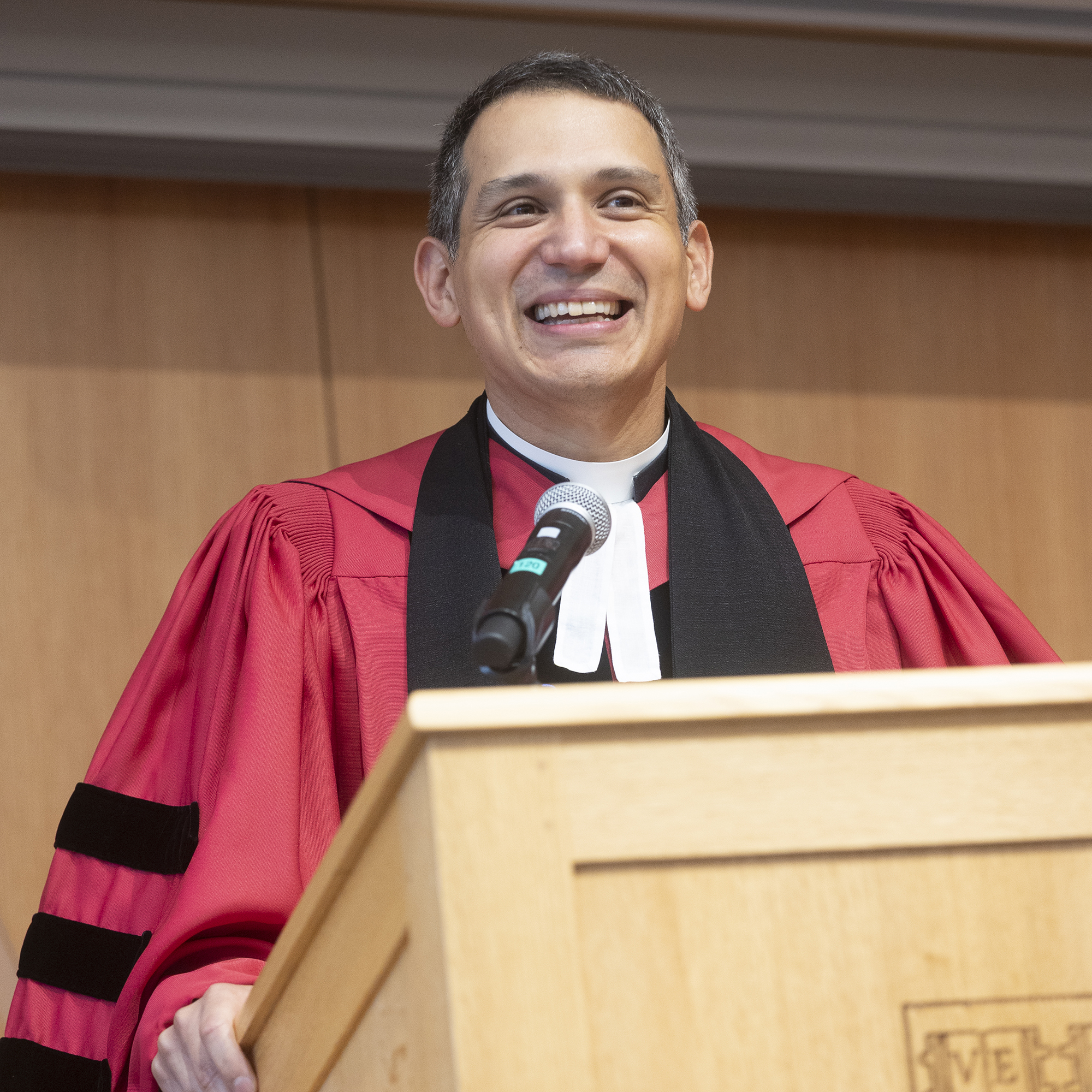
HDS Professor Matthew Potts introduces the 2026 HDS Convocation speaker, Amy Hollywood. Photo by Katherine Taylor.
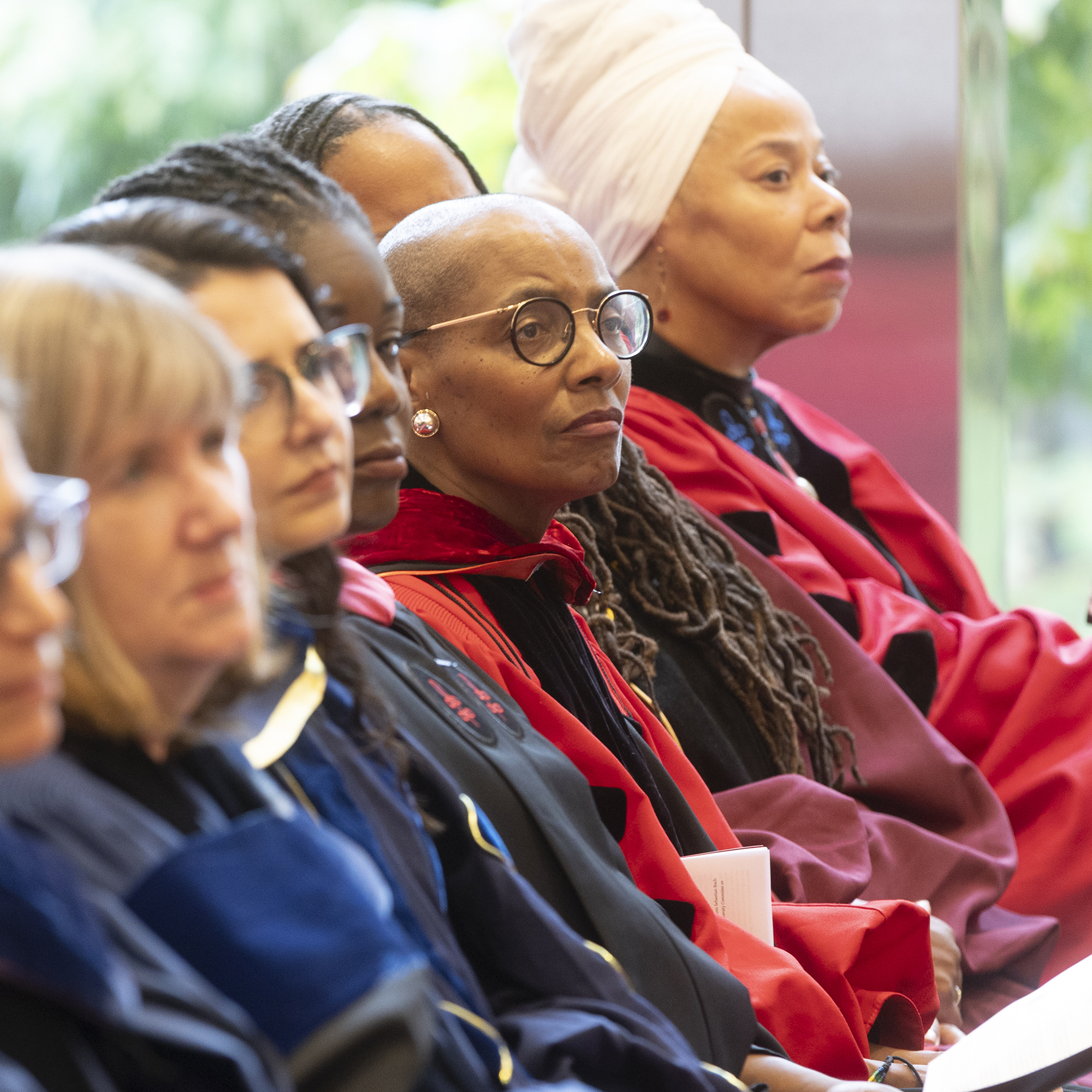
Photo by Katherine Taylor.
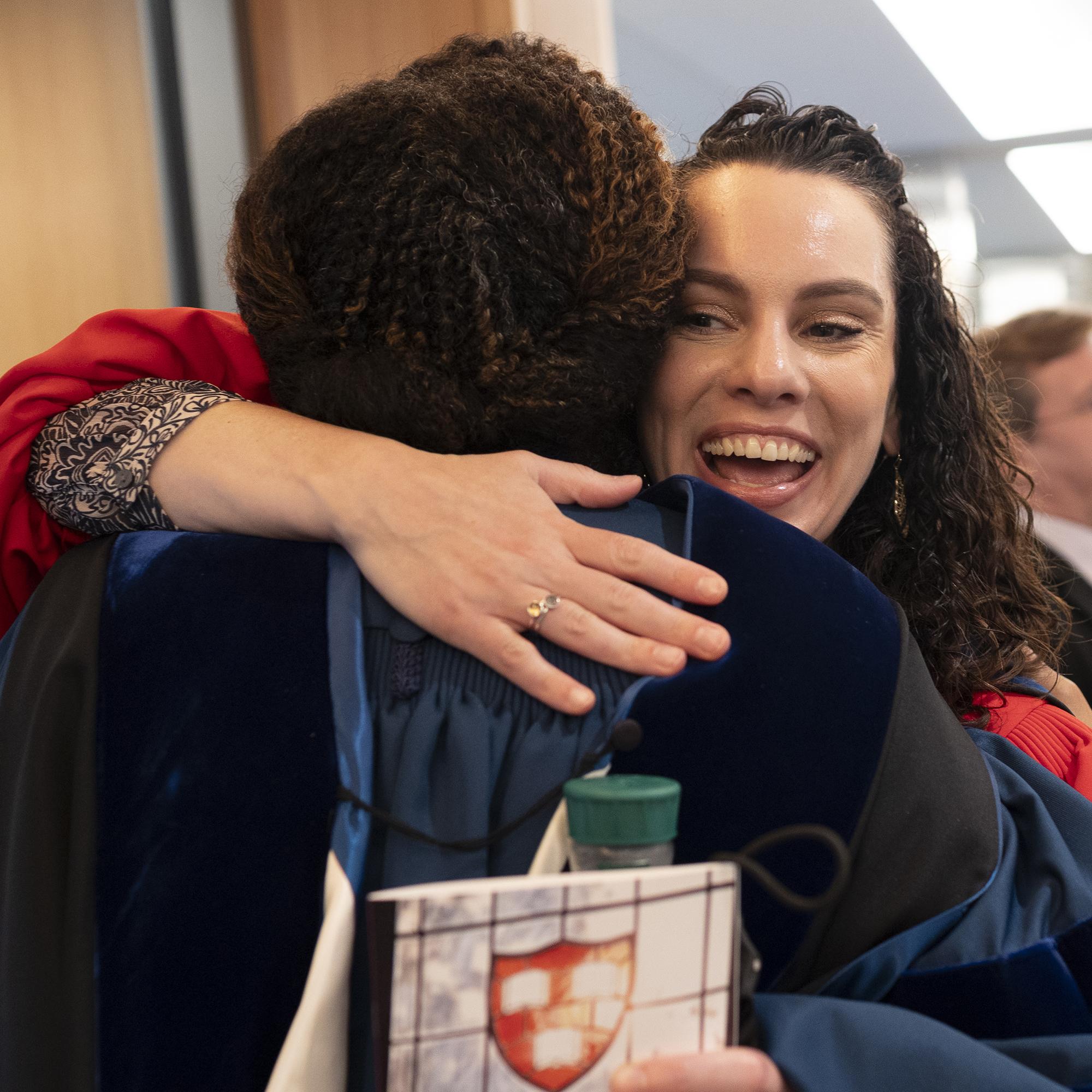
Photo by Katherine Taylor.
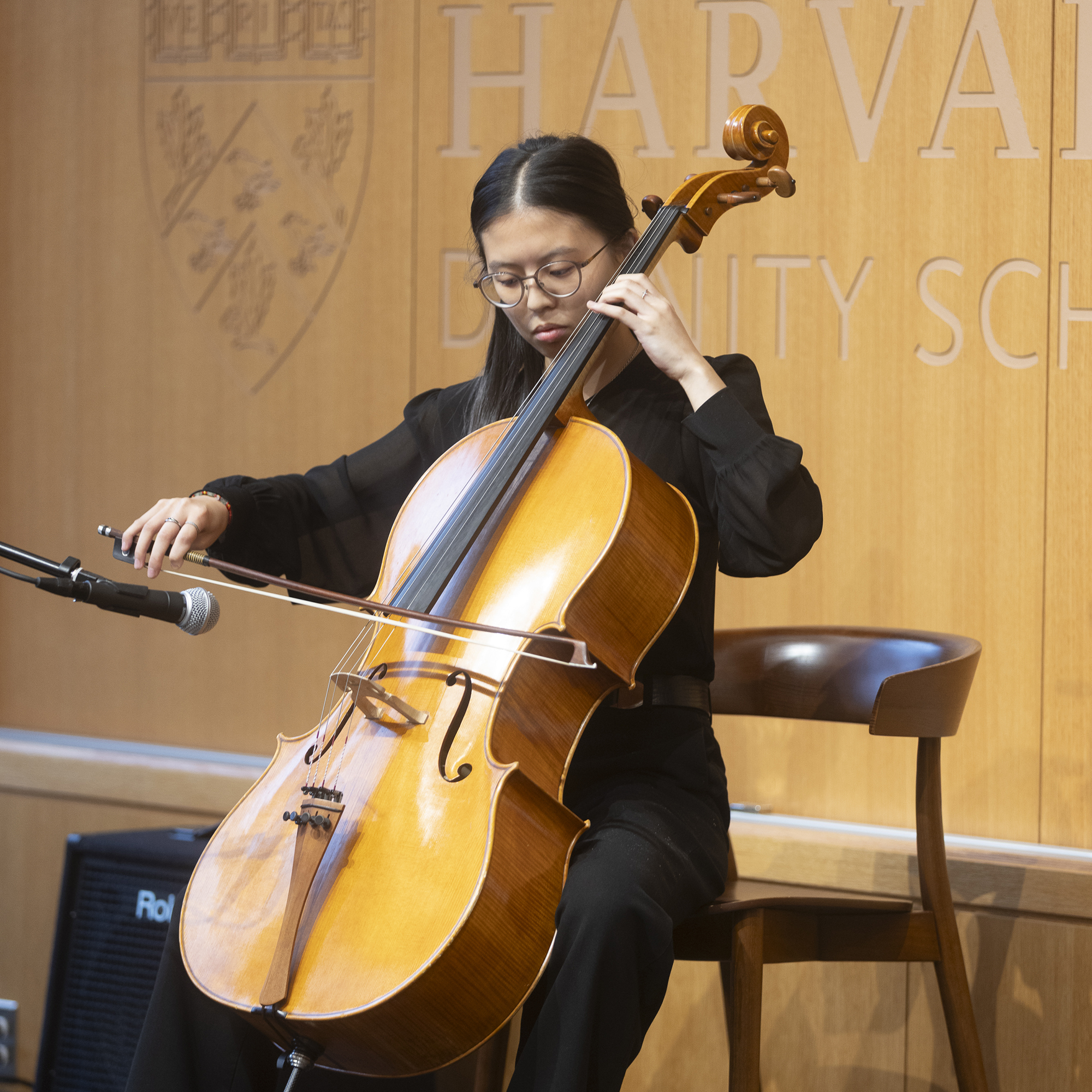
Chieh-Ting Joyce Cheng, MTS '26, plays a musical accompaniment during the 2026 HDS Convocation. Photo by Katherine Taylor.

HDS Dean Marla F. Frederick offers remarks at the beginning of the 211th HDS Convocation. Photo by Katherine Taylor.
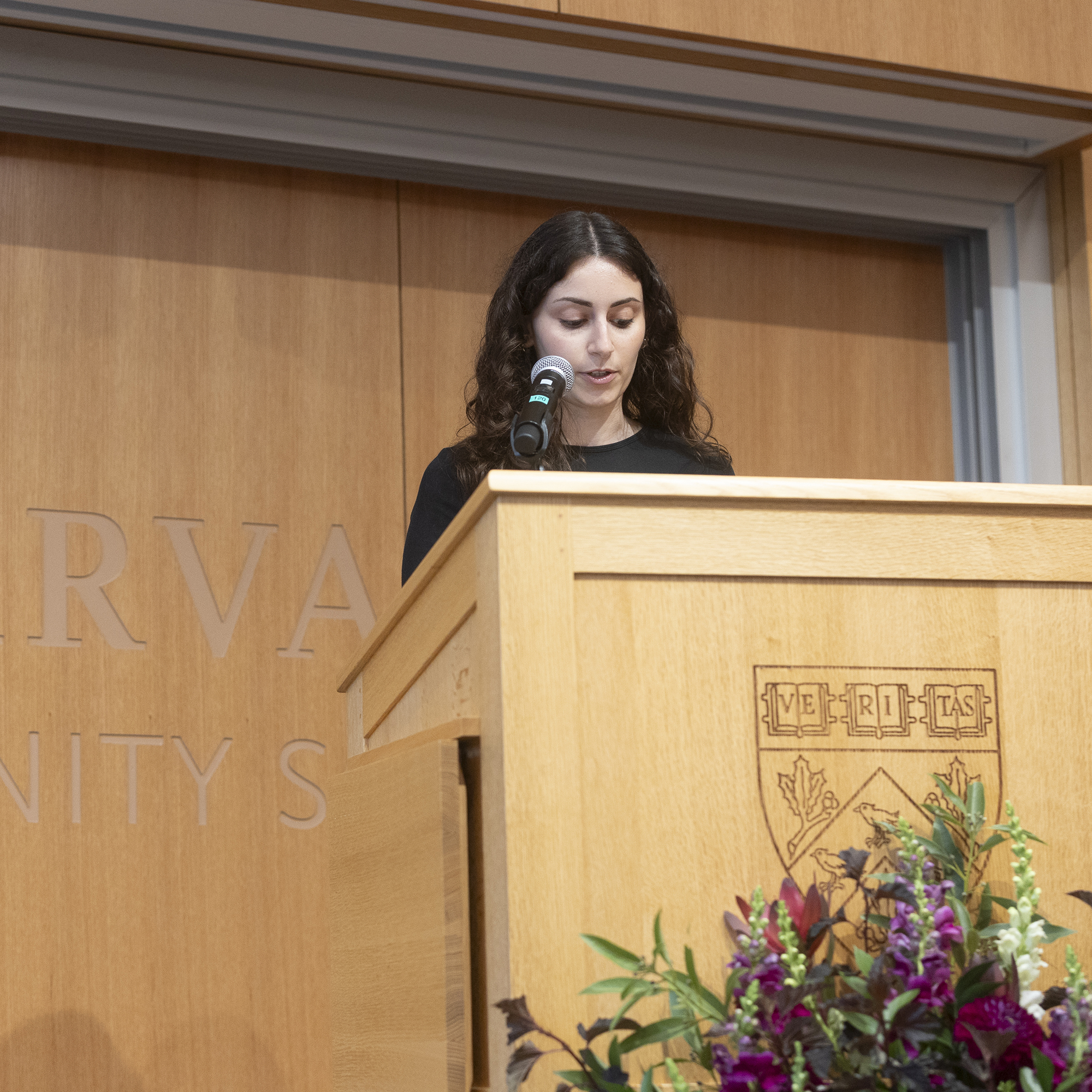
MTS candidate Emma Scharff reads a poem during the Convocation ceremony. Photo by Katherine Taylor.
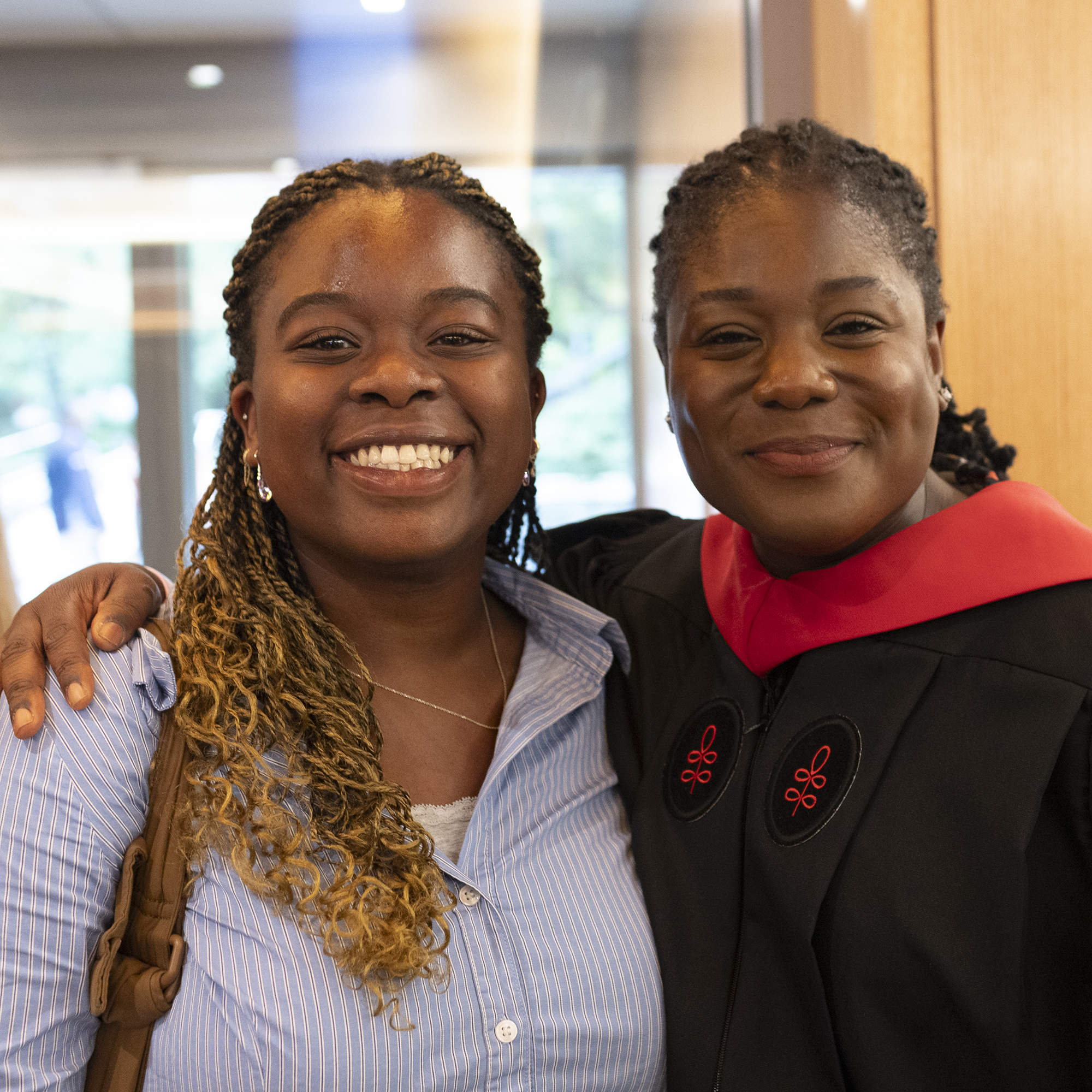
Photo by Katherine Taylor.
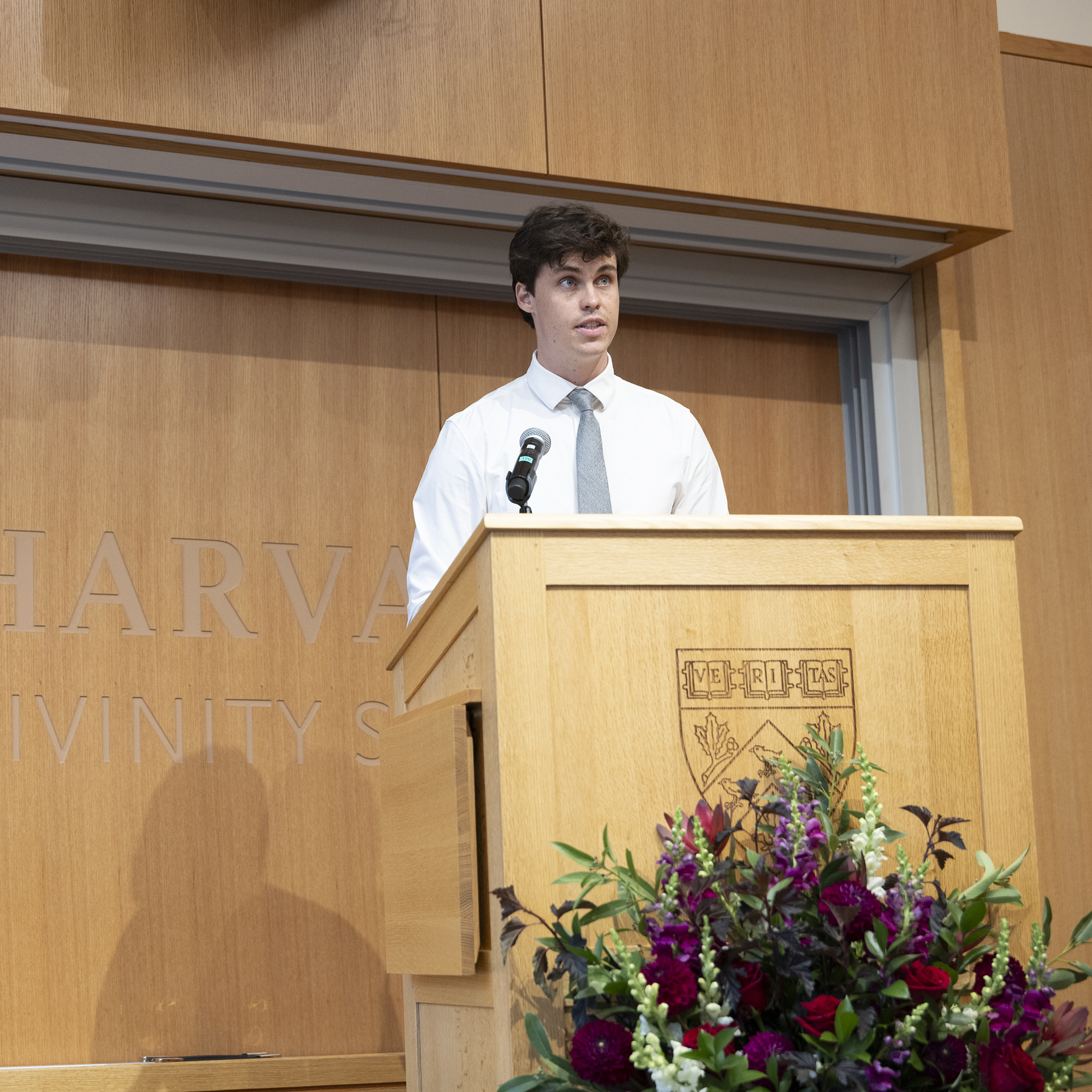
MDiv candidate Clay Wackerman recites a poem during the ceremony. Photo by Katherine Taylor.