

Music as Remembrance and Renewal
Payam Yousefi of the MTO Zendeh Delan Ensemble and Lily Henley brought distinct musical traditions into conversation during a concert exploring faith, practice, cultural memory, and musical heritage.
The sound of the Persian kamancheh and songs in Ladino recently filled Williams Chapel at Harvard Divinity School (HDS) as Payam Yousefi and Lily Henley brought Sufi and Sephardic Jewish musical traditions into conversation.
Yousefi, Assistant Professor of Ethnomusicology at University of Florida, offered a musical presentation that was deliberate and contemplative, transforming poetry into remembrance songs through recitation and accompaniment on the kamancheh, a spiked Persian fiddle. Henley brought a different energy, mixing Sephardic folk songs and original compositions in Ladino, accompanied by her guitar and Duncan Wickel on fiddle.
The event, “Building Harmony: Uniting Across Difference Through Music,” was organized jointly by the HDS Office of Student Life and the Office of Culture, Community, and Engagement at the Harvard Kenneth C. Griffin Graduate School of Arts and Sciences, and co-sponsored by the Presidential Initiative on Interfaith Engagement. The concert explored “The Role of Song and Faith in Healing the Self and the World” and was followed by a facilitated conversation in which the artists discussed their crafts, practices, and the traditions they carry forward.
When singing in the saz-o-avaz style, Yousefi does not prepare a fixed program beforehand. Rather, he enters a concert with poetry and some musical modes in mind, but the music takes shape in the moment, grounded in the Sufi practices of dhikr, or remembrance, and samāʿ, or spiritual listening.
“There are hundreds of lines of poetry in my mind and heart at any given moment,” Yousefi said. “Those turn into the hooks and the grooves when I improvise. I think about it as a practice of centering, using sound and audition as a form of remembrance, centering, and self-clarification.”
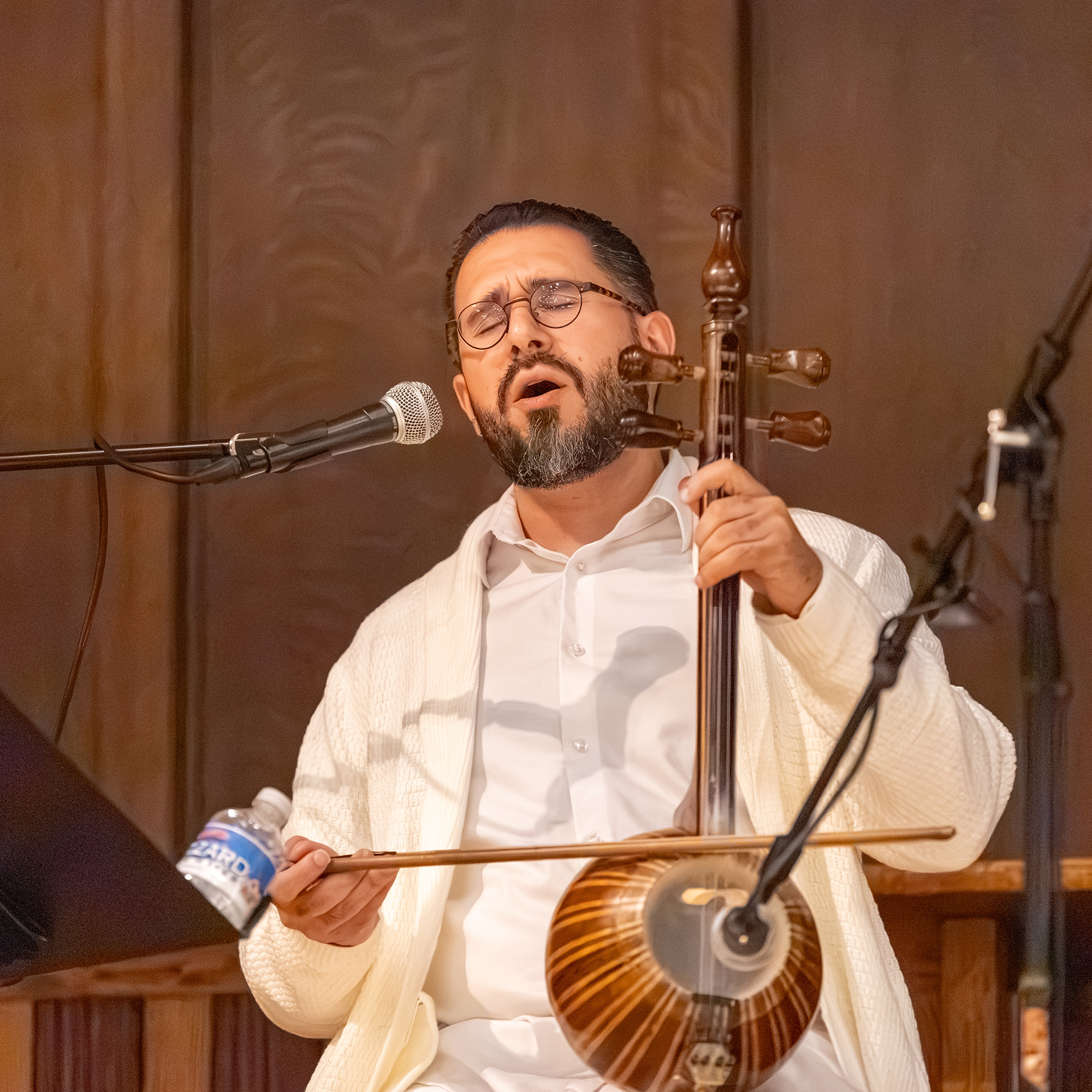
Payam Yousefi, Assistant Professor of Ethnomusicology at the University of Florida, performs during the "Building Harmony" concert. Photo by Azhmeer Jesani.
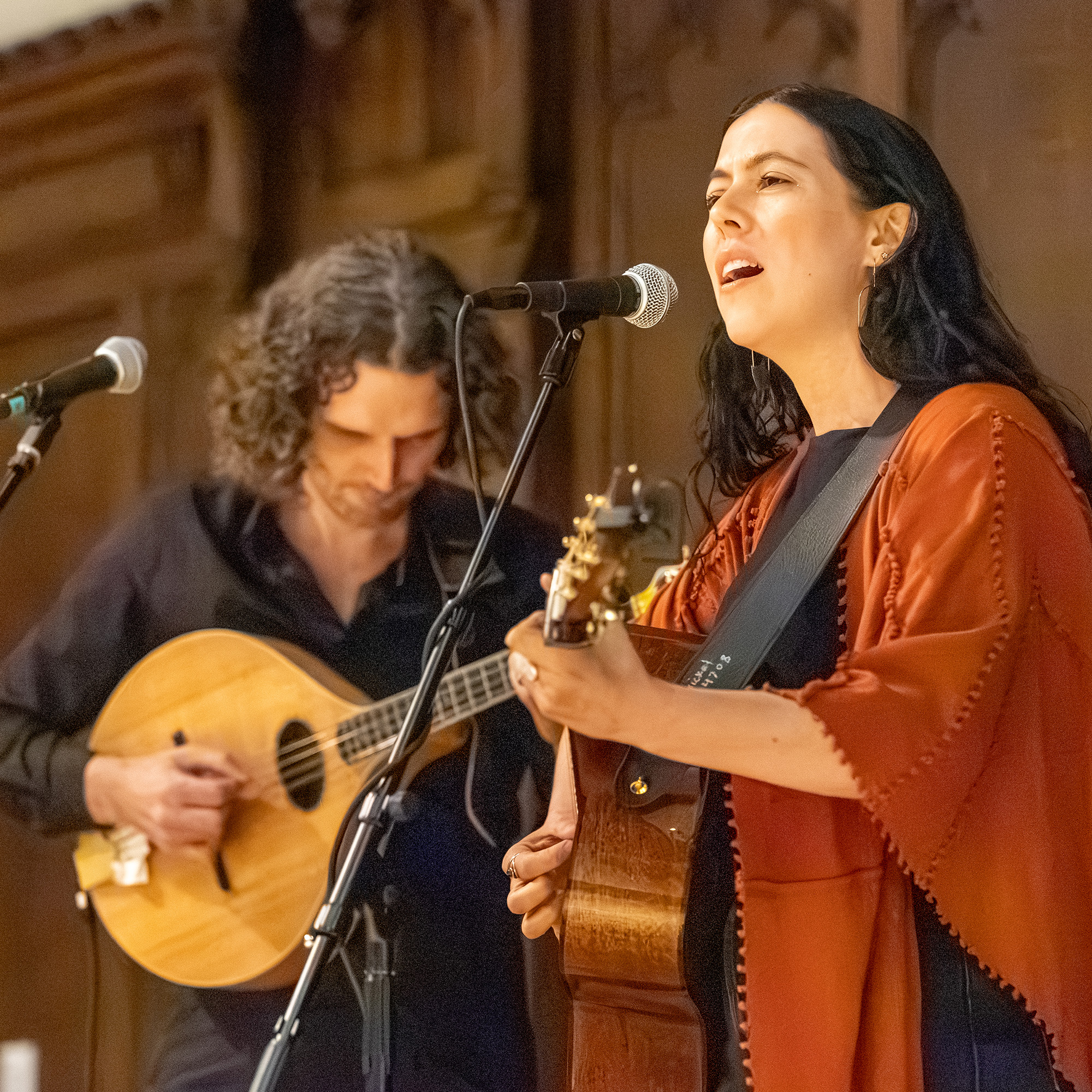
Duncan Wickel (left) and Lily Henley perform during Thursday's "Building Harmony" concert. Photo by Azhmeer Jesani.
Medieval classic Persian poets such as Rumi and Hafiz figure prominently in Sufi music, but listeners in this presentation exclusively heard the contemporary poetry of Professor Sadegh Angha. Centering the poetry of this twentieth-century Sufi master highlighted Yousefi’s comments that “Sufi music is a living practice."
Keeping a musical tradition alive is also central to Henley’s work. A Harvard doctoral student in ethnomusicology, she moves between the secular and the sacred, presenting liturgical hymns alongside love ballads. As both a scholar and performer, Henley sees preservation and creativity as part of the same practice.
“Any vernacular use of Ladino breathes life into an endangered tradition,” Henley said. “When I make traditional Sephardic culture present, that’s important, but I’m also a creative musician and I want to make new music! I make sure everything I create is grounded in something from the past, rooted in that culture.”
In the conversation following the performance, moderated by Harvard ethnomusicology doctoral student Micah Huang, Henley and Yousefi discussed the “why” of their music and the journeys that led them from discovering music as children to becoming bearers of musical traditions.
Yousefi described growing up surrounded by a community that practiced music as a way of looking within. For Henley, singing Sephardic music became an entry point to the Ladino language, as well as a way to pass it along.
“There isn’t a lot of access to older repertoires,” Henley said, “and what I do as a performer is to make it more available.”
Together, the practices and performances showed how preserving musical heritage can be an act of both remembrance and renewal. By bringing these traditions into conversation, the evening invited audiences to listen across difference and hear how musicians keep inherited traditions alive while allowing them to evolve.