

At the Intersection of Religion and Society
HDS scholars explore religion’s influence on public life across a range of dimensions.
The newest degree program at HDS, the Master of Religion and Public Life (MRPL), was established in 2020. At the same time, the School launched Religion and Public Life programming to provide a broad intellectual canopy for examining and deepening understanding of the role religion plays in different dimensions of society. In the words of David N. Hempton, Harvard University Distinguished Service Professor and Alonzo L. McDonald Family Professor of Evangelical Theological Studies, the Dean under whom these endeavors were developed, “Religion and Public Life leverages Harvard Divinity School’s historic strengths in scholarship and ministry studies to address some of the most complex issues facing the world today.”
The MRPL Degree Today
Today, the MRPL degree program, as well as the related Certificate in Religion and Public Life (CRPL) offered as an optional supplement to the Master of Divinity (MDiv) and Master of Theological Studies (MTS) degrees, creates opportunities for students to explore a wide range of fields where religion and public life intersect, including the arts, business, community organizing, education, health and wellness, humanitarian action, journalism, law, media, public service, science, technology, and beyond. The MRPL degree program provides a place for established professionals to explore their work through the lens of religious studies while also bringing their expertise to the School through coursework, connections with fellow HDS community members, and events designed to share knowledge across different fields. In academic year 2025–26, nine students earned MRPL degrees.
Additionally, 21 MDiv and MTS students received certificates in Religion and Public Life. The CRPL prepares students with the tools, skills, and experiences to understand how religion plays out in a range of professional contexts. The certificate program offers experiential learning, including a required internship—providing MTS and MDiv students with the opportunity to work with supervisors who have relevant experience across a range of fields. Last year, 24 CRPL students completed internships in the following professional realms: arts and popular culture, education, government, humanitarian action, journalism, and organizing. Placements included the Boston Faith and Justice Network, the International Center for Religion and Diplomacy, the Network for Empowered Aid Response, and New America, among others.
MRPL at a Glance
- The Master of Religion and Public Life (MRPL) is a one-year graduate program designed for experienced professionals who wish to develop in-depth knowledge of the ways religion influences public life in their fields.
- This program provides a way to understand religion in the context of society. Candidates for this degree have included journalists, government officials, humanitarian workers, educators, artists, healthcare professionals, business leaders, and lawyers.
- Master of Theological Studies (MTS) and Master of Divinity (MDiv) students interested in this work may also earn a Certificate in Religion and Public Life (CRPL).
- To learn more, visit the Master of Religion and Public Life program page
Expanded Reach
The degree program, certificate, and related programming all speak to the vital need to better understand the undercurrents of religion in society—as well as the strong forces religious beliefs can play—across professions at the local, national, and international levels. Throughout the 2025–26 academic year, HDS hosted an array of public events focused on the intersections of religion and public life. Topics ranged from climate and sustainability, to capitalism and ethics, to social movements inspired by different faith traditions. Highlights include the following:
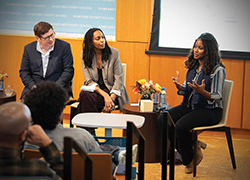
“How Social Values Impact Climate Innovation”
In October 2025, Dean Marla F. Frederick convened a panel discussion to explore the interconnections of ecology, climate technology innovation, interdisciplinary climate work, and questions of ethical and religious values. The panel featured Etosha Cave, co-founder and chief science officer of Twelve, a carbon transformation company pioneering climate technology. The conversation also included Kurt Keilhacker, MTS ’07, a member of the HDS Dean’s Council and general partner at Elementum Ventures, a deep tech venture capital fund that invested early in Twelve. Cave and Keilhacker were joined by HDS faculty member Nikki Hoskins, MDiv ’12, Assistant Professor of Religion and Ecology. Terrence L. Johnson, MDiv ’00, Charles G. Adams Professor of African American Religious Studies and director of RPL, moderated.
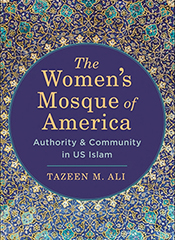
“Gendered Authority of Women’s Mosque of America”
In November 2025, Religion and Public Life hosted a virtual conversation with Tazeen Ali, Assistant Professor of Religion and Politics at the John C. Danforth Center on Religion and Politics at Washington University in St. Louis. Ali spoke about gendered authority at the Women’s Mosque of America (WMA). She presented several chapters from her book, The Women’s Mosque of America: Authority & Community in US Islam, examining how Muslim women at the WMA exercise different forms of religious authority.
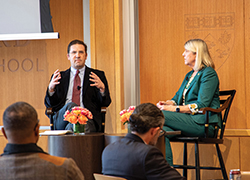
“Capital, Conscience, and Knowledge: Religion and the Common Good in a Market-Driven Society”
In partnership with Arizona State University’s Department of Religious Studies, HDS hosted a conference in March 2026 that addressed fundamental moral questions shaping higher education within market and political economies increasingly influenced by artificial intelligence, digitization, and related social dynamics. Alongside broader themes at the intersection of religion, capitalism, higher education, and endowments, the conference explored how payout rules, restricted gifts, and investment mandates affect academic freedom, moral formation, and public trust.
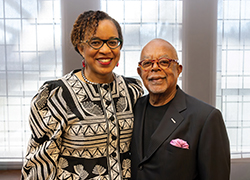
“Black and Jewish America: An Interwoven History”
In his latest PBS documentary, Black and Jewish America: An Interwoven History, Henry Louis Gates Jr., Alphonse Fletcher University Professor and director of the Hutchins Center for African and African American Research, chronicles the intertwined histories of Black and Jewish Americans. This theme was the focus of a March 2026 panel discussion with Gates, co-hosted by HDS and GBH and moderated by Dean Marla F. Frederick. Among the panelists were Terrence L. Johnson, MDiv ’00, director of RPL; Susannah Heschel, MTS ’76, Visiting Professor in Jewish Studies; and the documentary’s co-executive producers and directors, Sara Wolitzky and Phil Bertelsen.
I want to express my gratitude to Terrence L. Johnson, MDiv ’00, for leading this work this past academic year. While we will miss Terrence at Harvard Divinity School, I wish him great success and joy in his appointment as the Mary Lee Hardin Willard Dean of the Candler School of Theology at Emory University. Terrence brought intellectual rigor and a deep commitment to bridging divides to his leadership of Religion and Public Life. Over the past year, he convened a series of important events and conferences to advance the public understanding of religion.
Looking Ahead
Over the past several years, new faculty with a range of interests at the intersection of religion and contemporary society have come to HDS. Scholarly focus areas now include ethical leadership across the domains of AI, business, climate, film, media, mental health, politics, and public service. With appreciation to Diane L. Moore and Terrence L. Johnson for their early leadership of the Religion and Public Life program, this work will be guided by the HDS faculty’s defining vision of a broad intellectual canopy.
Scholarship examining religion and society will continue to be woven into the academic life of HDS. Under the leadership of Associate Dean for Faculty and Academic Affairs David F. Holland, HDS remains committed to supporting MRPL and CRPL students through sustained faculty leadership and continued engagement with the intersections of religion, ethics, leadership, and contemporary public life. “Following one of our most robust admissions cycles in recent history, HDS nearly doubled the size of the MRPL cohort for the 2026–27 academic year,” says Holland. “This fall, we welcomed 17 new students to the program—each of whom brings a dedicated interest in developing greater religious literacy and in using that knowledge to advance understanding, empathy, and human flourishing.”
This work advances one of the central goals of HDS’s strategic plan: preparing students to lead with insight, imagination, and purpose in an ever-changing, multireligious world.
2026 MRPL Students & Final Projects
Students bring a wide range of professional experiences and perspectives to their work. The 2026 MRPL cohort demonstrates the depth and breadth of their scholarship through projects exploring democracy, respectful disagreement, grief, joy, storytelling, AI, ethical decision-making, and more.
Manisha Agarwal
Project: “Ethical Decision-Making and Spiritual Leadership in Corporations”
Adviser: David N. Hempton, Alonzo L. McDonald Family Professor of Evangelical Theological Studies and Harvard University Distinguished Service Professor
Elyssa Back
Project: “Legacy Is a Verb: Moving Community-Focused Donors from Intent to Action in Faith-Based and Secular Philanthropy”
Adviser: Dan McKanan, AB ’89, Ralph Waldo Emerson Unitarian Universalist Association Senior Lecturer in Divinity
Amy Brenneman, AB ’87
Project: “Inflatable Trickster: Joy as Resistance in Liminal Times”
Adviser: Kimberley C. Patton, AB ’80, AM ’86, PhD ’92, Professor of the Comparative and Historical Study of Religion
What I really loved as a returning student was how comfortable it was at HDS for people of all backgrounds and ages. In my nine-person cohort, there were people in their 40s, 50s, 60s … we’re all fairly established in our fields, you know? And I can honestly say that I also became good friends with people in their 20s and 30s in different degree programs! I think that’s because I consciously did not come here as a teacher; I came as a seeker and a student … and regardless of age, as students, we were all in this together. —Amy Brenneman, AB ’87, MRPL ’26
Kathryn Everett
Project: “What Documentary Film Can Offer Us Now: Shared Reality, Witness, and Moral Formation in a Time of Fragmentation”
Adviser: Matthew Ichihashi Potts, MDiv ’08, PhD ’13, Plummer Professor of Christian Morals and Pusey Minister in the Memorial Church
Ric Keller
Project: “Disagree Better: Challenge Ideas, Respect People”
Adviser: Terrence L. Johnson, MDiv ’00, Charles G. Adams Professor of African American Religious Studies
AmarAtma Singh Khalsa
Project: “Building an Architecture of Care: Framing Compassionate Grieving”
Adviser: Stephanie Sears, Lecturer on Spiritual Care
Francine Hermelin Levite
Project: “Who Am I? What Have I Inherited? What If Anything
Do I Want to Do About It?: A Personal Essay on Ideological Reorientation through Letters, Reflections, and Interviews”
Adviser: Shaul Magid, Professor of Modern Jewish Studies in Residence
Jen Serena
Project: “Theology of Tech Reformation: Spiritual Crisis and Constructive Response in the Age of AI”
Adviser: Amy Hollywood, Elizabeth H. Monrad Professor of Christian Studies
Erica Washington
Project: “Locating Ourselves: Sacred Capacities for Democratic Life”
Adviser: Melissa Wood Bartholomew, MDiv ’15, Associate Dean for Community and Belonging and Lecturer on Community and Belonging