

An Exploration of the Past and Potential of Hindu Ministry Studies at Harvard Divinity School
In a recent conversation, HDS faculty, alumni, and students discussed the value and possibilities of Hindu Ministry Studies at the School.
Harvard Divinity School (HDS) has a long history of preparing future religious leaders to serve their faith communities. What began at HDS’s founding as a commitment to training Christian and Unitarian ministers has blossomed into a wider, multireligious focus, one that has expanded offerings in spiritual care and ministry studies at the School to Buddhist, Hindu, Islamic, Jewish, and other traditions.
On Wednesday, November 4, the HDS Office of Ministry Studies convened a panel discussion at the Center for the Study of World Religions (CSWR), “The Dharma Among Us: The Past, Present, and Future of Hindu Spiritual Care at HDS,” that considered the role of Hindu spiritual care in preparing religious leaders and contributing to theological education at the School. Leading the conversation was Parkman Professor of Divinity Francis X. Clooney, S.J., whose pioneering work in the field of comparative theology as both a faculty member and former director of the CSWR (2010-17) has contributed significantly to multireligious pedagogy and community life at HDS.
Clooney was joined on the panel by four HDS community members: current MDiv candidate Nitai Wilson; Sabbi Lall, MDiv ’26, who serves as Instructor in Ministry Studies and Pastoral Counseling at HDS and chaplain resident at Mass General Brigham Hospital in Boston, Massachusetts; Rajeev Persaud, MTS ’24, a Hindu chaplain at Emory University in Atlanta, Georgia; and Swami Tathagatananda, a 2026-27 Visiting Hindu Monastic at HDS.
In her opening remarks, Dean Marla F. Frederick celebrated the expansion of ministry studies at HDS.
“Today, pluralism is at the core of the HDS mission,” said Frederick. “We have specifically deepened curricular and co-curricular offerings around the study of ministry and spiritual care, first with the Buddhist Ministry Initiative, in recent years with the Visiting Hindu Monastics, and now more extensively in the traditions of Hinduism, Islam, and Judaism.”
A Legacy of Hindu Studies
The study of Hindu texts and practices at Harvard and HDS goes back farther than one might realize. The Wales Professorship of Sanskrit at Harvard was established in 1903 as the first endowed Sanskrit chair in the U.S. The first holder of this professorship, Charles Lanman, co-founded the Harvard Oriental Series, a distinguished series of Sanskrit texts and other writings in Indian languages published by Harvard for more than a century; the series continues today. Swami Vivekananda, among the first Hindu spiritual leaders to come to the West, gave a lecture in Harvard Yard in 1894.
According to Clooney, whose Indological scholarship addresses the theological commentarial writings in the Sanskrit and Tamil traditions of Hindu India, the CSWR is tied to this history. When the CSWR was opened in fall 1960, the inaugural speaker was the philosopher of comparative religion Sarvepalli Radhakrishnan, who was then serving as the vice president of India (and would later become India’s second president). Radhakrishnan’s address sketched an early vision of religious pluralism and interreligious dialogue. He also gifted the School a special memento—one that remains on display at the Center.
“The Shiva Nataraja statue in the back of [the CSWR Common Room] is a gift from Radhakrishnan,” said Clooney. “It has been here since that day.”
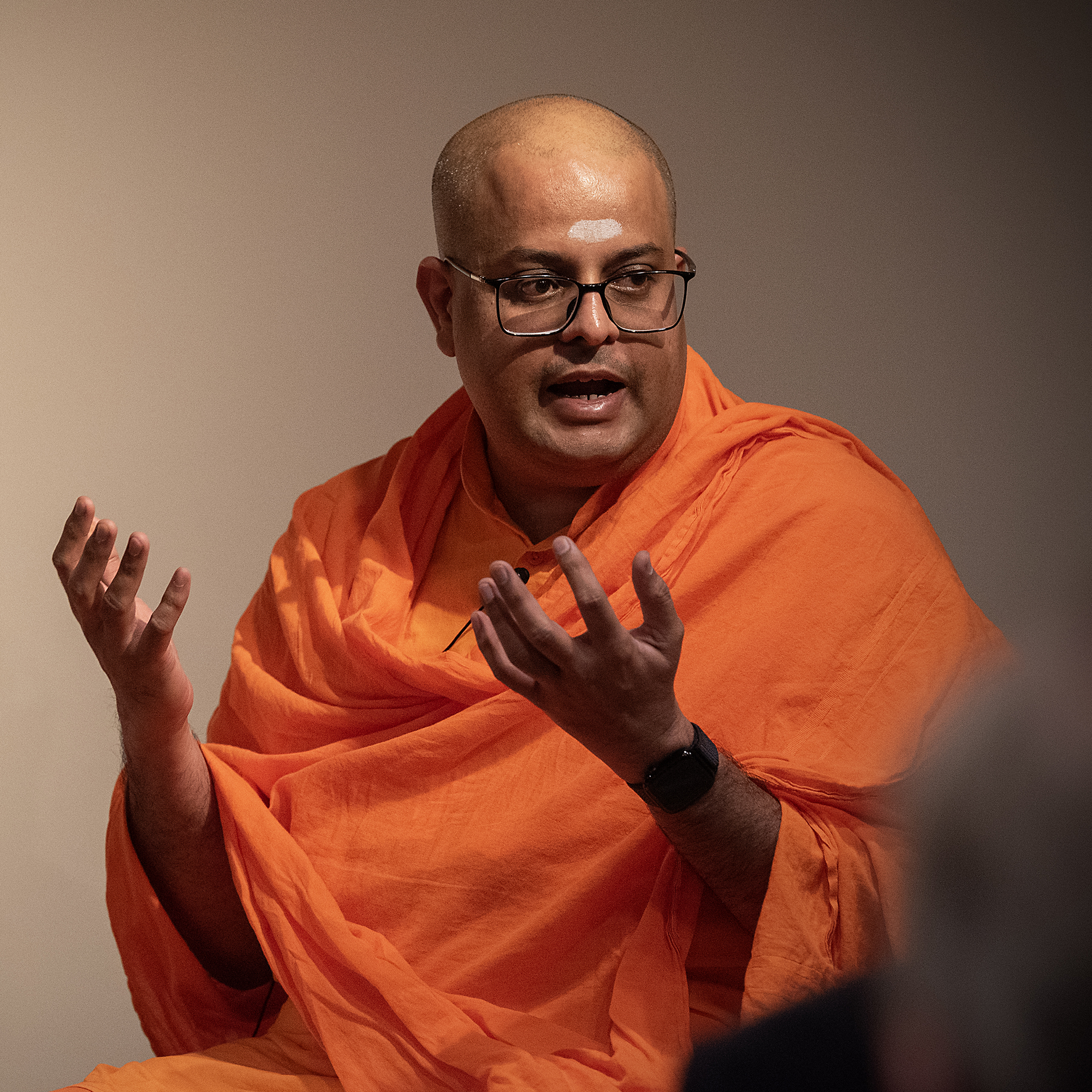
Swami Tathagatananda, a 2026-27 Visiting Hindu Monastic at HDS, speaks during Wednesday's event. Photo by Jeffrey Blackwell.
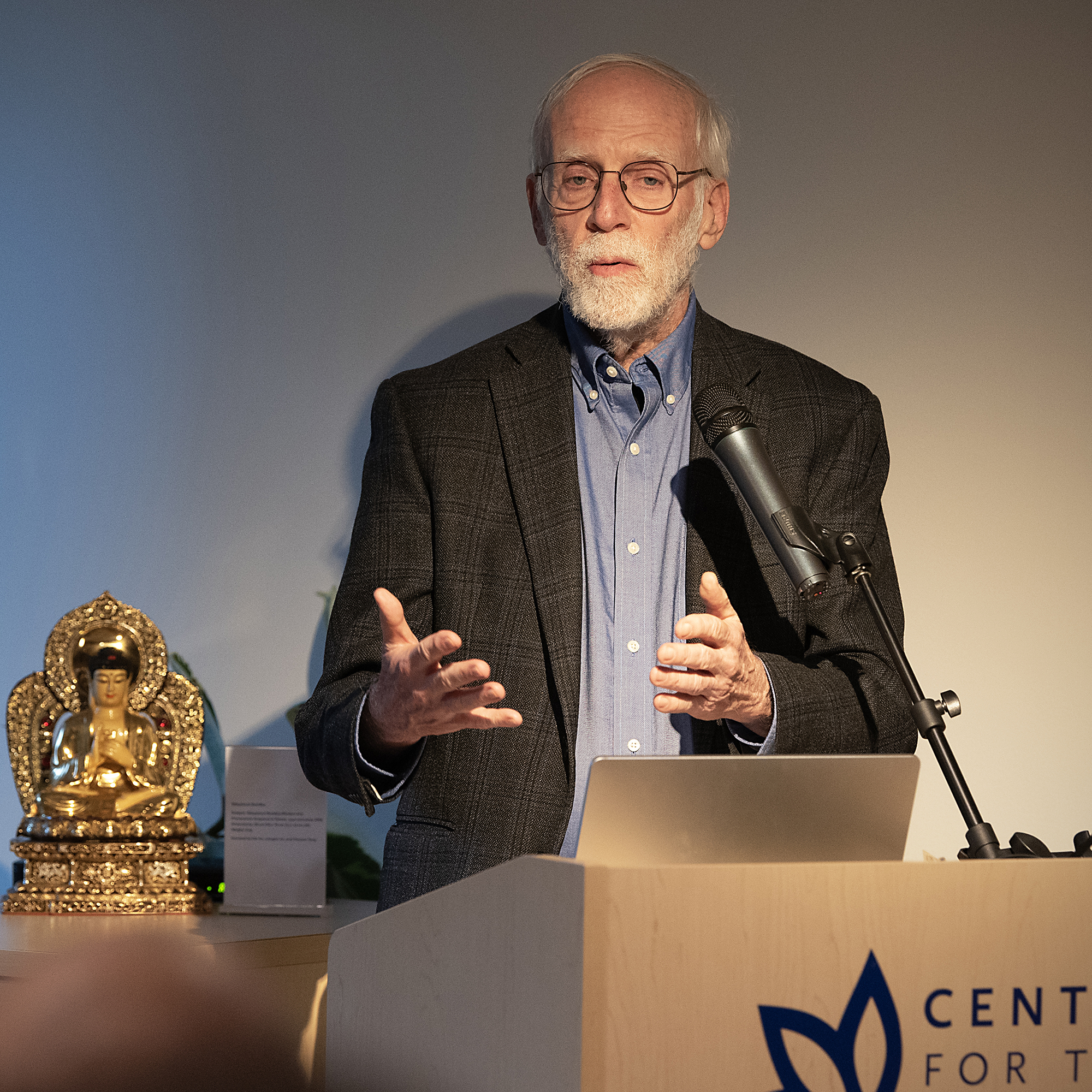
HDS professor Francis X. Clooney, S.J., offers introductory remarks during a panel discussion on Hindu ministry studies at HDS. Photo by Jeffrey Blackwell.
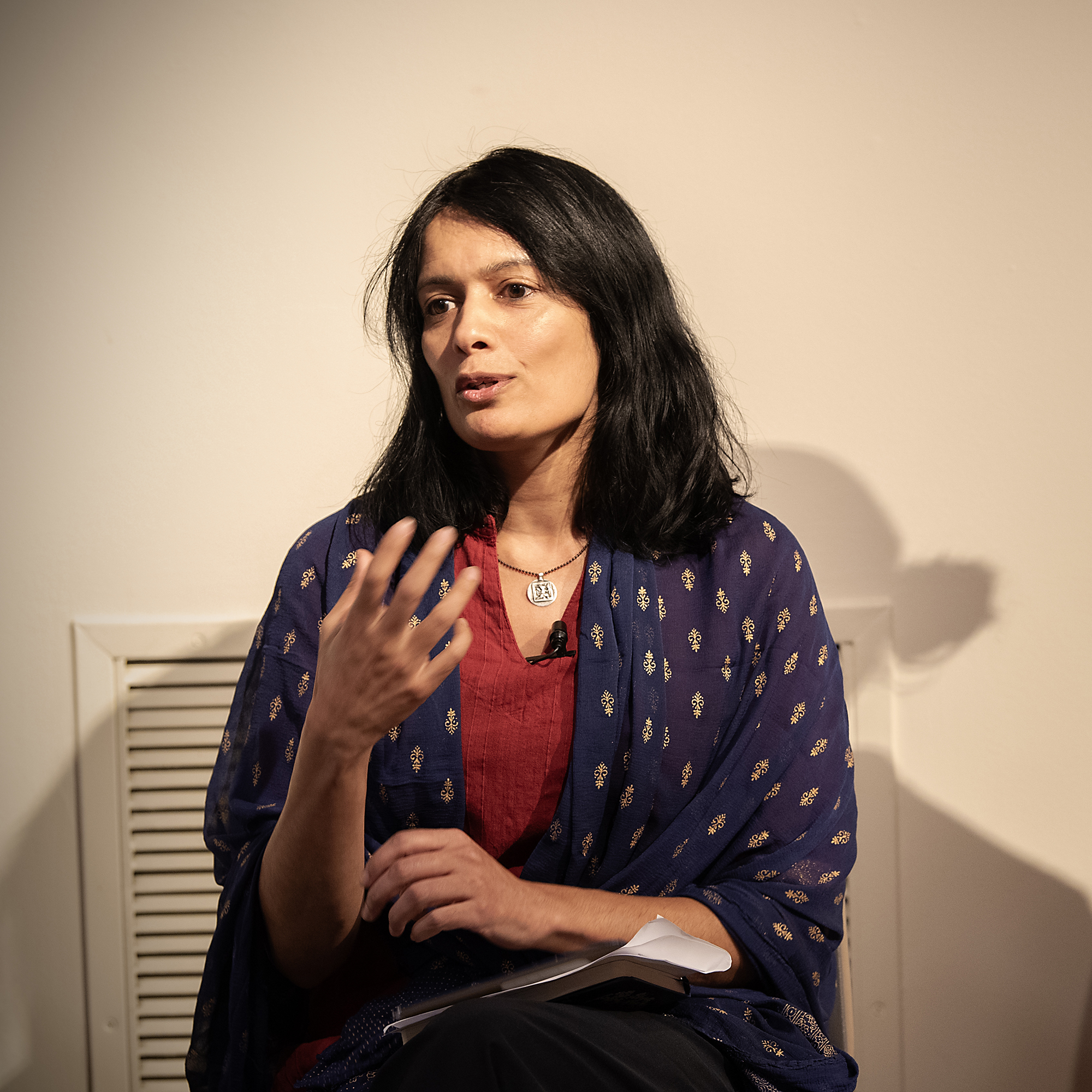
Sabbi Lall, MDiv '26, discusses how her time at HDS has impacted her work as a chaplain. Photo by Jeffrey Blackwell.
Clooney named several influential scholars in Hindu studies that have been affiliated with the Center, including Professor of Comparative Religion and Indian Studies Emerita Diana Eck, whose scholarship on India focused on popular expressions of religion; Parkman Professor of Divinity Emeritus John B. Carman, the former director of the Center and former Dean of HDS whose work centered on Hindu traditions and South Asian religions; and the Indian philosopher J.L. Mehta, who lived at the Center for a time and regularly taught at HDS over a span of 20 years.
He also discussed the important role of the Visiting Hindu Monastics program within this context, which started in 2019.
“We’ve had around a dozen swamis here since then,” said Clooney. “They’ve immeasurably enriched our community through their work in the classroom and all the ways in which they’ve been part of our community.”
The Value of Hindu Ministry Studies at HDS: Four Perspectives
The panel explored the value of the study of Hindu spiritual care at HDS, sharing how the School prepares students to lead in various settings. Persaud, whose first day at HDS coincided with the first day of Assistant Professor of Hindu Studies Swayam Bagaria, shared that his conception of Hindu ministry was transformed at HDS. Originally trained as a priest serving Toronto’s Indo-Caribbean diaspora, Persaud testified to the paradigm-shifting nature of the School’s Hindu studies curriculum—enabling him to move from being “a chaplain who is Hindu” to “a Hindu chaplain.”
“The Hindu chaplain is one who is trained with the necessary academic frameworks to make sense of ‘Hindu-ness’ within community,” said Persaud. “It’s why a place like HDS is so important. I feel the program gave me the frameworks to do my university chaplaincy effectively—not only the frameworks related to my own tradition, but those of other traditions as well. Having knowledge of a wide range of spiritual traditions is important in my work.”
Wilson, a second-year MDiv candidate and active member of the HDS Ganga student group, came to HDS by a circuitous route. Living as a monk in a temple for two years, and then as a priest for five years after that, he later found himself in Northern Utah. Needing community, he became involved in a Unitarian Universalist Church. As his leadership responsibilities grew and he became responsible for the care of community members’ spiritual needs, he realized he needed further training.
“I realized that if I was going to provide spiritual care, I needed to learn to do it ethically,” said Wilson.
Wilson spoke to the impact of the curriculum, particularly with its ample offerings of Hindu language courses, which have been important in his formation.
“A full half of my classes here are language classes because the reality is, the Hindu traditions don’t happen robustly in English,” said Wilson. “If you want to experience the depth of Hindu philosophy and traditions, you need to be rooted in Sanskrit. I’m also connected to South Indian forms of Vaishnavism, so the Tamil language also forms the backbone of the texts and traditions that have made my life so meaningful.”

Today, pluralism is at the core of the HDS mission. We have specifically deepened curricular and co-curricular offerings around the study of ministry and spiritual care."
For Lall, whose journey to HDS began when she realized she wanted to be better equipped to address her yoga students’ spiritual concerns during the COVID-19 pandemic, her time at HDS gave her the tools, such as counseling techniques and a deepened knowledge of the Upanishads, to be an impactful chaplain. She recalled a transformative moment during her work at Mass General Brigham, one that further testified to the importance of quality training in Hindu spiritual care.
Early on in her tenure, she was called into a patient’s room. When she walked in, she saw an image of a famous Indian guru resting on the table. When the patient saw Lall, her eyes opened wide.
“She couldn’t believe that someone who looked like me was walking into the room, someone who understood the years she’d spent with the guru in India,” said Lall. “I sat with her. I was present with her. We talked. By the end, we recited ‘Asato ma sangamaya’ together. The suffering was still there, but she felt seen. There’s such a need for this—more Hindu chaplains in these spaces.”
During his time as a Visiting Hindu Monastic at HDS, Tathagatananda has relished the academic opportunities afforded by the School. With a PhD in economics from a top university in India and a decorated academic background, he was especially drawn to HDS by the chance to study in a multireligious academic environment.
“In one of my current classes, ‘Who Needs God?’ with Professor Clooney, I’d already studied the Hindu texts we read,” said Tathagatananda. “But I am now studying them in comparison with Christian texts, for instance. This kind of contrast gives me a lot more insight into my own tradition. I’m seeing it in a different light—one I could have never imagined.”
Looking Ahead: The Future of Hindu Studies at HDS
In the years to come, HDS plans to continue expanding its offerings in Hindu ministry studies. In light of the impact of the Visiting Hindu Monastics, the community has experienced the different perspectives and approaches inherent within Hinduism—something HDS hopes to continue highlighting through the planned Hindu Ministry Initiative.
For Clooney, the CSWR panel was a chance to put into practice the communal work necessary to move forward, reflecting on and imagining together what might come next.
“Through today’s event, we’re asking ourselves, can we celebrate where we’re coming from over the past century or more, can we celebrate what is happening right now, and can we imagine together where we will be in the next decade? Will we be ready for that future, with the resources we need?”
Banner photo by Jeffrey Blackwell.
SPEAKER 1: Harvard Divinity School.
SPEAKER 2: "The Dharma Among Us, The Past, Present, and Future of Hindu Spiritual Care at HDS," November 4, 2026.
MARLA F. FREDERICK: Good afternoon, everyone. I'm Marla Frederick, and as dean of Harvard Divinity School, it is my absolute joy to welcome you this afternoon to today's event, "The Dharma Among Us The Past, Present, and Future of Hindu Spiritual Care at HDS."
Our discussion today focuses on the preparation of leaders in Hindu spiritual care, as well as contributions of Hindu studies to the broader field of theological education through the multi-religious context of HDS. Harvard has a long tradition of learned ministry dating back to the University's founding in 1636.
Since then the Divinity School has deepened and expanded spiritual care offerings, building on the school's historic strengths in Christian and Unitarian ministry. As the world became more multi-religious and pluralistic, academic and ministerial preparation at HDS evolved. Through the Center for the Study of World Religions, in which we are gathered, HDS expanded its academic expertise well beyond the study of Christianity and Unitarianism.
Today, this pluralism is core to Harvard Divinity School. In more recent years, we have specifically deepened curricular and co-curricular offerings around the study of ministry and spiritual care, first, with the Buddhist Ministry Initiative and in recent years, with visiting Hindu monastics and now, more extensively, in the traditions of Hinduism, Islam, and Judaism.
These efforts bolster the HDS vision to research and teach the varieties of religions in service of just world at peace, across religious and cultural divides. With this vision as a guide, the school prepares students to teach and research at colleges and universities around the world to lead diverse, faith-based, and nonprofit organizations and to serve the spiritual needs of community members as ministers and chaplains in religious organizations and multi-faith settings.
Professor Frank Clooney has lived out this vision in truly inspiring ways. As a brilliant scholar of Hindu theology, religious history in India, and the Tamil and Sanskrit languages, as an insightful leader in developing the field of comparative theology, as a dedicated teacher and a translator of the practice of spiritual care as a Jesuit priest, with deep regard for Hindu traditions and all human beings.
Prior to the current director, Charles Stang, of the Center for the Study of World Religions, Frank served as the director from 2010 to 2017. You will surely hear the echoes of his teaching and mentorship through today's conversation. Frank, we are deeply grateful for your immense contributions to the study of religion, to HDS, and to our students.
[APPLAUSE]
I also want to recognize Professor Swayam Bagaria, who is on leave this year, luckily, on leave this year. As an anthropologist of religion and assistant professor of Hindu studies, his scholarship illuminates many ways that spiritual and religious beliefs are part of life in contemporary societies, with a focus specifically on India.
He recently received a grant from the Templeton Foundation to develop a new program to train mental health professionals to better understand the religious and spiritual lives of the communities they serve. In all of these areas of study and practice, centering our shared humanity is vital, not only for successful leadership across an array of traditions and professions, but also, for the health and well-being of the organizations and institutions HDS graduates are called to serve.
We now, have the privilege to hear from community members who know this work well. Francis Clooney, SJ, Parkman professor of divinity and professor of comparative theology, who will be leading today's panel discussion; Rajeev Persuad, a 2024 graduate of HDS, who currently serves as the Hindu chaplain at Emory University; Sabbi Lall, a 2026 graduate of HDS, who is a trained scientist, a scientific editor, a yoga and meditation instructor, and a hospital chaplain; Nettie Wilson, who is currently an MDiv candidate here at the school; and Swami Tathagatananda-- I got it, right? Yes-- joining the HDS community as a visiting Hindu monastic this year. please join me in thanking each of our guests for sharing their time, insights, and expertise with us today.
I would also like to take a few moments to thank many people here at HDS who helped make events like this possible, especially the development ministry studies, and facilities teams, as well as each of you for joining us here for this conversation. Again, thank you for joining us today to hear more about the past, present, and future of Hindu spiritual care here at HDS. Without further ado, I'd like to turn the microphone over to Professor Clooney.
[APPLAUSE]
FRANCIS X. CLOONEY: Thank you, Dean Frederick for a lovely introduction. And you're right. So many times in this room, I introduced events, and being back up here is a wonderful experience in this beautiful space. So it's great to be here today.
Briefly, I'd just like to point out the long history of Hindu studies at Harvard University. I was checking online and figuring things out. The Wales Professorship of Sanskrit, one of the oldest in the United States, goes back to about 1900, when Charles Lanman was the first holder of the professorship, and he also was one of the founders, with Henry Warren, of the Harvard Oriental Series, which is a distinguished and ongoing series of Sanskrit texts and other texts of Indian languages that are published by Harvard over the last century plus. So it goes quite far back.
And then in a very distinguished way, even earlier, in 1894, Swami Vivekananda, one of the most famous of the early Hindus to come to the West, gave a lecture in Sever Hall in Harvard Yard. And talking about the universal message of Vedanta for the world, about 10, 15 years ago, Swami Tyagananda of the Ramakrishna Vedanta Society in Boston and I hosted an event there commemorating the 1894 lecture. But Swami Vivekananda has roots in this space as well, and we look back to him.
This building, the Center for the Study of World Religions, was opened in 1960, and the opening day speaker was Dr. S. Radhakrishnan, Oxford scholar, President of India, a well-known, respected figure. And the Shiva Nataraja statue in the back, the murti there on the stand against the wall is a gift from Dr. Radhakrishnan. And that's been here since the opening of the center back in 1960.
And connected with the center, many fine scholars have come through this space. Our own Diana Eck, who has taught almost 50 years at the University and continues to have roles at the University even now. John B. Carmen, who was for the longest serving director of the Center in Hindu studies, Hindu-Christian studies, lived in this space and led so many wonderful programs here.
The Indian philosopher, JL Mehta, a well-respected, universally-known scholar, lived in this space and again, over a 20, 25-year period came regularly back to Harvard to teach at the center and at the Divinity School. And if you go upstairs to the library, which you can do on your way to the reception, there are so many dissertations up there by scholars who became well-known scholars of Hindu studies.
So the center has a long history of Hindu studies and the Center, therefore, as part of the school has that relationship. The Hindu View of Life lecture, which goes back to 2016, wonderful gift from Mr. Akhilesh Gupta, was a gift to enable that there be echoing Dr. Radhakrishnan's work in annual lecture on the Hindu view of life.
Professor Vasudha Narayan of the University of Florida gave the first lecture in 2016, and only a few months later, Professor Arvind Sharma gave the second lecture. He also finished his PhD here in 1978 and he passed away recently. So a great man, one of the first Hindu scholars tenured in the North American context, studied here, lived here at the Center, and we still remember him fondly.
And many teachers over the years. I won't go into detail because my time is very short. Professor Anne Monius, who is a great scholar, a great member of this community who passed away far too early in 2019, we still miss her. You mentioned Swayam Bagaria, who's on sabbatical, up and coming scholar, anthropologist, contemporary Hinduism in India today. And I've been here since 2005 and happy to be part of this context.
In the front of the building, as you go out, there's a meditation room. And when we opened the meditation room in 2010, Swami Tyagananda, the Ramakrishna Swami here in Boston, came over and chanted and did a formal house blessing for the space. And we had an Indian quartet with a sitar and so on like that, music to accompany it. So there's a resonance in the space of the Hindu blessings in this building itself. And Swami Tyagananda was part of it.
And then three times he and I taught a course, Introduction to Hindu Spiritual Care, beginning in COVID, and then two more times after that, gathering students, both Hindu and of other faith traditions, to think about Hindu spiritual care from a Hindu perspective, and to learn across the boundaries and to bring in experts on Zoom in campus ministry, hospital ministry, hospice care, and so on. So a very rich experience. And one of our speakers today, Sabbi Lall will be taking that over in the spring and teaching the course, and we're excited to pass it on to new and young hands. So we're looking forward to your presentation.
The monastics program, as our dean just mentioned, has been flourishing since 2019-20. It was a brilliant first year until suddenly, COVID sent everyone scurrying home in March of 2020. But we've had about a dozen swamis coming in-- monastics, men and women-- over the years since 2019, immeasurably enriching our community, learning a lot from being here, from our studies and so on, but also, in many ways, enriching us by their presence, by their work in the classroom and all the other ways in which they've been part of our community.
Last year's swami who was here, Keshava Swami, who's now back in the UK, he emailed me oddly only yesterday. It was perfect timing for this, that he was so impressed by his time here at HDS, he's writing a book about his year here called Ashrama to Academia, A Swami at Harvard University. And he's a very well respected writer, and he'll be talking about what did it mean to be a swami in this space and on this campus, and we look forward to seeing his book when it comes out.
And then finally, Gunga, our student Hindu organization, has done so many wonderful things since being founded, maybe three years ago, four years ago. Wonderful group. Many services, gatherings, prayer meetings, cultural events, music events, often in this space or in Swartz Hall across the street. And things like today's noon service, the Diwali Puja today. There'll be also a Puja on Friday at 5 o'clock, followed by a dinner. Any of you are welcome to come back, if you're able to come back for that, and other events on and on that the Hindu community at HDS is making happen and enriching the lives of all of us in this multi-faith community.
And I think one of the questions arise by today's event is really to ask ourselves, can we celebrate where we're coming from over the past 100 plus years, can we celebrate what's going on right now, and where will we be in 5 or 10 years? Who will be the leaders of this initiative, and how will it go forward?
And I think we have four of the answers here. Four young people who will speak to us. So they've already been introduced. Rajeev, who graduated in 2024; Sabbi, who graduated in 2026; Nitai, who will graduate someday in the future, probably two years from now; and Swami, who's only been here a few months, but has made a wonderful impact on the community.
So our procedure will they'll open with seven-minute statements each, more or less about their experience, introducing themselves in any way that they wish. And then after that, I have a few questions to pose to them. They know the questions already, so it's not a gotcha thing, but questions, basically, for them.
And then a little bit back and forth and then open it up to the community for further discussion. And when we finish near to 5:30, there's a reception up in the front. So we look forward to this event, and I invite Rajeev to come up and to speak from there.
RAJEEV PERSAUD: Yeah. Awesome. Thank you so much, Professor Clooney. Good evening, everybody. My name is Rajeev. As Professor Clooney and Dean Frederick said, I'm the Hindu chaplain at Emory University, where I've been since graduating from here in 2024. But I'm originally from Toronto, so I'm very proud of my Canadian roots.
Before coming to HDS, I was trained as a priest in the Toronto area, serving the Indo-Caribbean diaspora, which is the community that I am from. And so I came here as a way to maybe round out that practice in the academic space, which, with all said and done, happened, but took on a very different kind of direction after I left.
My time here was very formative I would say in three main ways-- spiritually, academically, and also, in the way of my identity, in the way that doesn't relate to those two things. And I think that is almost entirely because of the Hindu studies experience that I had here.
Foremost among the people who I met here is Professor Clooney, who my friends always joke that he's my Catholic grandpa. And I share a close relationship with him, I still do, and we still communicate, as well as with Swayam Bagaria, who you've heard of.
My first day of class was his first day of class, and so we share a good relationship in that way. But my time here, I want to speak about maybe those two things more broadly, the spiritual transformation or spiritual formation and the academic formation. So the spiritual formation, as is the case with most people who come here, was very challenging.
For the first time, I was forced to critically examine the things I believe. What do I believe? What is its validity? What are the truth claims? So on and so forth. That was challenging. And then academically, in a related way, it's the first time that you're getting to deal with texts firsthand and analyze and read commentaries, read them in their original language and so on, and then have scholars who have studied this and made a life of this to guide you through all of that.
In the vein of what we're talking about today, spiritual care, how it exists and how we hope to take it further, in the university space, Hindu chaplaincy revolves almost entirely around religious literacy. And so CPE, clinical pastoral education, chaplaincy training is vital, of course, but in the way that I'm thankful that I don't have to deal with a lot of traumatic things in the University space that a person in the hospital space might have to.
In turn, what I'm dealing with mainly is spiritual formation, is how our students making sense of their belief, especially in the 21st century diaspora, how are they negotiating their Hindu identity with their experience in the University space. And religious literacy is central to all of this. And it begs the question for me is, when entering this field of university chaplaincy, are we producing Hindu chaplains or chaplains who are Hindu?
And that's been a central idea for me in this whole experience for these last three academic years, working in that space. And the difference is, a chaplain who's Hindu is, as the term entails, the person doing the pastoral care and coming from a Hindu identity, Hindu affiliation, Hindu background. But the Hindu chaplain is one who is trained with the necessary academic frameworks to make sense of that Hinduness in the context of the university space.
And that's really unique about that space. But also, I feel in my experience and talking to other students, underserved, which is why a place like this is really important. And the program that has been built here and we hope to build further is really important, that do I have, in addition to the traditional training, the language training and my own personal practice? Do I have the frameworks to bring this into a different context?
Do I have the intellectual frameworks that aren't necessarily specific to Hindu tradition? And that's another important thing about the pluralistic training here is I'm learning from other religious traditions how they make sense of certain ideas. I got to talk to Nitai earlier about learning about Aquinas and Ramanujacharya, and how they both understand incarnation, which are both really important ideas, but they don't understand the same ways, and they complement each other.
And specifically, in the university context, what are the ways that Hinduism appears in the political discourse, in the social justice discourse? How are students able to square their Hindu identity or Hindu teachings with the political discourse, with the social justice discourse, which are, obviously, at the forefront of thinking in student life. At university, students want their ethics and their religion to be squared.
And so in the way that that's part of my job, the foundation that I receive here helps me to do that in an immeasurable-- there's no metric that can quantify the ways in which this has been central to me being able to do that is what I can say for now.
MARLA F. FREDERICK: Great. Thank you.
RAJEEV PERSAUD: Thanks.
SABBI LALL: Hello. I'd like to start just by thanking the organizers for inviting me. Thank you for your wonderful introduction, Dean Marla, and thank you, everyone, for being here this afternoon/evening.
So I'm Sabbi Lall. I graduated just very recently, in May 2026, here from Harvard Divinity School and from the Masters of Divinity. And I now work as a hospital chaplain, and I do some work guiding practices at Tufts University as well.
And I will say that Harvard Divinity School has been absolutely essential to my journey. So I was a scientist in the lab, helping write grants in the cognitive sciences, and I love that, and I'm still very connected to that world. But during the pandemic, I had been teaching yoga and meditation on the side, and suddenly, they came front and center.
And not only did they come front and center for me, but my students would stay after class, and they would tell me about their losses and this includes students from India who were at MIT, their losses, their loneliness. And I made yogurt. I don't what to do. I love the history and philosophy of yoga. I teach a little bit of Sanskrit, but I'm not equipped for this. I'm not a counselor.
And that's when I applied to Harvard Divinity School, and to my absolute shock, they admitted me as a scientist. And yeah, my time here taught me that I have what it takes and gave me the tools in courses like spiritual care and counseling, the Upanishads, that I have the wherewithal. And I discovered that I already had the presence and compassion, and that's what's at the heart of chaplaincy and spiritual care, presence and compassion, and built the confidence to go out there and use it, and boy, is it needed out there.
So I work in the hospital, as I said, and let me share a couple of stories with you. And I remember walking into a patient's room. For some reason, I expected a Roman Catholic, so I was ready for that, because we get called to a lot of Christian patients because they know that chaplains are there and spiritual care is there for them.
And when I walked in, this patient had an image of a very famous Indian guru on the table, and her eyes just opened wide. She couldn't believe that someone who looked like me was walking into the room, someone who understood the years she'd spent with the guru in India, someone who understood that, although she understood the teaching intellectually of the Gita, that passing through death is almost like a change of clothes. That in the terrible pain that she was in that moment, it was very hard for her to hold that teaching closely.
And I sat with her. I was present with her. We talked, and by the end of the visit, we recited Asatoma together. And the suffering is still there. It doesn't change her circumstances, but she felt heard, and she felt seen. And I've seen other patients like that, patients in the diaspora and different from another part of the world who are here and are now facing the idea that although they're great devotees of Shiva, they may never see his great temples in India. And of course, Shiva is everywhere, and so we discussed those things.
And so I will say that we are very much needed out there. But the Hindu Hindu-inflected spiritual care is particularly needed, and there are very few of us who are trained to do this and really serve Hindu patients out there.
Chaplaincy, its origins really are in the Christian tradition and in the work of people like Anton Boisen, he was Christian, and he was brilliant. He understood that to be sick isn't just to tend to the body, psychology, and social circumstances, it is also to tend to the spiritual and the divine for everyone, their transcendence, their connection.
And so his teachings are brilliant. And my calling now, is to really make sure that this kind of presence and compassion reaches everybody, and it reaches people with a Hindu background too. Because as I mentioned before, even my hospital badge, in big words, it says chaplain. And that just sounds Christian, and that's what people think sometimes when I walk into the room. And I have had patients who've said, oh, well, Jesus is good, let's talk about Jesus. I'm like, no, I'm here for you.
And so it's getting the message out there also, to the patients that we're there for them. And I'm working really hard to do that. And I know that both other chaplains, my colleagues and doctors, really feel that Hindu patients are underserved right now. And this is what's really driving me, as I start to teach the Hindu spiritual care course.
I want colleagues out there on the front lines with me, and there are some to be out there and know that this compassionate care and presence is available to everybody. And sometimes it's not about religion. It can be-- when I was working at MIT as a chaplain, just talking to people about their experiences with racism or in hospital, with the fact that the food is really bland compared to the food from home, like Gujarati food and Punjabi food is so much better. And so it's just being there for them in those moments, as they have those sharings.
And Harvard Divinity School, as I said, is doing the important work, I think is really important for me that I took a class every semester with Professor Clooney, except the one when you disappeared to Nepal. And he's been continued to be a wonderful mentor to me. And so with that, I'll turn it over to Nitai, the next generation.
[APPLAUSE]
NITAI WILSON: Hi. So my name is Nitai, and as you've heard, I am a second-year MDiv here at Harvard Divinity School. And I can't say there is a normal path to Harvard Divinity School, but I kind of did it backwards. By the time I got here, I had been a monk in a temple for two years. I was a priest in a temple for about five years after that, as I was getting my first master's degree.
And then through an odd set of circumstances, I found myself in Northern Utah, which, you may be surprised, does not have an incredibly robust Vaishnava community. And so needing a community, I accidentally took over a Unitarian Universalist Church for about two years, as one does. And halfway through that, I realized that if I am going to be doing this, if I am going to dedicate my life to providing spiritual care for other people, I need to learn how to do it ethically.
And I was not interested in a program that was going to teach me how to be a really good Methodist chaplain, because that is not who I am, and that is not the experience that I've lived. But unlike my panelists who have graduated and gone to go find their footing, I spend most of my days in classrooms or libraries getting ready to go into classrooms.
OMS has been very graciously in helping me figure out how to do this, but a full half of my classes, while I am here for my degree, are language classes. Because the reality is, the Hindu traditions don't really happen robustly in the English language. And if you want the depth of philosophy and just the rich tradition of thinking that goes back to the dawn of written language and far beyond that, you need to root yourself in Sanskrit.
And as someone who is connected to South Indian forms of Vaishnavism, the Tamil language also forms the backbone of the text and tradition that have made my life so meaningful as an adult. And so now that I'm here, I'm reading Divya Prabandham, which is what I came here to do. With some help from the Tamil professor here, Professor Ripley. I am spending Tuesdays working through line by line, syllable by syllable, sometimes taking 20 minutes to look up archaic grammatical forms through the very first of those texts, with Professor Clooney's help and assistance and blessing.
And then in Sanskrit, I'm struggling with Visarga Sandhi. If you know, you know. You get through it. But at the end of the day, when I'm reading, I'm reading elementary renditions of the Ramayana. And so even the most challenging parts of my program put me in contact with my tradition.
But one of the really cool things about being at HDS is they do not let us stay comfortable by just staying in our own tradition. We are forced to grasp with other people's traditions and the complexity of religious diversity in the world we find ourselves in. So this semester, for example, I am taking a class that I am loving, it's made me cry three times, on ancient Mesopotamian ritual and the anthropological and sociological ways that people have made sense of those.
And as someone who has been deeply committed to Hindu religious rituals for my entire adult life, it's interesting to consider the social impact that the things I do and the way that my words can create new social realities. And in this class, tomorrow, I get to talk to a bunch of students, many of them undergrads, about the sectarian markings that I wear almost every single day and what they do to me and the community around me.
I'm also taking a class on the spiritual lives of the non-religious to better understand the ways that the secular among us, which is an ever-growing demographic in our world, how they find meaning and hold themselves together in community in times of joy, and sorrow, and grief, and hope, and understanding the ways that my own identities intersect with those or are challenged by those identities and how to reach those especially in the South Asian context, where secularism is also on the rise.
But through all of it, I'm learning language and lenses that really help me understand myself better and frameworks that allow me to translate myself between my academic, theological, and secular contexts. And it sounds selfish, but I truly believe that if I learn how to do that for myself, I will be able to assist other people in navigating those complex realities that we all live in in between. And I'm hoping that that'll build better, stronger families and communities moving forward.
And for me, Harvard Divinity School really has been about community. You may have heard earlier, but one of the positions I find myself in this year is the president of HDS Gunga, which is our Hindu student organization here. And it is an incredibly exciting and dynamic time to be us. It's an incredibly exciting and dynamic week to be us.
As you might have heard, we led noon service today to share a little bit of Deepavali from four pretty different perspectives, with people who may have never encountered it before, but hopefully, walked away touched by a tradition they hadn't encountered before. We're also hosting a Deepavali dinner on Friday so that the students can understand the food and famine and festivities that really shape what that festival is for most people, hoping to make sure that the Hindu liturgical calendar is part of the spiritual life here at Harvard Divinity School.
But we're also really making sure that we are not tied in our own corner. We are working with other students of dharmic backgrounds to host a dharmic solidarity symposium to highlight and elevate the diverse dharmic voices on campus. Because we know that together, we can make an impact, and people will remember us here. We're also working with the Muslim student group to do devotional music night, the ecologians to celebrate spring, and animal welfare and justice. And we're excited about the future.
[APPLAUSE]
SWAMI TATHAGATANANDA: My name is Swami Tathagatananda, and I have a bit of a different role than the others, but I don't see it as much differently. I'm one of the two visiting Hindu monks for this year. The other, Swami Padmanabha, is right in front of me. A bit of a background about myself, just so that I can impress myself and you about what the Divinity School is doing to me, I have about 15, 16 years of traditional learning in the Advaita tradition, which means getting to basic advanced texts in Sanskrit and day in and day out, every day, I study with my guru for at least an hour with these texts, and I've been doing that for the last 15, 16 years. And I also have an academic background, so I have a PhD in economics.
So I was asked, even when I was selected to this program and then I started sharing with people that, hey, I'm going to the Harvard Divinity School. Then people were like, what can Harvard add to you, when you already have this much of a background already? What can it do to you? I mean, what are you expecting to do there?
I said, I'm going there with an open mind. Let's figure out. I've had background in one of my brother monks, whose picture you must have seen when you came early in. Swami Satchidananda, he also did this program a couple of years back. So I have an idea, but then I thought, let's go with an open mind and see what is it that I can pick up from the Divinity School.
It's just been a couple of months as Father Clooney just told you, but I already feel like I wish I had much longer to be here and just a one-year program for reference. So what is it that I'm gaining? Am I gaining by being in Harvard just an academic way of studying things?
Probably not because of my academic background, and my PhD was in, arguably, one of the top publicly funded universities in India. So it's not just the academic lens that I'm bringing to traditional study, but something more rigorous, or transformative than that. For example, one of the Father Clooney's courses that I'm doing, which is called, very provocatively, Who Needs God, it's so much of the Hindu texts that we deal with in the course, I have studied them.
But I am now having to study them in comparison or in the light of parallel Christian, generally Catholic treks. And then that kind of a contrast gives me a lot more insight into my own tradition. I am looking at my own tradition in a totally different light, which I would have never imagined I would be doing. I am now forced to, in a good way, forced to deal with these two things and then see what one is saying and what the other is not saying, and then why one is saying something and the other is not saying something.
And in the process, I find the entire course, and I'm going to use this phrase for a few courses in my introductory talk now. I find the course very meditative. There's another course for which I'm going to use the expression, but I will come to it and not just transformative, but meditative.
For example, I would tell Father Clooney about that particular week when we did the reading from the Brothers Karamazov. I was, for the next two or three days after doing the reading, so much activity going on in my mind because I am face to face with questions which I would have otherwise never thought about. So even for a monk who's had a long, traditional training and an academic background, there is something really rewarding I found in being here. And that's just one aspect of his wonderful course.
And then to give you another example from another course that I'm doing of the wonderful Professor Hallisey, so he has a course called Buddhist Stories. So how in native Buddhist countries, people generally learn about Buddhism from Buddhist stories, not necessarily by reading Buddhist texts, but children grow up listening to stories from the Buddhist world and how that informs them of their religion than the study of religious texts, per se, or philosophical texts, per se.
I often find myself, as many of my friends who also do the course would tell you, so much in amazement end of the class, there is something that this course is doing to me. And to use Hallisey's own example, so we all enter the course with some pre-configuration. All of us do. All of us have some pre configurations. And we read what we are reading the stories that we read in the Buddhist course.
So he uses the word the stories have an agency. They are doing something to you without you even realizing that it's happening, only in retrospect to say, hey, what just happened? And then he says, that is configuring my personality totally or transfiguring my personality totally without me even knowing how it's happening.
And I apply this to-- I was speaking to Rajeev earlier in the evening about my love for the Valmiki Ramayana, which is pretty intimate to me. I have no words to adequately describe how I connect to the text, but I'm applying the same kind of framework on the stories of Valmiki's narration of Ramayana. How that is having a tremendous agency upon me, upon anybody who's reading them, how much it can transform a person's life totally as my guru would say before reading Valmiki and after reading Valmiki is a totally different person.
And so after doing Professor Hallisey's course, I told this to him, I feel like I am a child who had a lot of thoughts, who's now given a new language to speak or express his thoughts. Now, when I look at the Ramayana and now that I'm going to speak on the Ramayana, incidentally, I'm going to speak on the Ramayana just this weekend somewhere in Cambridge.
So now, when I speak on the Ramayana, I'm using the framework of Hallisey's course and looking at Ramayana in a completely different lens, which probably, I would not have encountered by myself otherwise. It's all out there, but then it's this course that is giving me that opportunity. Then quickly to another course before I wind up, we are strict on time, then another course, which I'm doing together with Swamiji, and he would also agree the course on mysticism and literature, where we discover these wonderful parallels of mystics from Christianity, Islam, and Judaism.
And we read English translations of some of their core texts in which the professor, Professor Negron, is brilliant. He knows about 14 or 15 languages, but thankfully for us, we have provided a translation. So to even discover the parallels between them and the mystic traditions within Hinduism, but it's not just that. It's the conversations I get to have with the professor, to pick up on his mind. I can give you examples, but due to paucity of time, probably I'll go some other time. So that course is transformative in that sense too.
And finally, the one course, which is probably the most enriching to me is a course, which I'm officially not doing. And the dean should probably not listen to this, but I'm officially not doing, which is a course at Boston College. So there's a Boston Theological Institute Consortium, where, for some strange reason, from this year onwards, monastics are not allowed to do cross-register course, DTI.
But the professor there was kind enough to say, it's OK can come and sit in my class. It's a course on Thomas Aquinas, where it is meditative, coming back to my original expression. Week after week, sections from the [? summa, ?] I am amazed at the course every week.
And there, the interaction which includes interactions with a lot of people that I have here, some of my friends are in the audience, too, from other departments within Harvard, and interactions that I have with Jesuit scholastics at Boston College, this is all something enriching, which is probably what only a Hindu monastic fellowship at Harvard can give you and give even to a monk who studied for 15, 16 years, who's had an academic background and yet, needs them. And I really thank Harvard for giving me that opportunity to even discover that I needed it and giving me the opportunity. Thank you.
[APPLAUSE]
FRANCIS X. CLOONEY: So if I can pick up on a point, really, that Nitai and Swami were both raising about classroom experiences, ideas in the classroom, because sometimes people have the idea that anything you need to about Hinduism is unchanging. Nothing really evolves over time. As long as you the word Sanatana Dharma, you got it. As long as you talked about the Bhagavad Gita, you've got it.
I'm wondering-- and Rajeev and Sabbi, of course, you also-- any kind of insights from the classroom, let's say, in courses related to Hinduism. But even courses like theories and methods or other courses in the program that have made you opened up how you think about Hindu traditions or religion in South Asia that you have anecdotes or whatever, particularly the two of you have graduated, that might carry with you thoughts you wouldn't have had unless you were here.
Now, you've already said this in various ways, but further examples of what happens in the classroom that makes a difference outside the classroom?
RAJEEV PERSAUD: Do you want this?
SABBI LALL: Sure. So I took a class with Professor Selby, actually, which was on translation and the theory of translation. And in the very first class, she handed us a French poem and told us to translate it. And I don't speak French, or I haven't since I was eight, could come up with a reasonable translation.
But the reason this course had such an effect on me was that we could then translate from a South Asian language of our choice, a text, and I chose the Stri Parva, or part of it, which is part of the Mahabharata, The Book of Women. And through that course, I really discovered and with professor's guidance, that the lament of Gandhari in this text has never really been well translated, because the Sanskrit is simple, so the people who translated it before have tended to just translate it very literally without capturing the emotion.
I mean, she is devastated. She is falling to her knees and lamenting for all the wives and mothers that have lost their husbands, sons, relatives in the Mahabharata battle. And so getting the chance to translate that and try and bring out the emotion, that was one formative thing, seeing that chapter from a new point of view.
FRANCIS X. CLOONEY: That's great. Rajeev.
RAJEEV PERSAUD: Yeah, you said theories and methods.
FRANCIS X. CLOONEY: Give an example.
RAJEEV PERSAUD: Yeah. Well, that made me--
FRANCIS X. CLOONEY: Because everyone has to do it.
RAJEEV PERSAUD: Yeah, it's like a meme that nobody likes theories and methods and admittedly, me neither. But as I'm thinking, when I think about the class, if you ever watched The Karate Kid, the wax on, wax off. That's what the theories and methods class is like. Is you learn these things, and you don't realize that they have translatable skills.
And then I'm doing something in my job. I'm like, oh, I learned this thing. I read Said, and now, I know how to handle, like I have a framework to approach something beyond the Orientalism thing. So that's a more broad-based way that the classes have lasting impacts.
But something more pointed, related, to what I said earlier about the Aquinas and Ramanujacharya thing, Professor Clooney taught a class called Krishna and Christ. And that was awesome because for most people, it was an introduction to Hinduism by way of Lord Krishna and the Gita and Bhagavata.
But for me, there are so many parallels that we spoke about-- Swamiji especially spoke about the parallels between so many different traditions. It gives me a new language to understand the same thing in my own tradition. If they're talking about very similar things, neither of them are going to say the same thing, but because they're talking about the same thing, I have the lens to understand it more broadly.
And then practically in the university space, living in an America where a lot of the language around religion is informed by Christianity, that framework is helpful in translating Hindu teachings to American Hindu students, who are trying to negotiate religious identity in a predominantly Christian context. And so that's just one example of how the ways in which these traditions converse with each other in the class has lasting impacts outside of it.
FRANCIS X. CLOONEY: Great. Thank you. Nitai. You already spoke of that question, but you can say more?
NITAI WILSON: Sure. So I think many people who have taken Professor Clooney, his classes end up being, really, where a lot of this plays out. Because he requires us to wrestle very deeply with the texts that form the foundation of our tradition and doesn't give us the easy out of tradition. He really requires us to look at what is being said, both in our own tradition and other people's tradition.
And so I was able to take the Intro to the Upanishads last semester. And I think there's a comfort in your own tradition where you know what it means. You're familiar. You're comfortable with it. But people who have never asked about it before are suddenly, really confused, for example, about the universal form, the theophany in the Bhagavad Gita.
Like, what is this? It's confusing. It's complicated, I don't know. And when it's familiar and it's comfortable, and it's just a part of the beauty of God, you do have to step back and look at it through different eyes and understand the discomfort that other people have and learn to articulate what you find beautiful about it through the lens of their own discomfort. And you learn to start building bridges from where other people are to where you are.
And I think that you find within the Hindu context, we pretend like Hinduism is one thing, but I think anyone who knows anything about Hinduism knows it's not a really good fit for any particular group of people. And there's a certain truth that if you've met one Hindu, you've met one Hindu. Such is the great of our plurality.
And so I think that watching the class respond to a question that someone doesn't agree with and having five different objections from five different angles, you often walk out more complicated and confused by the other Hindus in the classroom than by the pagan who raised the question.
SWAMI TATHAGATANANDA: Just to quickly add, I already said what I gain from classes, but I also learn new words. One of the words we hear often and I learned only after coming here is the word theophany, which he used. But one of the other things that I also know from classes is the other course of Father Clooney on the yoga sutras.
So I've studied the yoga sutras to a bit, but then you get to have these references, which you probably did not encounter otherwise. For example, the book on Gokul is an author who has a book that has yoga sutras and Buddhism compared. So every sutra, he would give you something like what's the Buddhist parallel? So Visuddhimagga is telling something, Vasubandhu is telling something, Nagarjuna is saying something else, and he'd bring it.
So these enormous rich resources that, A, we are being referred to and B, to be able to access it due to our wonderful library. We need to mention that too, Divinity School's wonderful library, both with online access and offline, some of these.
And then also, discovered final point, during the course, as Father Clooney mentioned, the Harvard Oriental Series. There is only one English translation of a very profound commentary on the yoga sutras by Vachaspati Mishra. The only English translation ever made done in the 1920s, I guess, and it is a Harvard Oriental Series book, such discoveries are also something that we learned from this. Class.
FRANCIS X. CLOONEY: If I can add, since you're mentioning the Yoga Sutra course. So we happened before class a couple of weeks ago, and we were going to talk explicitly about Buddhism and yoga sutras. One of our visiting Buddhist monastics was in the hallway, and I showed him the Visuddhimagga, which was one of the classic Buddhist texts.
And he said, oh, can I come to the class for that discussion. And he ended up sitting in the front, giving us like a discourse on how, at his monastery in Burma, they would study Visuddhimagga and the yoga sutras together. And it was like a total free, rich possibility that we wouldn't have had otherwise.
And then yesterday in class, talking about the basic moral principles, yamas and niyamas, in the yoga Ashtanga. Half the class are yoga teachers, and everyone is a yoga practitioner, I think, about when you have a yoga studio, when you have a yoga course, often, people expect you to begin with the asanas, the positions.
But what about ahimsa? What about truth telling? What about asteya? What about brahmacharya? And the teachers in the class reflecting on the problems of what students come looking for and then the teaching. It was a wonderful kind of conversation around the experience that I think was so rich. It's hard to imagine too many places where that can take place.
And then, again, we do regret that Swami Bagaria is not here, because some of his courses about public health and modern India, he's an anthropologist, yoga in modern India, youth in modern India, and yoga and so on like that, I think would bring in other angles that I can't possibly bring in.
But this brings me to the flip side of the question, if I could ask a question that isn't quite on the paper. Given your experience here of having done the degree, the two-year degree, the three-year degree, being here for two months, being here in a year and a half almost, are there courses you wish were offered related to Hindu studies or Hindu spiritual care that haven't been offered?
Because you're often dependent on who's on sabbatical, who's here and what they know. And we're very lucky to have Professor Selby helping us from the South Asia department. But are there courses you wish we were offering and we don't have professors to offer them? Any thoughts on that?
SWAMI TATHAGATANANDA: I have a list. So all of Professor Clooney's courses should all be offered in all semesters, probably. I probably have one or two courses that probably should be offered, but then I also have another perspective on courses that are not always offered.
For example, Charles Tang's beautiful, wonderful course on Neoplatonism. I mean, not all professors offer every course every semester or every year too. Some of them are only once in a few years it's offered. So that becomes a restriction for somebody like me who's here only for two semesters. If it's not offered that year, then I'm missing a wonderful course. Of course, there are other courses that he's offering, but not the one that I would have really loved to sit in.
But I had one idea in mind which, given that I have my friend, Shivam, from the quantum physics department sitting here, in Harvard. He's doing a PhD. So now, imagine, he's interested in quantum physics and in Advaita Vedanta. That's how we became friends, and we almost meet every week and talk about it.
Imagine, there's already a course on consciousness, mind, and the other departments. If at least there was one module in it from the Hindu perspective, which you have a lot of studies, incidentally, Anthropic picked one monk to visit their center, one Hindu monk amongst people of various religions, representatives. The one Hindu monk that got picked to visit Anthropic is an alumnus of the monastic fellowship here, Swami Sarvapriyananda.
So that's the potential that Harvard itself offers is something that's worth exploring, a module on science of consciousness and mind and things like that with or probably an entire course on Hindu teachings on the mind and consciousness and things like that, which I'm sure they would have cross registrations also, like my friend who would love to come and attend. And making best use of such alumni and others who already work on those areas is probably a good idea for the future.
FRANCIS X. CLOONEY: That's a good start. Other examples of what you wish was taught that wasn't taught or not taught in your time, whatever?
SABBI LALL: I really enjoyed your course on the goddess and the Virgin Mary. It was really-- actually, that's another course that made me really rethink knowing how-- anyway, but that's not the question right now. So I think a course on female figures that parallels-- Janet Gyatso teaches a course on Gender and Buddhism, a similar kind of course that uplifts feminine figures, the divine feminine, Shakti and traditions.
FRANCIS X. CLOONEY: That's great. I would take the course, too.
RAJEEV PERSAUD: Yeah. Please. No, you go first, please.
NITAI WILSON: So one thing I think a lot about-- and if you me, this will not surprise you. I really, really wish Harvard offered a class on ritual theology. I think that there is a legacy of a certain kind of aniconic Protestantism that shaped this university, and that has fed a lot of the intellectual life and really created a culture that allows us to thrive.
But in that, I think we don't always deeply consider the way that rituals transform us in our lives and the role that that plays in our spiritual care. And I have examples, as someone from a Hindu background of how and what that could look like. But I think I could understand that better if I were in a class with students wrestling with Judaism and rituals and Catholicism and ritual and Islam and ritual.
And so if there were a place where we could come together and reflect deeply on the rituals that shape our lives, how they make our lives meaningful, and how we can transform ourselves in the world with them, I would sign up for that class.
SABBI LALL: So would I.
RAJEEV PERSAUD: Yeah. First, something that both Swamiji and Nitai said, I think points to the challenge of the consistency issue, because both of the things that you imagined, Hinduism and the Psyche and Ritual are classes I actually took here. But they're just not offered all the time.
And so Diana Eck, who, I'm so lucky I got to be in her very last class and she was probably my first introduction as a much younger person to scholastic Hinduism. And so she taught a class on ritual and Swami taught a class on Hinduism and the Psyche.
But the consistency is challenging here, because I think a lot of burden rests only on Father Clooney and Swayam now, to do these things. But in a similar vein, if there were classes that if I had a choice, if they could be offered that, again, fostered serious religious literacy in the way of the developmental history of Hinduism, what are the different Hindu traditions.
I don't think people can really, as of yet, come to HDS and leave HDS knowing what are the mainstream Hindu things? What do people believe? What are the philosophies of Hinduism?
Simply, what are the different types of vedanta? You hear the word vedanta all the time, OK, there's advaita, vishishtadvaita, dvaita, all these different kinds. That would be helpful to contextualize the plurality of Hinduism in the way that they actually are also all kind of related. They have some shared vocabulary, some shared frameworks, but they are manifest in these different schools.
That's helpful in the way that it's academically robust. You're learning about history and all these things and also, in the way of contextual education. And similarly, like I said, the history of things, I think people, like everybody, including all the Hindus, are unclear about the history of things. And it can even be contentious. But that's important. That's why we're here to be a little contentious sometimes.
SWAMI TATHAGATANANDA: Can I add something? So this is something that I've been talking to in the run up to the panel discussion. I've been talking to some of my non-Hindu friends, using it very loosely, friends who don't identify as Hindus or identify with other religions in the courses and what are somethings that you look forward to in the Hindu studies at Harvard.
And one idea that three or four people told me is, a simple course called Introduction to Hinduism. It cannot be a simple course, but then just a course like Introduction to Hinduism, it's an ambitious project, but something like that would, I'm sure, draw a lot of cross registrations too, apart from just people in the Divinity School. And it's probably something like that in the undergrad college or something, I don't know. But the Divinity School has its credentials.
FRANCIS X. CLOONEY: We do find that courses that have introduction to in the title often get a whole group of students who wouldn't take the course, otherwise, that they realize I don't know enough. I don't know anything about this, but here's an introductory course, so I can come in and take it. And there's really nowhere else to go, I might add, that the South Asian department does the languages and the literature very well. But for courses in Christianity, let's say you can go to BU, BC, other schools in the BTI.
But for Hinduism, there's really nowhere else outside of Harvard Divinity School at Harvard University. So it's really a burden on us to say, do we have the staffing and the plan of a curriculum to offer the courses that we need? And that's even before we get to the course that Sabbi was stressing and now taking over on the pastoral side, through OMS ministry courses and the like.
And that could relate to the ritual course that Nitai is talking about, how do we preach, do these, and then I think maybe somebody mentioned the other day, you have preaching courses, our MemChurch and so on, which are quite fine. But to preach in the Hindu context isn't the same thing, giving a discourse, and therefore, it can fall flat if it's imagined you're in the pulpit preaching at a service. So there's so many things like that could be further added.
Let me ask one more question, and then I think we have such an interesting audience, and we have a Swami sitting in the front row here who might want to add something as well. But one more question. Even me, who everybody knows who I am and what I do and don't do and so on that, will ask me somewhat questions with incomprehension about why anyone could be interested in Hinduism today.
Because Hinduism is in the past. Hinduism has a caste system. Hinduism seems to be behind the times on this issue or that issue. And I'm wondering, in this very friendly, multi-faith environment of Harvard Divinity School, have any of you run into, not hostile reactions-- hopefully, we don't have those here-- but incomprehension, not quite saying, but how can you people believe those things. Does that come up at all? Have you had tough experiences or tough conversations like that that you'd want to share?
NITAI WILSON: Sorry to jump in, but this is actually something that happened about two weeks ago, and there is a class here that it's exciting, and I wish I could be a part of it on Dr. Ambedkar. And people are reading through his works and his thoughts and his philosophy, which I think are really critical to understand the present moment in a lot of ways.
And I have a very good friend who I've built up an amazing relationship in my year and a half here. And as I was sitting getting ready for the Diwali celebrations this week, he asked if I had a moment, because he was troubled. Because sitting in this class, week after week, with no other perspectives, he told me that these things I hear week after week after week, the more that I think about it, the more that I get this impression that the world would be better off if Hinduism weren't here.
And I understand Ambedkar's point and perspective, and I don't want to diminish what he experienced in the ways that caste has and continues to impact and harm people. But also, I think everyone in this room knows that that's not all that Hinduism is. Hinduism is so much more and so much better than that. And the best parts of our tradition called us to be better than the worst things that it's done.
And I think, especially in a context where we don't have Hindu leadership that's visible and accessible, a lot of the burden of catching those questions falls on the students who are visibly Hindu. And so I'd say, yeah, these are concerns that are incredibly alive at school today.
FRANCIS X. CLOONEY: And you had a good discussion with the student about--
NITAI WILSON: We had a fantastic conversation, and we're continuing that conversation.
FRANCIS X. CLOONEY: OK, great. Any other experiences like that?
SABBI LALL: I would say sometimes around the Gita, when I'm teaching, because I teach teachers who will teach yoga. And around the Gita, people sometimes misunderstand the battle itself and the idea that Krishna is telling Arjuna to fight. So that's a common discussion.
But to follow up on what Nitai said, there are many counterexample versus if you look into the history of the dharmashastras, as Patrick Olivelle has done, the ideas about caste don't track back to the ancient world. And so yeah, talk about missing courses, that could be one, like the history of these ideas and how they emerged.
FRANCIS X. CLOONEY: I often thought at some point, either Swami or I should teach a course on the Laws of Manu.
SABBI LALL: Yes.
FRANCIS X. CLOONEY: Because people have no idea what's in the book, even though they often hate the book. There's so much in there.
RAJEEV PERSAUD: Swam is first, please.
SWAMI TATHAGATANANDA: So just to add to the discussion, also something that happened just a few weeks back in Professor Clooney's course, actually, and then we had a message in Gunga about somebody being disturbed by comments made in the course. Because that course you're reading Christianity and Hinduism parallelly.
And you might have somebody in the audience who has strong opinions on, that's not right. Only this is right. And they might be very vocal in expressing that too. And Father Clooney knows this because we have friends who would like-- you better tell us that this is right, and that is wrong. But he wouldn't.
In him, we have the best friend for Hindus we could have. We should all convince him to stay for longer. So it's been my experience that when something like that comes up, at least in Father Clooney's course, he does a good job in settling the question down. He would say something like, but that's what you are saying. You're free to say it, but that's what you are saying.
And so it does give us space to explore our own religion too. And when such frictions come up, of course, there are frictions, always. But professors have done something to address and can always go and talk to them also. And of course, you're always allowed to speak in the class too. Somebody gives a different opinion, you can always say, but I don't agree with that.
FRANCIS X. CLOONEY: It's always challenging in a classroom to have a good disagreement. It's often better to be polite and to respect the other and then leave it unsolved, unresolved et cetera, et cetera. So that's always the goal is to do that.
RAJEEV PERSAUD: Yeah. So similarly, to all three of you all, I had a good friend here named Santosh Raut. He was a postdoc here, and he was an Ambedkarite Buddhist from India. And so we were great friends, even though he's a little bit older than I am.
But the point I wanted to make about that was we had this disagreement, not like spirited, but just internal disagreement around the redemptive qualities of Hinduism, especially, obviously, as it pertains to caste. And the ability that HDS provides for people of differing views of such a relatively niche topic, the redemptive qualities of Hinduism, to have those discussions outside of a classroom, we used to go in the Widener Library, there's a Sanskrit Library. And I remember we were hanging out in there and having this discussion about the redemptive qualities of Hinduism.
And sometimes arriving at a point that, OK, agree to disagree. But just the ability that you have here to engage that outside of the classroom in an intellectually serious way, with intellectually inclined people, is something I'm thankful for here and also, makes you introspective, what are the perspectives that I'm missing that, in the ways that this tradition privileges me and what I believe at the detriment of somebody else maybe.
FRANCIS X. CLOONEY: First of all, thank you, everyone, for coming. Thank you to our splendid panel.
[APPLAUSE]
FRANCIS X. CLOONEY: Thank you. I think I deliberately began by echoing back to the founding of the Wales professorship around 1900, Swami Vivekananda's visit in 1896. And then remembering Dr. Radhakrishnan, Professor Diana Eck, who retired not that long ago, Professor Monius, who passed away and so on and so on. But it's actually a wonderful and fragile field, and that there are so many ways in which Hindu studies have enriched the school and so many wonderful things have been going on.
But then we look to the future, the question marks about five years from now, or 10 years from now, where is the field going? What will the Hindu ministry program look like? Will it be a Hindu denominational councilor? What will the monastics program look like? Will that go forward?
I'm getting near to retirement too, and what kind of successor, what kind of new hiring will be done in work like mine or related fields of work? All these are open questions, and I think the important conversation we've had tonight really asks us to keep asking the questions about where is this field going next two years, five years, 10 years? I'm really glad we were doing this tonight. And to remember it and say, what are the questions and what are the ways that we can further this conversation going forward?
So as we conclude, I invite you as you leave the room to do pranam to Shiva Nataraj, brought to us by Dr. Radhakrishnan in 1960. Take a peek into the meditation room, as you go out to the front. But there's a lovely reception set up in the conference room in the front, and we can continue the conversation there. But thank you all.
[APPLAUSE]
SPEAKER 2: Sponsored by the Office of Ministry Studies and Office of Alumni Relations at Harvard Divinity School.
SPEAKER 1: Copyright, 2026. The President and Fellows of Harvard College.